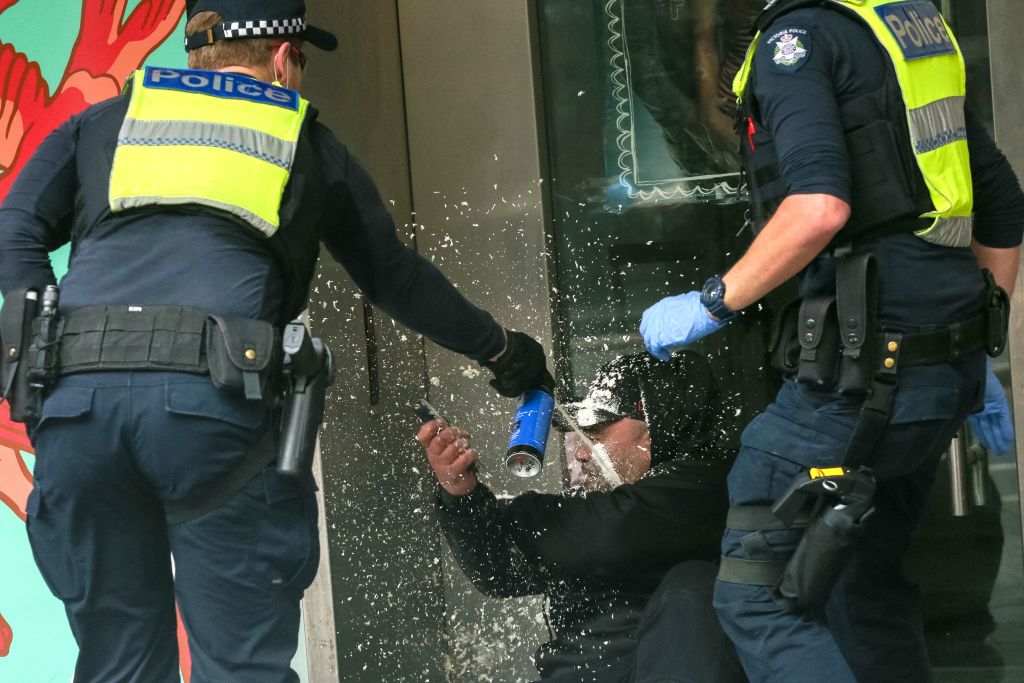

The Northern Territory (NT) is to join Western Australia (WA) in allowing civilians to carry pepper spray for self-defence under strict conditions.
Chief Minister Lia Finocchiaro announced the launch of a 12-month trial, which will start in September, allowing approved members of the public to carry a low-percentage oleoresin capsicum (OC) spray.
The specifics of the trial will be determined after consultation, which will be led by the NT Police and involve industry bodies, licensees, key stakeholders, and the broader community.
“This is about giving Territorians more choice when it comes to personal safety,” Finocchiaro said. “This is about equipping Territorians with more options, not less control.
“We’re strengthening the frontline with more police, stronger laws and better prevention, but we also believe individuals should have lawful tools to protect themselves if needed,” she said in a statement.

The legality of the spray’s use in WA arose not as a result of a change in government policy, but as the outcome of a landmark 2003 Supreme Court decision, which held that it was legal for a person to possess OC provided they had a “reasonable excuse.”
That did not require that they face an imminent threat of violence, but it was sufficient that the person believed circumstances might arise in which it would be necessary to use the spray for self-defence.
That makes the NT the first jurisdiction in Australia where the government has actively decided to arm its citizens with pepper spray.
The legality of oleoresin capsicum and similar disabling sprays varies widely across the world, with all 50 states of the United States allowing it to some degree, as well as South Africa, Malaysia, France, Russia, and many other countries.
However some, including New Zealand and the UK, classify them as an offensive weapon.
Pepper Spray’s Effectiveness Yet to be Proven
Despite its relatively widespread availability, no research has been undertaken to determine whether this reduces crime.
One study noted that, since the jurisdictions that legalised it didn’t require that civilians be trained in its use, “people may be unaware of the best procedure” to deter an attacker.
There have also been instances of people misusing the devices.
As recently as June 9, 2025, Houston Police arrested a 62-year-old man after he allegedly sprayed aerosol mace aboard a Metro train, sending three passengers to the hospital.
On June 5, an 81-year-old Florida woman was arrested after allegedly using pepper spray on two girls, aged 6 and 3, who were blowing bubbles in her driveway. And on April 16, police in Boston arrested a man who they claim entered a courthouse wearing a gas mask and tactical gear and attacked several people with pepper spray.
There have, however, been studies conducted into its effectiveness when used by police.
A 2010 study by the US National Institute of Justice (NIJ) found that even trained officers who used pepper spray faced an increased probability of injury of 21 to 39 percent (depending on the model).
A 2019 NIJ paper noted that, in a law enforcement context, “limited OC effectiveness and concerns over its safety for officers help account for the decline in popularity of pepper spray as a standard policing tool, culminating in a decision by some departments to no longer issue OC.”
Deaths directly caused by pepper spray are extremely rare, but it has been a contributing factor in some cases, such as when the person sprayed has a pre-existing medical condition, such as asthma or heart disease or if they had taken some types of legal or illegal drugs.
Opposition Stance
Northern Territory Opposition Leader Selina Uibo said Finocchiaro’s decision was an “admission of failure” by the government.
“They are now telling Territorians to defend themselves because the government cannot do the job,” she told reporters.
The government should invest more in policing if it is serious about community safety, “rather than handing out pepper spray and telling Territorians to hope for the best,” Uibo said.
However, one market research study found that carrying a weapon such as pepper spray made 73 percent of respondents feel safer, so the move is likely to be popular.
The Finocchiaro government made law and order the cornerstone of its first budget, with a record $1.5 billion investment in corrections, courts, and police. It also lowered the age of criminal responsibility from 12 to 10 and introduced tougher bail laws.