
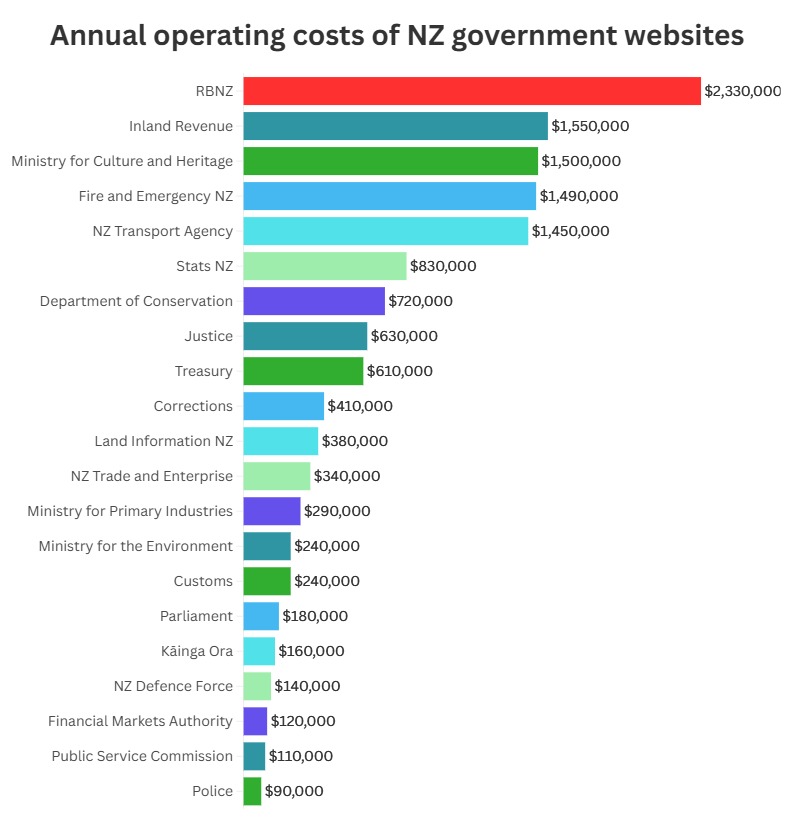
New Zealand’s Reserve Bank (RBNZ) is spending $2.3 million a year—$6,300 (US$3,587) a day—on its website, while also substantially increasing staff numbers, according to data submitted to Parliament.
The Bank also spent $19 million on software licencing fees, up 178 percent from the $6.8 million cost in 2020 and equivalent to around $27,000 per head.
The next biggest spender on its online presence is the Inland Revenue Department (IRD), whose website handles the processing of monthly and annual returns, allows taxpayers to calculate their liability for a variety of taxes and levies, and holds a queriable large database of tax law decisions. It spends $1.55 million a year.
RBNZ has 641 staff, an increase of 155 percent since June 2018. It added 40 of those (another 7 percent) in the three months to September 2024, at a time when Finance Minister Nicola Willis was demanding cutbacks across the entire public sector. These cutbacks led to an estimated 9,520 reduction in positions (redundancies plus vacant roles that will now remain unfilled). The Bank also employs 72 contractors.
Its “Strategy, Governance, and Sustainability” team now has 63 full-time equivalents (FTEs) versus 29 in 2021; the “Transformation, Innovation, People and Culture” team has more than tripled in size over four years, now at 38 staff compared to just 11 in 2020; and the Governor’s Office has expanded from three staff two years ago to five currently.
In comparison, staff numbers at the NZ Treasury have also grown since 2018, but at a much slower rate—up 23 percent from 489 to 600.
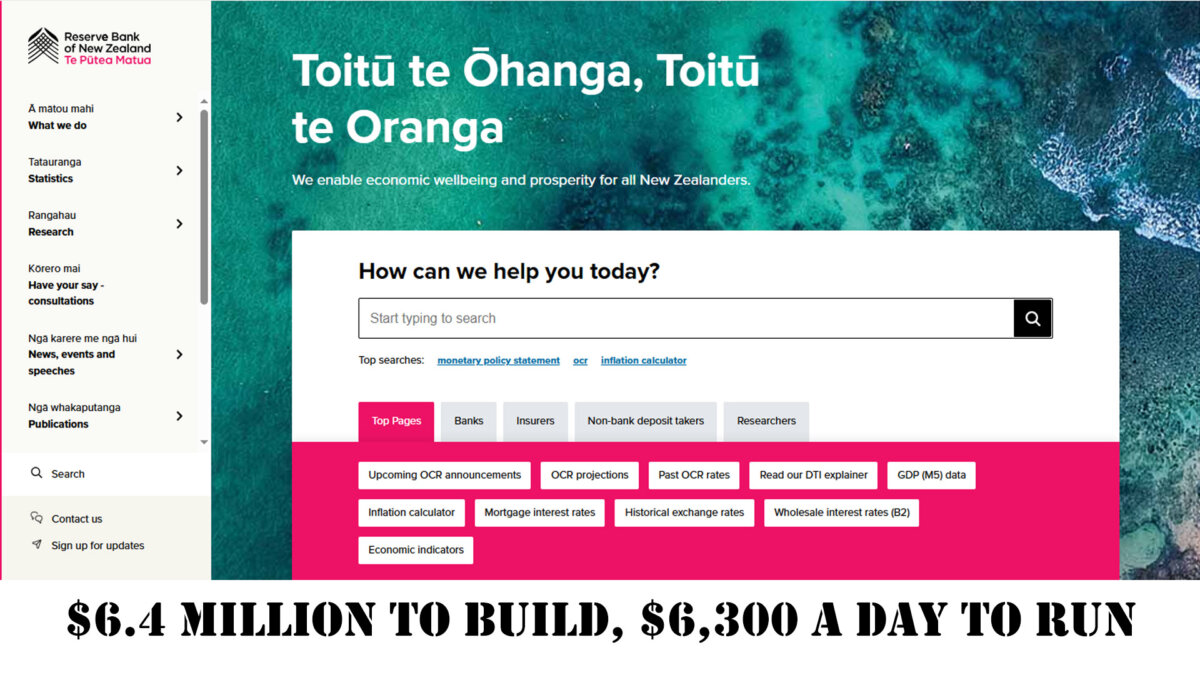
The Bank’s website was built in 2022 at a cost of around $4.4 million. A further $2 million was spent on “ongoing costs to keep the website fit for purpose” and $978,000 on “software licences, vendor monitoring, and maintenance,” as well as hosting costs.
At the time, ACT Party leader David Seymour said “it seems unbelievable [Reserve Bank Governor Adrian Orr] would sign off on such an exorbitant sum to develop a new website.
“As if we needed another reason for the RBNZ to get back to basics and focus solely on monetary policy. In the middle of a cost of living crisis Adrian Orr thinks it is appropriate to spend millions on new websites. If it were not so serious, it would be quite amusing.”
The RBNZ describes its function as a “core communications and engagement tool for RBNZ, including publishing MPR/MPS [money policy statements on the official cash rate] and other time-critical data.”
Although it is working on a central bank digital currency (CBDC), none of that cost appears to be included in the website.
The data was obtained from information submitted to a Parliamentary Select Committee, which aimed to compare operating costs across public sector information technology. However, some agencies included their staff responsible for preparing content, while others did not.
In 2021, the Reserve Bank was criticised by Seymour for spending $400,000 on a sculpture for its foyer depicting a Māori god, which he described as “an over-priced monstrosity.”
ACT is now in government with the National Party, which was also critical of the Reserve Bank’s handling of inflation when it was in opposition.