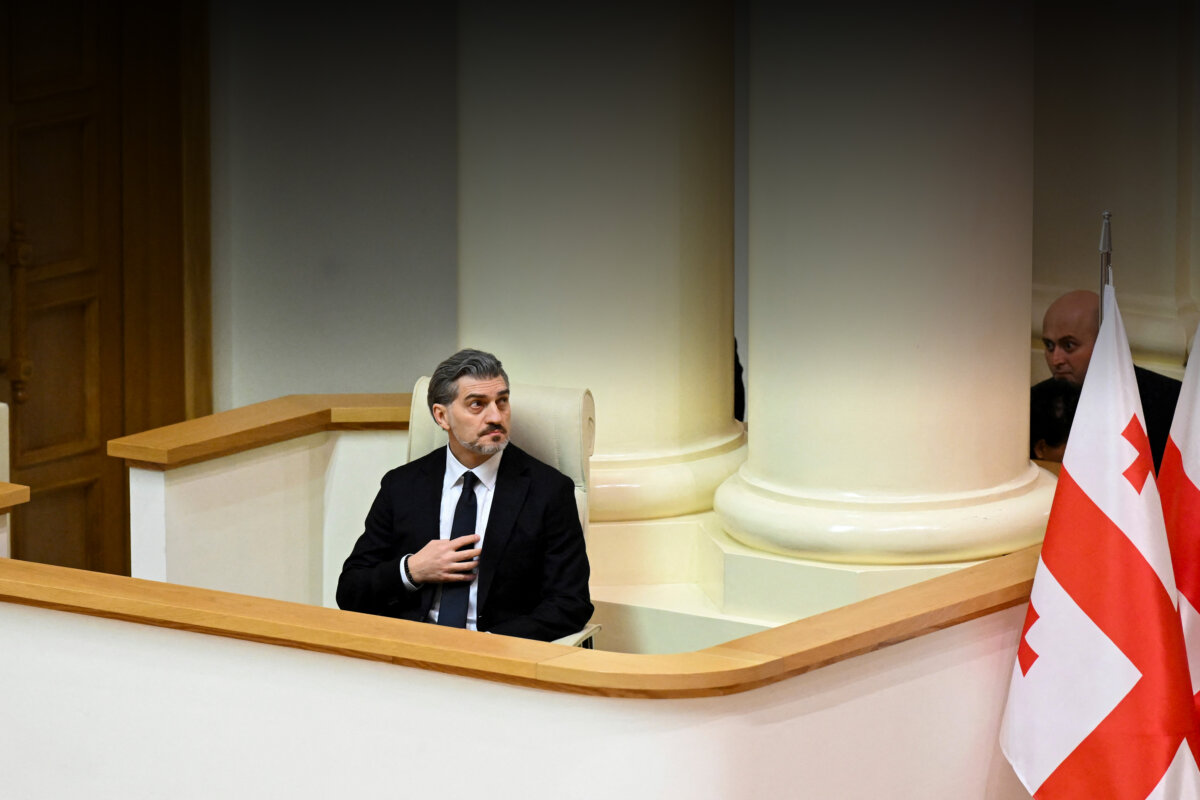
While Mikheil Kavelashvili has been sworn in as president of Georgia, outgoing President Salome Zourabichvili has branded her successor illegitimate and is demanding new elections.
After being sworn in on Dec. 30, Kavelashvili, a former Manchester City footballer, said, “The Georgian people have always understood that peace is the main prerequisite for survival and development.”
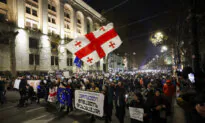
However, outgoing President Salome Zourabichvili, a pro-EU opponent of the ruling party, said in a speech to supporters outside the presidential palace that she was leaving the residence but that the new presidency was illegitimate.
“We are not demanding a revolution,” she told The Associated Press.
“We are asking for new elections, but in conditions that will ensure that the will of the people will not be misrepresented or stolen again.”
The ruling Georgian Dream party claimed victory in Georgia’s parliamentary elections on Oct. 27 with nearly 54 percent of the vote, prompting Zourabichvili to call for public protests amid opposition claims that the result favors Russia.
Demonstrators accuse the ruling Georgian Dream party of seeking to align the country with Russia at the expense of its longstanding ambition to join the European Union.
Zourabichvili is backed by the country’s four main pro-EU opposition parties, which have boycotted parliament since the election. They claim she will remain the legitimate president until fresh elections are held.
On Dec. 29, she said: “I will come out of here and be with you.
“I am taking legitimacy with me, I am taking the flag with me, I am taking your trust with me.”
The Georgian Dream party’s billionaire founder, Bidzina Ivanishvili, characterized the Oct. 26 election as a way of preventing the West from dragging Georgia into a conflict with Russia.
“It is a rare case in the world that the same party achieves such success in such a difficult situation—this is a good indicator of the talent of the Georgian people,” Ivanishvili told supporters on Oct. 27.
The European Union said that its election observers reported “an uneven level playing field, a divisive campaign in polarised atmosphere, and significant concerns over the impact of recent legislative amendments on this election process.”
The EU’s vocal opposition to the Georgian Dream—and its stated support for the protesters—has led to claims that the ongoing demonstrations enjoy covert Western support.
Kremlin spokesman Dmitry Peskov denied at the time of the October election any Russian interference in the vote.
Moscow has historically opposed EU expansion in its neighboring regions.
Germany Proposes Talks
German Foreign Minister Annalena Baerbock has recently proposed talks on the suspension of Georgia to EU membership.
According to the Federal Foreign Office’s Deutchland.de, Baerbock said on Dec. 27: “In the EU, we should now discuss formal suspension of the Georgian membership process due to the increasingly authoritarian policy being pursued by Georgian Dream.
“Instead of progress we’re seeing alarming regression.”
She said the Federal Foreign Office has scaled back its cooperation with the authorities in the country, and had suspended support projects worth more than 200 million euros.
According to Baerbock, Germany is also discussing further measures with its EU partners including “the withdrawal of visa-free travel for Georgian officials to targeted sanctions.”
 Calin Georgescu, the independent presidential candidate who won the first round of elections, in Izvorani, Romania, on Dec. 4, 2024. (Vadim Ghirda/AP Photo)
Romanian Court Annuls Results
The year 2024 was a complicated one for elections in former Soviet republics.
In December, Romania’s top court annulled the first round of the country’s presidential election, which was won by a right-wing populist, Calin Georgescu, who campaigned largely on TikTok.
Georgescu, 62, was due to face Elena Lasconi, a pro-European candidate from the Save Romania Union party, in a run-off.
The current president, Klaus Iohannis, claimed in declassified intelligence reports from the Romanian security service that Russia was behind a coordinated online campaign to promote Georgescu.
Georgescu told his supporters that he believed that “democracy was canceled.”
A pro-European center-left coalition won a confidence vote in parliament on Dec. 23.
Reuters, The Associated Press, Adam Morrow, and Chris Summers contributed to this report.