Two U.S. supersonic bombers conducted fire drills on Saturday, July 8, in South Korea in response to North Korea’s development of long-range and nuclear-capable weapons, notably its recent test-launch of an intercontinental ballistic missile (ICBM).
The B-1B Lancer strategic bombers flew from a U.S. base on Guam and conducted a simulated destruction of an enemy ballistic missile launcher and underground facilities at South’s Pilsung Range, flanked by South Korean and U.S. jet fighters. On their way back to Guam, the bombers were joined by Japanese fighter jets.
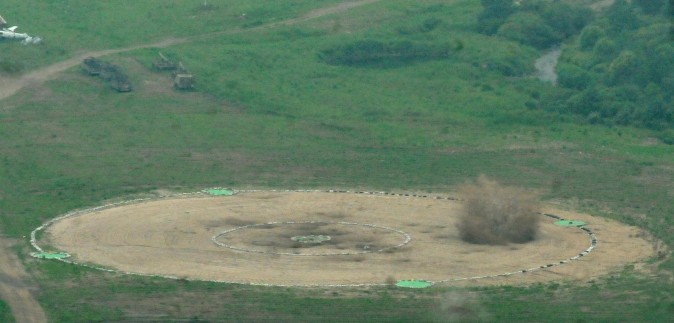 Inert weapons dropped from U.S. Air Force B-1B Lancers practicing attack capabilities impact the Pilsung Range, July 7, 2017. (U.S. Army photo by Staff Sgt. Steven Schneider)
“North Korea’s actions are a threat to our allies, partners, and homeland,” said Gen. Terrence O’ Shaughnessy, Pacific Air Forces commander, in a July 7 statement. “Let me be clear, if called upon we are trained, equipped, and ready to unleash the full lethal capability of our allied air forces.”
On Tuesday, July 4, North Korea announced a successful test-launch of an ICBM, a first for the regime and another step toward its goal of a missile arsenal capable of striking the United States with nuclear weapons. Some experts said the missile was capable of reaching Alaska.
Both the United States and the South find such a situation unacceptable but want to resolve it peacefully.
President Donald Trump is keeping pressure on China, the North’s biggest trading partner, to dissuade the regime from further pursuing its nuclear weapons program. China initially showed signs of promise, like halting some imports of coal from the North, but hasn’t shown any notable progress since.
“Trade between China and North Korea grew almost 40% in the first quarter. So much for China working with us – but we had to give it a try!” Trump tweeted on July 5.
Trade between China and North Korea grew almost 40% in the first quarter. So much for China working with us – but we had to give it a try!
— Donald J. Trump (@realDonaldTrump) July 5, 2017
During his meeting with Chinese leader Xi Jinping at the G-20 summit in Hamburg, Trump appeared willing to give China more time.
 U.S. President Donald Trump and Chinese leader Xi Jinping (R) shake hands prior to a meeting on the sidelines of the G-20 summit in Hamburg, Germany, July 8, 2017. (Saul Loeb/AFP/Getty Images)
“I appreciate the things that you have done relative to the very substantial problem that we all face in North Korea, a problem that something has to be done about,” he said, according to South Korean Jonhap News agency. “It may take longer than I’d like. It may take longer that you’d like,” he said. “But there will be success in the end one way or the other.”