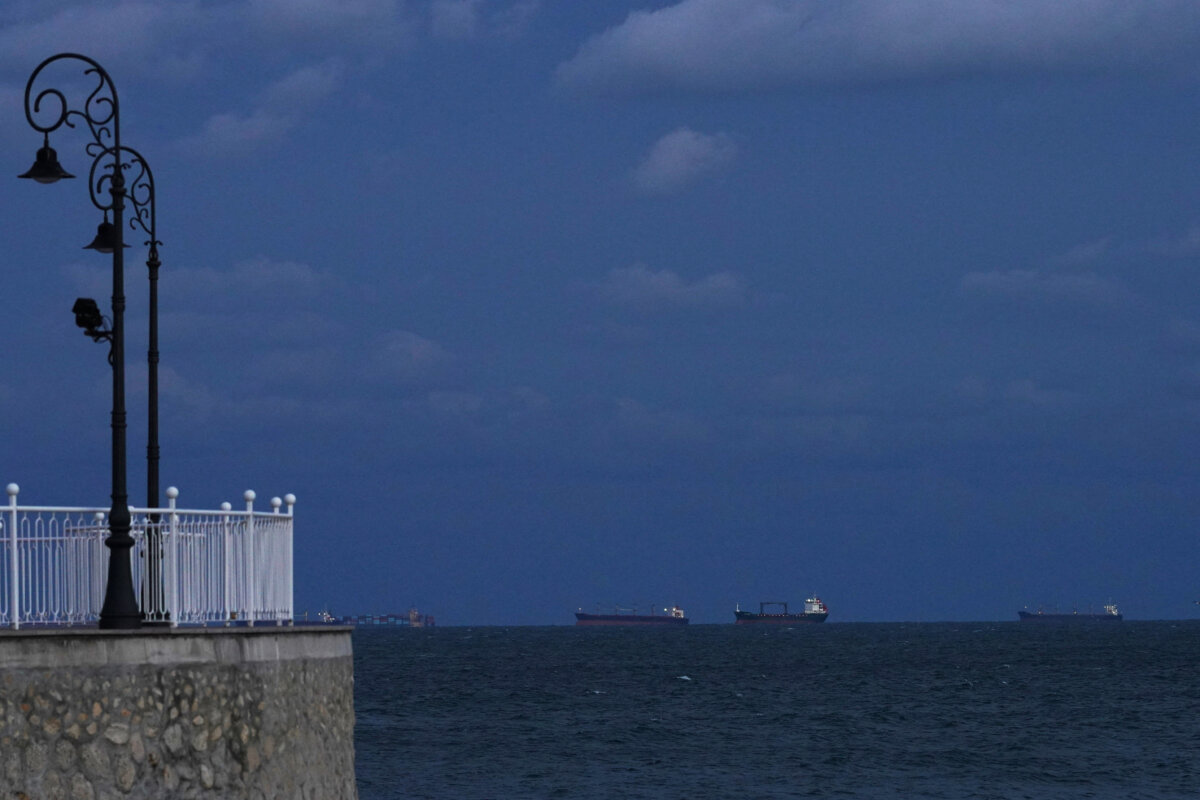

Romanian Prime Minister Luca Niculescu said that drones struck three commercial ships on Nov. 14 near the Danube Delta off Sulina, another incident of vessels being hit in the Black Sea near NATO member states.
Niculescu said in a Nov. 15 post on X that the Romanian Ministry of Defense radar had also detected aerial threats in the area and that the Romanian Air Force scrambled fighter jets on two separate occasions.
Romanian officials did not identify the origin of the drones, but described the incidents as being a direct consequence of the Russia–Ukraine war.
“These incidents are unacceptable and constitute a violation of international law,” the Romanian prime minister said. “They reflect the deteriorating security situation caused by Russia’s ongoing war against Ukraine.”
Bucharest, alongside Romania’s allies, will take necessary measures to strengthen security in the Black Sea, he said.
Romanian Defense Minister Stefan Radu Oprea said that the ships’ crews had managed to control the fires on board and that there were no casualties.
Oprea said that he would be in Brussels on Nov. 17 and 18 to meet with his fellow defense ministers.
“We need the solidarity of our allies, shown through patrols with surveillance aircraft and through equipment for counter-drone warfare,” he said.
Foreign Affairs Council
In an X post on Nov. 15, the Romanian Ministry of Foreign Affairs condemned the drone attacks against commercial vessels.
It said that at Monday’s meeting of the Foreign Affairs Council in Brussels, Romanian Foreign Minister Dan Neculaescu would make the case for safe and free navigation of the Black Sea.
“We have had four alerts—in drone alerts—in 24 hours, and we have had three ships hit over the weekend,” Neculaescu told reporters ahead of the Foreign Affairs Council on Nov. 16.
“This is unacceptable.
“I am going to ask our colleagues and our fellow ministers to continue contributing with capabilities in Romania, and I am going to be asking also [about] coordination between NATO and the EU on this aspect.”
Last month, NATO said it would be sending additional assets to the Black Sea region, including to support surveillance, reconnaissance, and forensic activities.
“We will continue to stand united and ensure that we are ready and able to address any threat and to keep our one billion people safe,” Allison Hart, NATO’s principal spokeswoman, said in an Oct. 20 post on X.
The added presence comes in response to several Black Sea incidents in which drones struck cargo vessels, with fatalities in some cases.
Attacks on cargo vessels off the coast of Romania and Bulgaria, which are both NATO members, have increased in recent weeks as fighting between Russia and Ukraine escalates in the Black Sea and Sea of Azov.
Reuters contributed to this report.