
The United States was, at its founding, a nation that claimed dependence on God. As such, the Founding Fathers were persistent in their encouragement of its people to give thanks.
Origins of the Thanksgiving holiday stretch back centuries, but long before it was a federal holiday, the Founding Fathers saw it not as an option, but an obligation of gratitude.
As America marks 250 years as a nation, here’s a look at what the early American leaders had to say about Thanksgiving.
Thanks Before Independence
In 1777, before the United States was free to function as an independent nation, Founding Father Samuel Adams made it clear that gratitude was a responsibility of the American people, not just a sentiment.
Adams said as much in the Continental Congress’s Thanksgiving Proclamation of Nov. 1, 1777.
“Forasmuch as it is the indispensible duty of all men to adore the superintending providence of Almighty God, to acknowledge with gratitude their obligations to Him for benefits received.”
The proclamation also encouraged Americans to acknowledge their sins and shortcomings.
The proclamation called on Americans to observe Dec. 18, 1777, as a day of thanksgiving and praise, before the holiday was on a set date.
The Founding Fathers were particularly thankful for the military success seen during the Revolutionary War.
Declaration of Independence signer John Witherspoon drafted the Proclamation for a Day of Thanksgiving in October 1782.
That year, the members of the Continental Congress called it “the indispensable duty of all nations, not only to offer up their supplications to Almighty God, the giver of all good, for His gracious assistance in a time of distress, but also in a solemn and public manner, to give Him praise for His goodness in general, and especially for great and signal interpositions of His Providence in their behalf.”
Congress identified the reasons for national gratitude, including successful foreign alliances and international recognition of American independence and the “present happy and promising state of public affairs.”
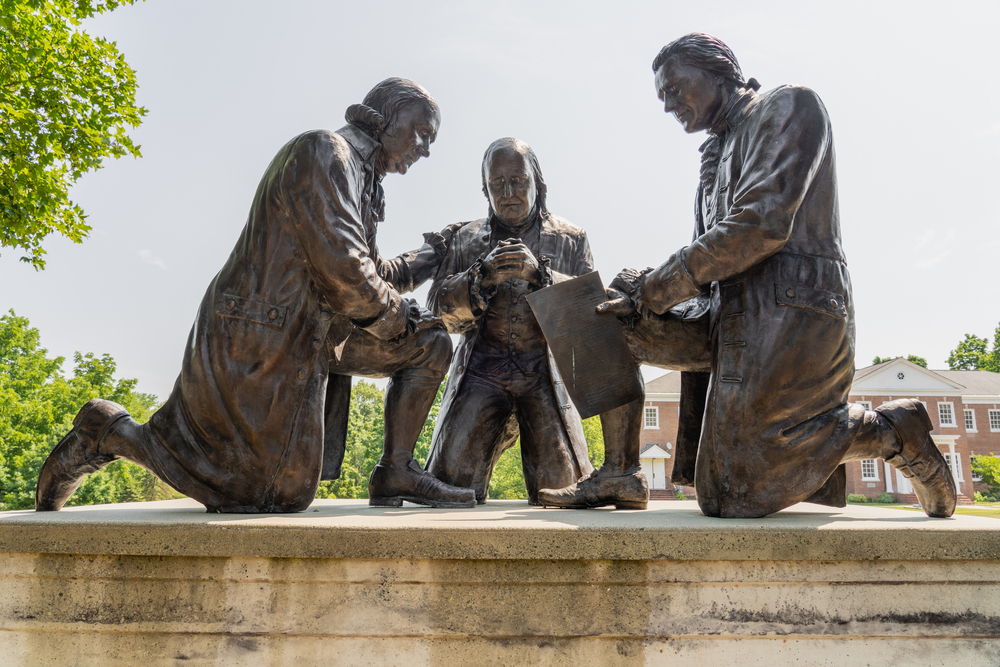 Bronze sculpture of Founding Fathers (L–R) John Adams, Benjamin Franklin, and Thomas Jefferson kneeling in prayer, by sculptor Stan Watts. Freedoms Foundation at Valley Forge (now merged into Founding Forward). (Rosemarie Mosteller/Shutterstock)
Responsibilities of a Grateful Nation
George Washington’s 1789 Thanksgiving Proclamation is seen as one of the most significant of its kind, as the first American president and a critical figure in the Revolutionary War.
The first president connected faith, gratitude, and the founding of the United States.
Just months after being sworn into office, both houses of Congress requested that he “recommend to the people” a “day of public thanksgiving and prayer.”
Washington asked that the people unite in offering their prayers to the great Lord and Ruler of Nations, “To promote the knowledge and practice of true religion and virtue, and the [increase] of science among them and us—and generally to grant unto all Mankind such a degree of temporal prosperity as he alone knows to be best.”
Another of Washington’s most noteworthy mentions of Thanksgiving was in his 1795 proclamation, where he designated Feb. 19 of that year as a day of public thanksgiving and prayer.
There, Washington called on God to preserve Americans from “the arrogance of prosperity,” at a time when the nation was just becoming prosperous and powerful, following the fight for independence.
Years later, in 1815, then-president and architect of the Constitution, James Madison, spoke to the importance of giving thanks in his 1815 proclamation.
“No people ought to feel greater obligations to celebrate the goodness of the Great Disposer of Events of the Destiny of Nations than the people of the United States,” Madison said.
“And to the same Divine Author of Every Good and Perfect Gift we are indebted for all those privileges and advantages, religious as well as civil, which are so richly enjoyed in this favored land.”
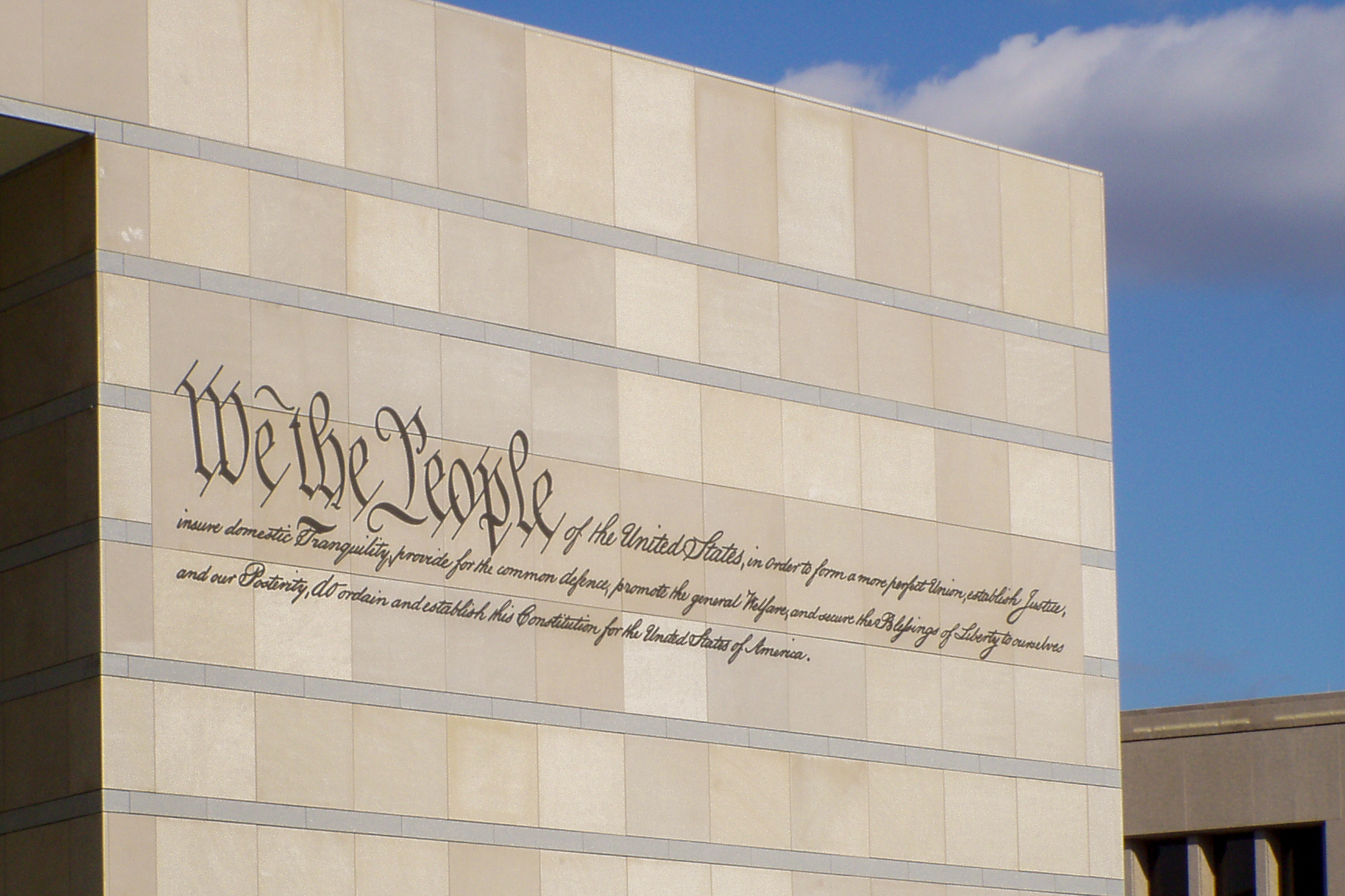 The opening words of the U.S. Constitution are displayed on the exterior of the National Constitution Center in Philadelphia on Sept. 15, 2003. Roger Sherman is among six Founders who signed both the Declaration and the Constitution. (Jeffrey M. Vinocur)
Thanksgiving as a Holiday Amid Another War
Decades later, a woman named Sarah Josepha Hale, an author and editor perhaps best known for writing the nursery rhyme “Mary Had a Little Lamb,” championed the effort to make Thanksgiving a federal holiday.
She began her cause in earnest in 1827, and later used her position as an editor to promote the idea to various public officials.
At that time, many states observed Thanksgiving, but Hale believed a common day of thanksgiving could unite Americans and create a national tradition.
In 1863, amid the Civil War, Hale wrote to President Abraham Lincoln, asking that Thanksgiving be made “a National and fixed Union Festival.”
Less than one week after Hale’s letter was sent, Lincoln issued a proclamation designating the last Thursday of November as a national day of thanksgiving.
Lincoln offered thanks for “the gracious gifts of the Most High God, who, while dealing with us in anger for our sins, hath nevertheless remembered mercy.”
From that year to this, every year the unique American holiday has served as a reminder to the people who celebrate it that the first Americans fought for freedom and received it with gratitude.