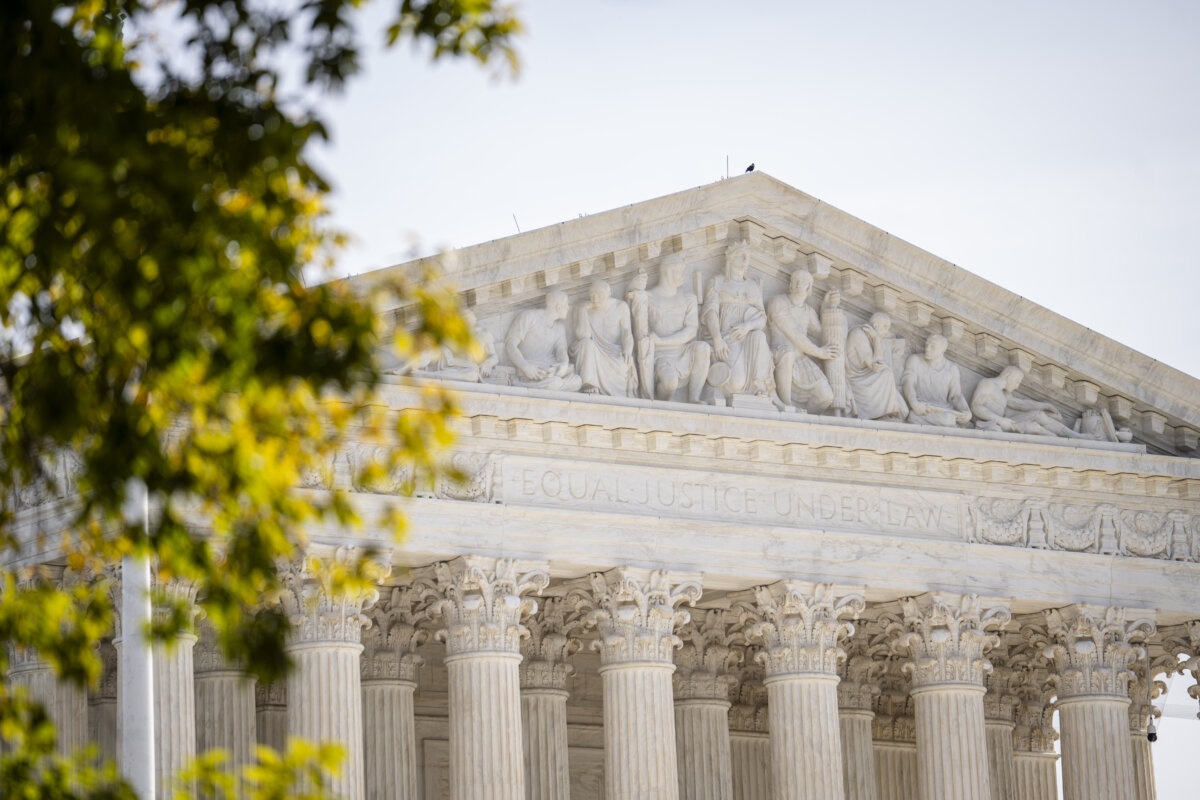

The Supreme Court heard oral argument on Nov. 9 in a case testing whether prisoners can still sue federal officials, in this case a prison nurse, personally for inadequate medical care under a 1980 ruling.
Francis Nielsen is the federal prison nurse at the center of it.
During the argument in Nielsen v. Watanabe, Justice Elena Kagan told Nielsen’s attorney, Lucas Walker, “You’re basically saying to us overrule Carlson without saying you’re overruling Carlson?” Carlson is a 1980 case that let prisoners sue over ignored medical care.
Walker responded, “It ends up … with essentially that result.”
Justice Clarence Thomas asked Department of Justice (DOJ) attorney Vivek Suri, who was supporting Nielsen, to provide an example of a Carlson claim that remains viable.
Suri replied, “In our view, there are no viable Carlson claims anymore.”
Justice Sonia Sotomayor pushed back on the idea of treating Carlson as only a death case. She said the original lawsuit was about the pain and suffering the inmate endured—not simply the fact that he died. Federal detainee Kekai Watanabe went two years without an X-ray that was needed to diagnose a fracture he sustained during a prison riot, and prison officials ignored his pleas for care, she told Walker.
Justice Brett Kavanaugh asked Walker what the justices should do with the fact that Congress has had 55 years since Bivens—the 1971 decision that first allowed people to sue federal officials directly for constitutional violations without a statute from Congress—and 46 years since Carlson to replace the court-created remedies, but has not done so.
Chief Justice John Roberts cautioned against overruling Bivens.
The DOJ has not asked the court to overrule Bivens, Roberts told Walker, and “they have broad experience in this context,” so why shouldn’t the justices “defer to their expertise and experience on that question?”
Nielsen v. Watanabe concerns the future of Bivens actions. In Carlson, the court allowed a prisoner’s mother to sue federal officials after her son died of an asthma attack that staff allegedly ignored for eight hours, and used a broken respirator and drugs that made his condition worse.
Watanabe, who was a federal detainee at the Honolulu Federal Detention Center, was injured in 2021. Rival gang members attacked him with an improvised weapon. Days later, he told staff nurse Nielsen that he was in severe pain and asked to be taken to a hospital. Watanabe said Nielsen denied the request. Officials gave him only over-the-counter pain medication. Months later, in February 2022, doctors diagnosed a fractured tailbone with bone chips in the surrounding tissue.
Watanabe filed suit against Nielsen in federal district court in Hawaii, arguing the nurse violated his Eighth Amendment right against cruel and unusual punishment by ignoring his serious medical needs. A magistrate judge recommended dismissal, and the district court adopted that recommendation. The court held that Watanabe’s situation was different enough from earlier Supreme Court cases that he should not be permitted to seek money damages from the nurse.
Watanabe appealed. A divided panel of the U.S. Court of Appeals for the Ninth Circuit reversed, holding that his claim was close enough to Carlson, which had allowed a damages suit for inadequate prison medical care.
Walker told the justices that virtually no Bivens claim survives anymore, and that even a case identical to Carlson would fail because post-Carlson legislation like the Prison Litigation Reform Act (PLRA) and the Administrative Remedy Program (ARP) create special factors that the 1980 decision never considered.
The PLRA requires inmates to exhaust administrative remedies before suing over prison conditions and imposes other limits on prisoner litigation. The ARP is the Bureau of Prisons’ internal multi-step grievance process that allows inmates to challenge conditions or staff actions before—or instead of—going to court.
Watanabe’s attorney Joshua Wesneski said that the “this far and no further” approach has been the court’s message for a decade, and despite that, Carlson remains good law in its core context.
Wesneski said if the court stops extending Bivens, it should at least leave Carlson intact.
The Supreme Court is expected to rule on the case by June or July 2027.