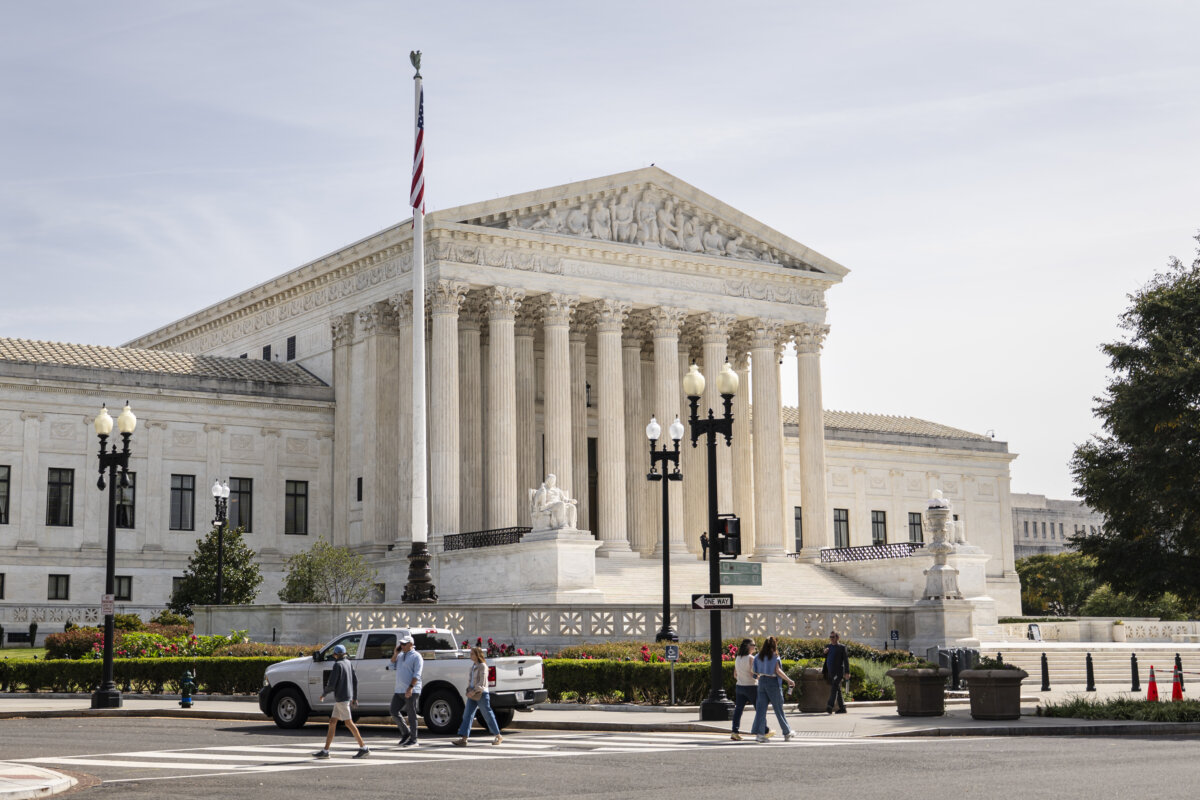

The Supreme Court will hear two cases on Nov. 9 that ask how much protection individuals get when federal power is involved.
The issue in Nielsen v. Watanabe is whether a federal inmate may sue a prison nurse for damages over allegedly inadequate medical care.
The second issue, in Hoffmann v. WBI Energy Transmission, is whether ranchers in North Dakota can recover their attorneys’ fees after WBI took an easement across their land under the federal Natural Gas Act. An easement is a legal right to use part of someone else’s land for a specific purpose, such as a pipeline, without buying the land itself.
Limits on Suing Federal Officials
Nielsen v. Watanabe concerns the future of so-called Bivens actions, lawsuits seeking damages from federal officials for constitutional violations. These suits take their name from a 1971 Supreme Court decision.
Kekai Watanabe, a federal detainee at the Honolulu Federal Detention Center, was injured in a 2021 prison riot. Rival gang members attacked him with an improvised weapon. Days later, he told staff nurse Francis Nielsen that he was in severe pain and asked to be taken to a hospital. Watanabe said Nielsen denied the request. Officials gave him only over-the-counter pain medication. Months later, in February 2022, doctors diagnosed a fractured tailbone with bone chips in the surrounding tissue.
Watanabe filed suit against Nielsen in federal district court in Hawaii, arguing that Nielsen violated his Eighth Amendment right against cruel and unusual punishment by ignoring his serious medical needs. A magistrate judge recommended dismissal, and the district court adopted that recommendation. The court held that Watanabe’s situation was different enough from earlier Supreme Court cases that he should not be permitted to seek damages from the nurse.
Watanabe appealed. A divided panel of the U.S. Court of Appeals for the Ninth Circuit reversed, holding that his claim was close enough to the 1980 Supreme Court decision Carlson v. Green, which had allowed a damages suit for inadequate prison medical care. Nielsen asked the Supreme Court to review that ruling. He and the federal government argue that Watanabe’s case is too different from earlier decisions to allow a damages suit, and that courts should be reluctant to expand this kind of lawsuit.
Eminent Domain and Attorney Fees
Hoffmann v. WBI Energy Transmission involves a disagreement among federal courts of appeals over whether landowners in Natural Gas Act takings can recover costs allowed under state law, or whether they are limited to the basic payment that the Constitution requires.
WBI Energy Transmission, a natural gas pipeline company based in Bismarck, North Dakota, obtained approval from the Federal Energy Regulatory Commission under the Natural Gas Act to construct a pipeline across ranchland owned by the Hoffmann family and others in McKenzie County, North Dakota.
When the parties could not agree on a price, WBI filed a condemnation action—the court process that allows a company with Federal Energy Regulatory Commission approval to compel landowners to sell the needed strip of land.
After about three years of litigation, the parties settled on the amount to be paid for the land itself. They left open the question whether the landowners could recover their attorneys’ fees and other legal costs. The district court awarded the Hoffmanns about $383,000 in fees under North Dakota law, which allows landowners to recover such costs in condemnation cases.
The U.S. Court of Appeals for the Eighth Circuit reversed. It held that when a private company uses the Natural Gas Act’s eminent domain power, the company is in the same position as the federal government itself. That means the company owes only the basic payment the Fifth Amendment requires—fair compensation for the property taken—and does not have to pay the landowners’ attorneys’ fees under state law. Other federal appeals courts have reached the opposite conclusion and allowed state fee rules to apply.
The landowners argue that because the Natural Gas Act says nothing about attorneys’ fees, North Dakota’s fee rule should decide the question.
The Trump administration is siding with WBI.
The Supreme Court is expected to rule on both cases by June or July 2027.