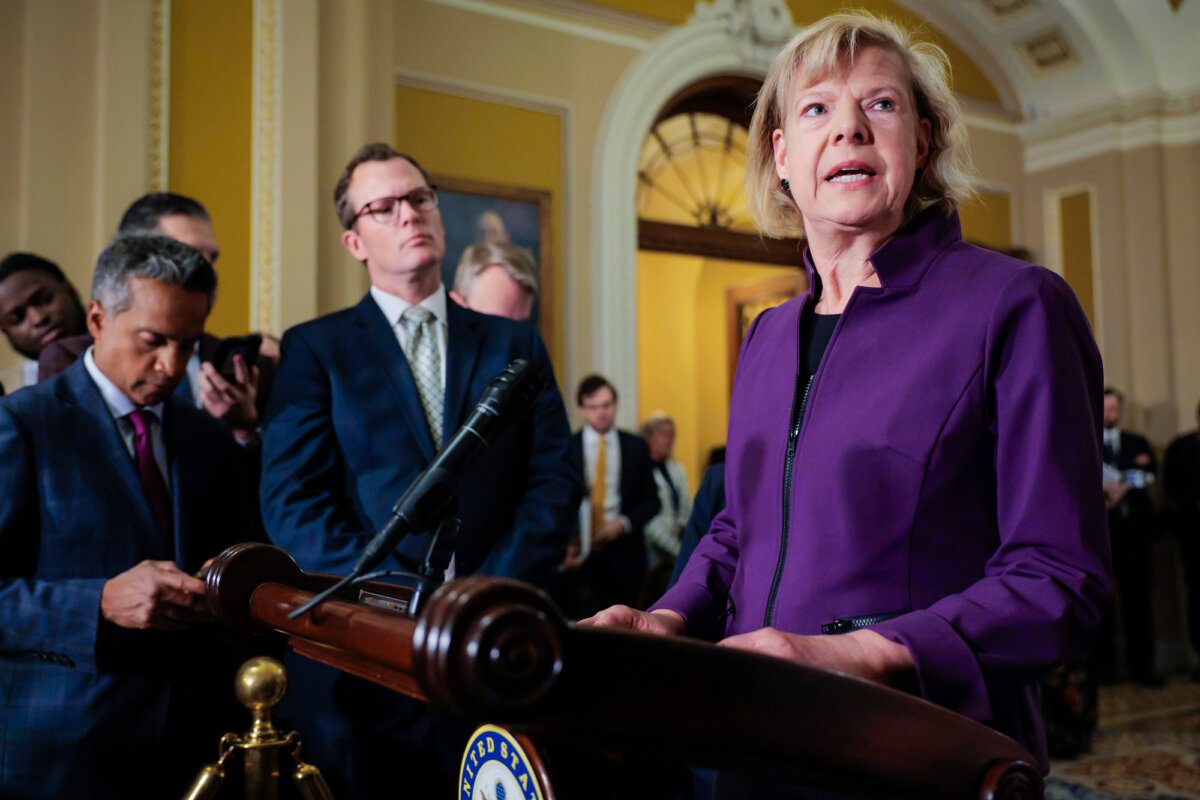

Sen. Tammy Baldwin (D-Wis.) introduced a bill Tuesday that would strip China of its permanent normal trade relations (PNTR) status and the lower tariffs attached to it.
This comes as President Donald Trump and Chinese leader Xi Jinping are expected to meet in Shenzhen, southern China, on the margins of the Asia-Pacific Economic Cooperation (APEC) summit later this week, their third face-to-face session of 2026.
Baldwin said in a statement that China has fallen short on fair trade. The status, which has applied since 2002, would end 12 months after the bill’s enactment.
The bill also tells the U.S. Trade Representative’s office to produce a report on the trade and economic problems China presents, drawing on the Commerce Department, the U.S. International Trade Commission, and other agencies.
“We need to reset our trade relationship with China,” Baldwin said.
Her office said the aim is a sturdier U.S. trade policy.
Trump could still veto the measure if it passes.
In August, the International Trade Commission estimated that ending the status would make Chinese imports costlier. Over time, it would push U.S. consumer prices up 0.7 percent and shave 0.2 percent off economic output.
However, the media release from Baldwin’s office said that the trade deficit with China cost an estimated 3.7 million American jobs, including nearly 89,000 in Wisconsin, from 2001 to 2018.
“Since being given PNTR status, China has failed to uphold the principles of fair trade, engaged in market manipulation and intellectual property theft, sought global dominance in critical industries like shipbuilding, and undermined American workers and manufacturers,” the release said.
“In 2000, Senator Baldwin voted against granting China PNTR, and more than two decades later, her fears of China’s continued unfair trade practices have come to fruition.”
The preferred trading status opened the U.S. market to Chinese products with trade advantages such as reduced tariffs.
The U.S.–China Economic and Security Review Commission (USCC), an independent, bipartisan congressional agency, urged Congress to repeal China’s permanent status in November 2024.
“This move would signal a shift toward a more assertive trade policy aimed at protecting U.S. industries and workers from economic coercion,” the commission said, adding that the Chinese regime shouldn’t benefit from the same trade terms as U.S. allies, given its practices such as intellectual property theft and market manipulation.
‘De-Risk, Not to Decouple’
Meanwhile, the United States and China have extended a trade truce through Jan. 10, 2027. First reached in Busan, South Korea, in October 2025, the truce included Beijing’s pledges to buy U.S. soybeans and other farm goods and to temporarily hold off on planned rare earth export controls.
Treasury Secretary Scott Bessent said Nov. 10 that the administration aims to reduce risks in the U.S.-China economic relationship while maintaining trade ties. Speaking at a New York gala for the National Committee on U.S.-China Relations, Bessent argued for a more even U.S.-China economic relationship. He said the objective is “to de-risk, not to decouple.”
Trump will travel to Shenzhen this week for the APEC summit, where he is expected to meet with Xi on the sidelines to resume talks on trade, tariffs, and rare earth supplies.
At the start of his term in January 2025, Trump directed his administration to assess proposals to revoke China’s trade status. The review was finished, but its PNTR recommendation has not been made public.







