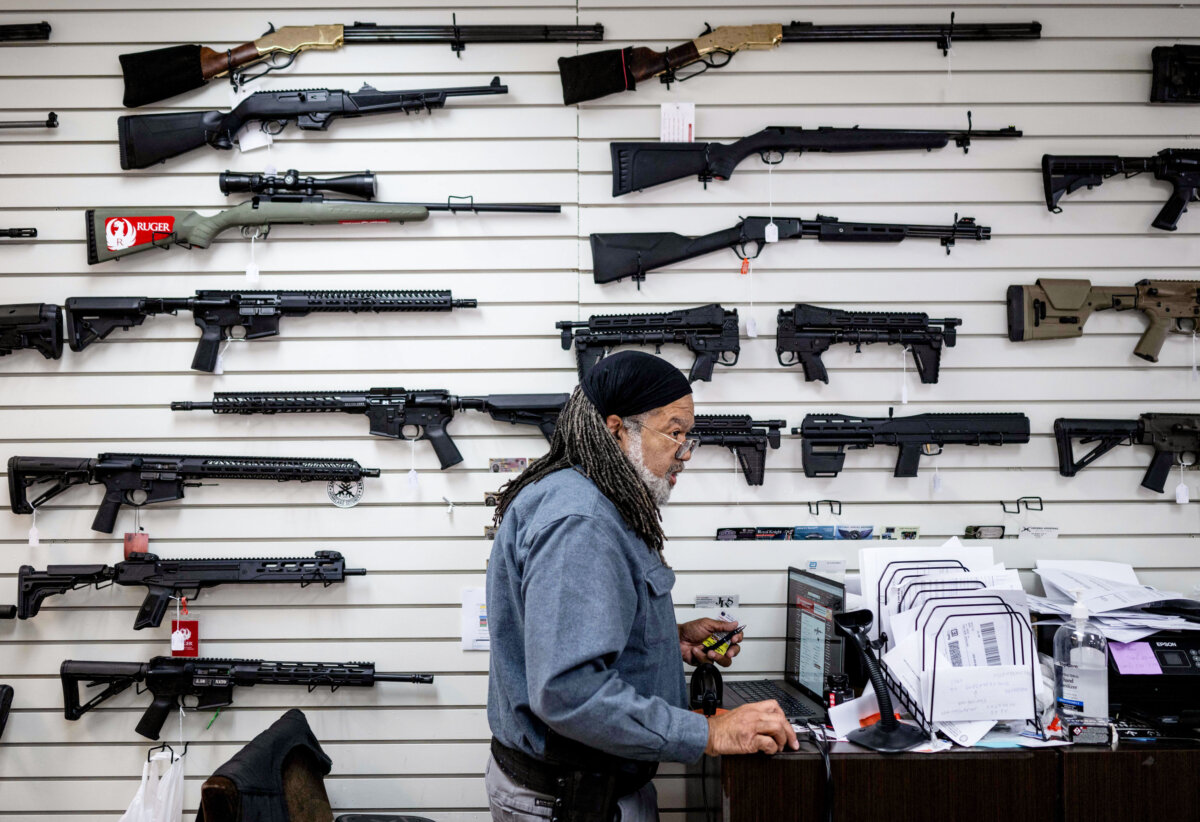

Eight major U.S. gun manufacturers and retailers are facing a class-action lawsuit alleging that they are manipulating gun prices.
Six defendants—Sig Sauer Inc.; Smith & Wesson Brands Inc.; Sturm, Ruger & Company Inc.; Glock Inc.; FN America LLC; and Beretta U.S.A. Corp.—are some of the largest manufacturers of retail firearms nationwide. They account for roughly two-thirds of domestically manufactured pistols and a substantial share of retail firearms sold in the country.
The other two defendants—BPS Direct, LLC d/b/a Bass Pro Shops and Cabela’s LLC—are two of the largest firearm retailers in the United States. BPS acquired Cabela’s in 2017.
The companies engage in an “unlawful price fixing conspiracy in the United States market for firearms (specifically, pistols, revolvers, rifles, and shotguns) sold at retail,” according to the complaint filed on Nov. 23 in the U.S. District Court for the District of New Hampshire.
This has caused consumers to pay “supracompetitive prices” for retail firearms bought from defendants, the lawsuit says. Supracompetitive means higher prices than expected under normal competitive conditions.
The plaintiff, William Foster, of Alabama, is accusing the defendants of violating Section 1 of the Sherman Act, which prohibits unreasonable restraints of trade. The lawsuit also alleges violations of antitrust and consumer protection laws in various states.
Beginning around January 2015, firearms manufacturers together with retailers allegedly agreed to adopt and enforce a minimum advertised price (MAP) policy or similar pricing policies for firearms.
The manufacturer defendants defined the word “advertised” in MAP as prices listed on websites, emails, coupons, shopping cart displays, and other methods by which a retailer may communicate a lower price to customers.
If a retailer or distributor were to violate MAP restrictions, they could allegedly be punished, including by shipment suspensions and termination of access to products. The restrictions prevented retailers from freely competing on price, according to the complaint, which says “MAP commonly became the price” paid by gun buyers.
When BPS bought Cabela’s in 2017 under common ownership, their combined influence in the industry increased. After a September 2017 supplier meeting at its Springfield, Missouri, headquarters, BPS allegedly met or spoke with each manufacturer defendant over the following year about MAP and other pricing policies, making clear that manufacturers that failed to meet its requirements risked losing valuable shelf space and promotional opportunities.
Manufacturer defendants later allegedly discussed BPS’s demands at various informal settings, assuring each other that they would comply.
BPS/Cabela’s is alleged to have monitored advertised prices at competing retailers and reported potential violations to manufacturers. The manufacturer defendants allegedly watched out for pricing policy violations, threatening retailers or distributors failing to comply with restrictions or terminations.
The plaintiff is asking for a jury trial.
The Epoch Times reached out to the eight defendants for comment but did not receive a response by publication time.
This is a first-of-its-kind lawsuit that seeks to recover overcharges paid by gun buyers across the United States, DiCello Levitt LLP, the law firm representing the plaintiff, said in a Nov. 24 statement.
The price-fixing scheme succeeded due to the alleged use of industry-wide fear- and identity-based messaging supported by the manufacturers and other industry participants, the statement says.
“Gun owners should not have to pay artificially inflated prices to protect corporate profit margins, especially when those profits help pay for predatory marketing,” Greg Asciolla, chair of the law firm’s Antitrust and Competition Litigation Practice Group, said in the statement.
Price-fixing in the firearms industry was highlighted in a July 6 analysis from Guns Down America, which said that at least six gun manufacturers had set policies implementing a minimum price that retailers and distributors must charge.
The nonprofit, which advocates against gun violence, said that these policies inflate profits for the gun industry at the expense of gun buyers.