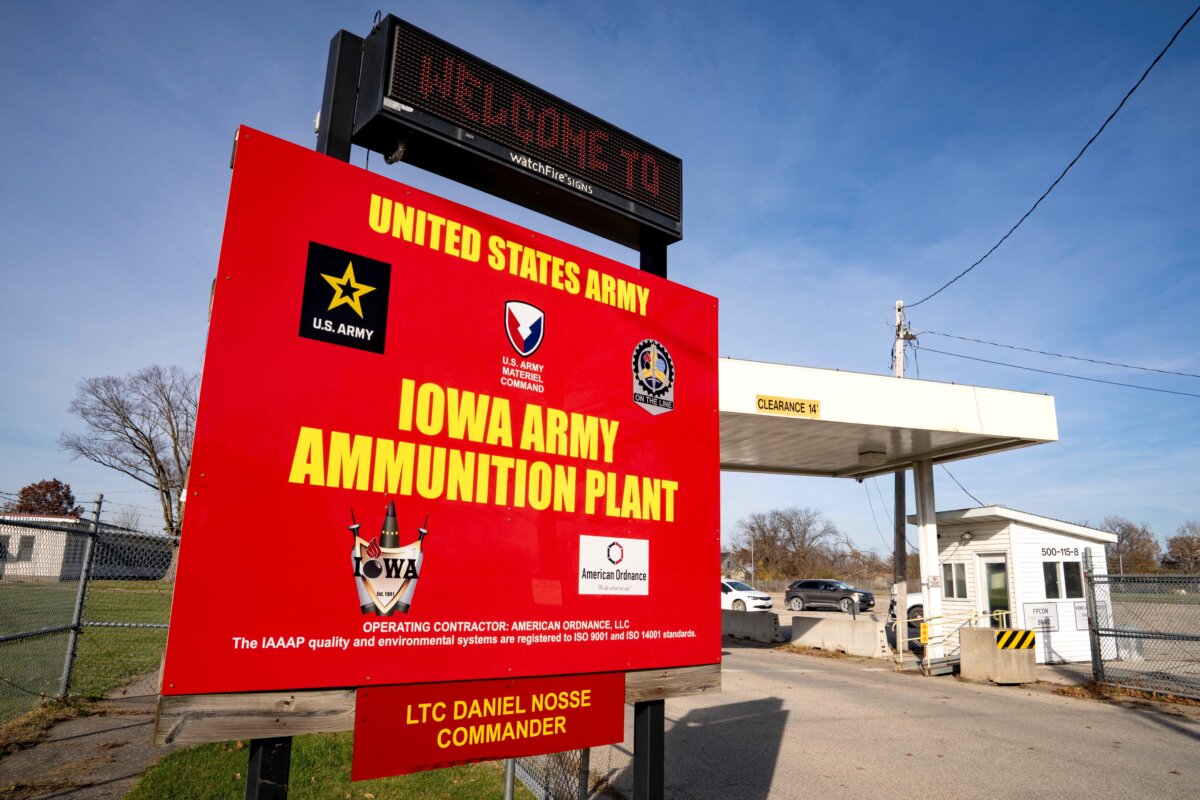

The governor of Iowa declared a disaster emergency in three counties on Tuesday, a day before the U.S. Army is set to detonate compromised bomb-making material at an ammunition plant in Iowa.
The proclamation covers Des Moines, Lee, and Van Buren counties, which Gov. Kim Reynolds’s office said would be affected by the planned lead azide detonation at the Iowa Army Ammunition Plant scheduled for 9 a.m. CT on Wednesday.
“Iowa agencies are actively engaged alongside our federal and local partners, and we remain focused on ensuring communities have the information and resources they need before, during, and after the operation,” Reynolds said in a statement.
The proclamation authorizes Iowa to mobilize state resources to assist residents in the three counties. It also activates the disaster response and recovery aspects of the state’s emergency response plan in preparation for the planned detonation.
According to the governor’s office, the Iowa National Guard would send up to 100 federally activated soldiers to support local, state, and federal agencies in public safety efforts surrounding the Army’s controlled detonation.
The soldiers would help to conduct community outreach to around 150 households identified by local and federal authorities to provide guidance and assistance for temporary evacuation, the governor’s office said.
The Federal Emergency Management Agency (FEMA) said some residents within 5 miles southwest of the plant may be evacuated, while those 5 to 20 miles southwest should stay indoors with windows closed to avoid airborne lead dust, according to the governor’s office. FEMA would provide hotel accommodations through Nov. 27, with extensions available upon request, the Army said.
The Army planned to detonate more than 9,700 pounds of degraded crystallized lead azide stored at the Iowa facility, saying the step was necessary to prevent a spontaneous explosion, a risk that increases in cold weather.
“There is consensus across the experts, across the country, that a controlled, mitigated detonation of the lead azide here at Iowa Army Ammunition Plant is far preferable to an uncontrolled, spontaneous detonation of that substance,” acting Army Secretary Adam Telle said at a Nov. 24 press conference.
The Army’s stockpile of lead azide barrels had deteriorated rapidly over the previous eight months, Col. Aaron Teller, commander of the 71st Explosive Ordnance Disposal Group, said. He said a ‘significant accumulation of crystallized lead azide’ on the outside of the barrels kept crews from moving them or opening the lids to treat the material with a chemical neutralization agent.
Maj. Gen. Eric Shirley, commanding general of the U.S. Army Sustainment Command, said a controlled detonation was the only safe way to dispose of the lead azide.
The Army initially scheduled two controlled detonations at the Iowa Army Ammunition Plant on Nov. 20 to dispose of the degraded lead azide. The detonations were later postponed to Nov. 23, before the U.S. Court of Appeals for the Eighth Circuit stayed a permit issued by the Environmental Protection Agency (EPA) for the detonation.
The Army subsequently scheduled the detonations for Nov. 25. Government lawyers told the court on Nov. 21 that the Army planned to invoke an emergency munitions and explosives exclusion to proceed without the EPA permit. The Appeals Court lifted the stay on Nov. 23, allowing the detonations to take place.
Timothy Frudd contributed to this report.