
Millions of Americans are preparing for one of the busiest travel weeks of the year as storms bringing rain, high winds, and flooding could complicate trips and events like the Macy’s Thanksgiving Day Parade.
The American Automobile Association (AAA) expects 81.5 million Americans to travel at least 50 miles for Thanksgiving celebrations from Nov. 24 to 30. The data represents a slight decrease from 2025, when 81.6 million people traveled for the holiday. Forecasts indicate they could face strong winds and flooding in some areas.
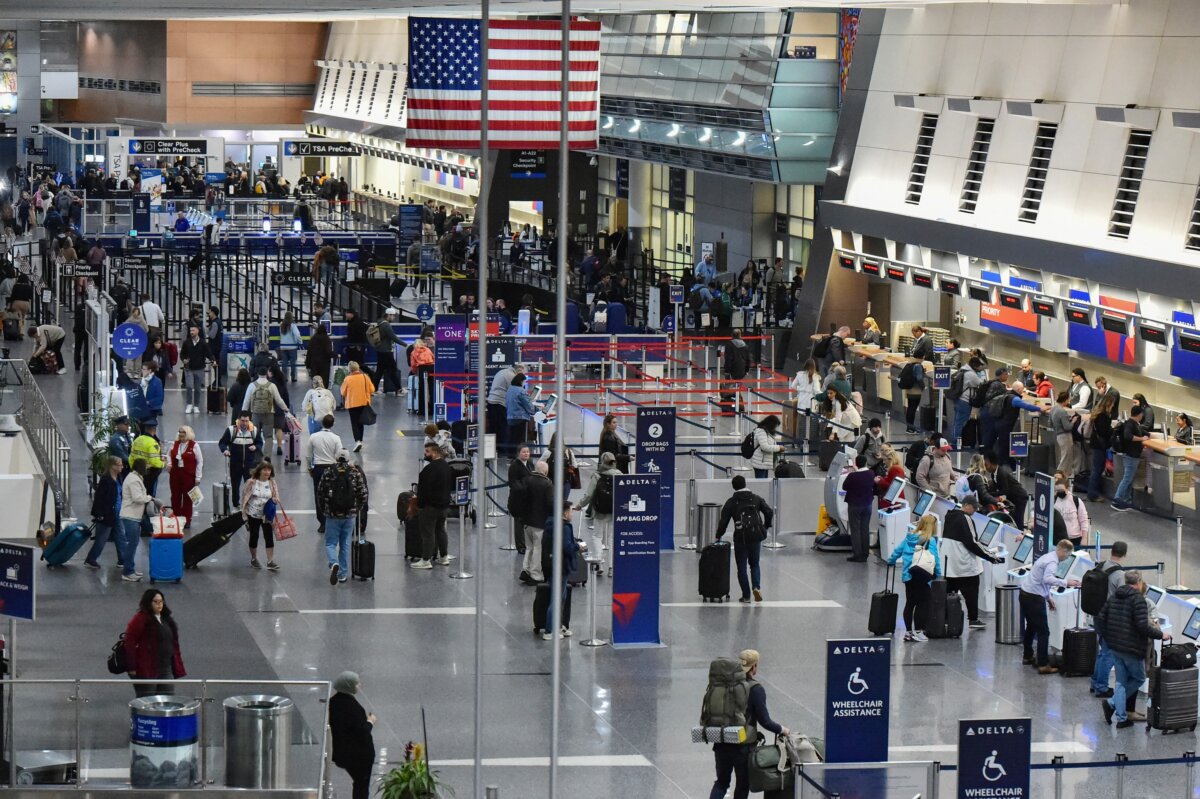
Meanwhile, nearly 6 million people are expected to travel domestically by air amid concerns about recent outages.
Here’s what those traveling for the holiday break can expect.
Weather Hazards
Dave Radell, a meteorologist with the National Weather Service in New York, told The Epoch Times there are three main hazards travelers will experience this week: rainfall, high winds, and coastal flooding.
“It’s kind of a one-two-three punch from this storm,” Radell said.
Parts of the Northeast could get one to two inches of rain, falling off and on for up to 12 hours, Radell said, adding that flooding is possible in urban and poor-drainage areas.
High winds could threaten the region, and depending on how quickly the storm comes through New York, Radell said the annual Macy’s Thanksgiving Day Parade could be affected.
New York City rules prohibit the flying of large balloons if winds are above 23 mph or gusts above 34 mph.
Radell said east-northeast winds could reach 20–30 mph, with gusts up to 45 mph possible, with peak winds coming Thursday afternoon.
Flooding is possible as a storm arrives Wednesday night into Thursday, bringing rain, strong easterly winds, and widespread coastal flooding Thursday into Friday.
Travel disruptions could extend beyond the Northeast, according to forecasts.
The National Weather Service is forecasting coastal flooding in San Francisco in effect through 4 p.m. Thursday, with peak tides as high as 8.6 feet Wednesday morning, rivaling the 1983 record of 8.66 feet.
Heavy Traffic
AAA said 72.9 million people will travel by vehicle for Thanksgiving, down from 73.1 million who drove to their destination last year. That 200,000-person decrease is in part due to higher gas prices.
With all those travelers, major roads could see heavy traffic. The worst time to travel starting Tuesday is between 2 and 8 p.m., between noon and 7 p.m. on Wednesday, and between 1 and 7 p.m. on Friday, AAA said.
The weekend will be even more congested, with AAA advising drivers to avoid starting a road trip between noon and 9 p.m. on Saturday, noon and 8 p.m. on Sunday, and 2 and 7 p.m. on Monday.
Before leaving, AAA advises checking tires, batteries, and fluids. Longer highway speeds for longer periods, especially in cold weather, can lead to tire blowouts. Tire pressure can drop one PSI for every 10-degree drop in temperature.
The organization responded to more than 500,000 roadside emergencies during the 2025 holiday travel week.
AAA said the best time to travel by car is before 1 p.m. on Tuesday.
On Wednesday, the organization said travelers should start their trip before noon. People can travel Thursday anytime as traffic is expected to be minimal.
After the holiday, AAA said travelers could start a drive to celebrations or back home on Friday before noon, on Saturday and Sunday before 11 a.m., and on Monday, Nov. 30, before 1 p.m.
Air Travel
Air travel will also decrease slightly from 2025.
AAA projects 5.96 million people will fly domestically, a 0.2 percent decrease from last year.
Airlines for America expects U.S. airlines to have 29 million passengers from Nov. 20 to 30, down about 2 million from the 31 million projected in the 2025 forecast.
Higher prices could be a factor for many Americans as round-trip domestic tickets cost an average of $800, a 17 percent increase from 2025, based on what travelers have paid when booking.
Recent outages have unsettled air travel. A communications problem caused a nationwide ground stop Nov. 13. On Nov. 22, Delta Air Lines flights were delayed nationwide because of a weight and balance automation system issue, according to the Federal Aviation Administration. More than 1,760 flights were delayed, and about 45 were canceled.
On Monday, flights coming into Chicago’s O’Hare International Airport were briefly paused due to staffing constraints at the Chicago Terminal Radar Approach Control, the FAA said in a post on X.
The TSA said it has the potential to increase passenger volume to process 3 million passengers on Nov. 29 as people return home from the holiday break.
Hartsfield-Jackson Atlanta International Airport remains one of the most popular in the country during the holiday travel week.
This year, the airport is ready for a rush of passengers.
“With our checkpoints fully deployed with the latest Credential Authentication Technology (CAT-2) and CT scanners, our officers are prepared to handle the rush,” TSA Federal Security Director for Georgia Michael Donnelly said in a news release.
Donnelly said travelers should arrive early, check bags for prohibited items, and leave plenty of time to navigate the airport safely.
For any questions about TSA prechecks, travelers can send direct messages to @AskTSA on X.