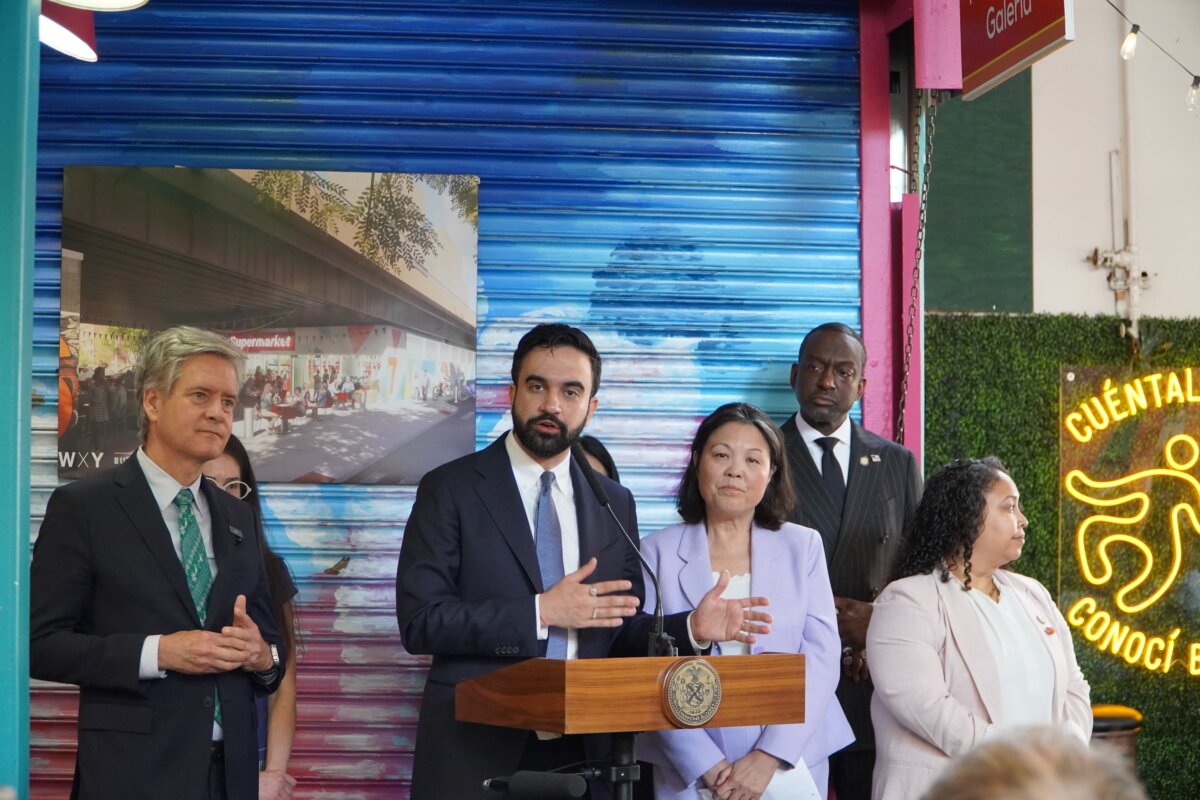

A federal judge denied the National Supermarket Association’s (NSA) request to stop Mayor Zohran Mamdani’s city-owned grocery stores from moving forward.
The association, which has 150 members managing more than 400 supermarkets in New York City, argued the city’s stores’ 30 percent discount off market prices on grocery staples constitutes predatory pricing and will cause irreparable harm to association members. It sought to stop the city from selecting an operator under federal anti-trust laws.
The city-owned grocery stores are part of Mamdani’s plan to fight rising food prices. The stores will offer a list of staple food items at 30 percent off the going market price. The city is searching for a private operator to run the stores.
The NSA argued the city was engaging in predatory pricing that would cause irreparable harm to members who would have to “defer renovations, delay technology improvements, seek rent concessions, or simply cease operations.”
Federal District Judge Jennifer L. Rochon ruled the NSA failed to prove the city is engaging in predatory pricing. Even if prices 30 percent lower than the market are below cost, it failed to prove the city has a plan to recover the loss by driving rivals out of business.
Rochon ruled that lowering prices is only anti-competitive if the stores plan to raise their prices later to recover their losses. Otherwise, lower prices are good for customers. The city argued that the city-run grocers are meant to complement, not replace, privately run stores.
Angel Nuñez, an NSA board member, owns a C-Town supermarket just half a mile from a planned city-run grocer location in the South Bronx at The Peninsula campus. He balked at how the city plans to subsidize lower prices.
He told The Epoch Times that if New York City is “using the money from the taxpayer to compete against me, obviously they’re going to send everybody to bankruptcy, and now they’re going to control the price.”
The private operator will not be expected to pay rent or property taxes and will receive subsidies from the city to cover the 30 percent discount as needed.
“So what are they going to create? A monopoly price in New York City,” said Nuñez, who sees it as the city using taxpayer money to bankrupt his business.
He said he feels the city just doesn’t understand the grocery retail business.
“New York City is an extremely competitive market. You don’t have one entity that fixes the price and says this is the price for sugar, this is the price for meat, this is the price for orange juice. You have nothing like that,” said Nuñez, who fears he won’t be able to compete once the city opens its store in his neighborhood at the end of 2027.
In response to the ruling, NSA President Anthony Peña said in a statement that the decision won’t change “our determination to advocate for a fair and competitive marketplace.”
He said the issues of fairness, taxpayer-funded competition, and the viability of neighborhood supermarkets still need to be addressed.
“Independent supermarkets should not be placed at a structural disadvantage when competing with government-funded stores that receive construction funding, operating subsidies, and tax advantages unavailable to ordinary neighborhood businesses. We will carefully review the court’s decision with our legal counsel and evaluate all appropriate options moving forward,” Peña said.