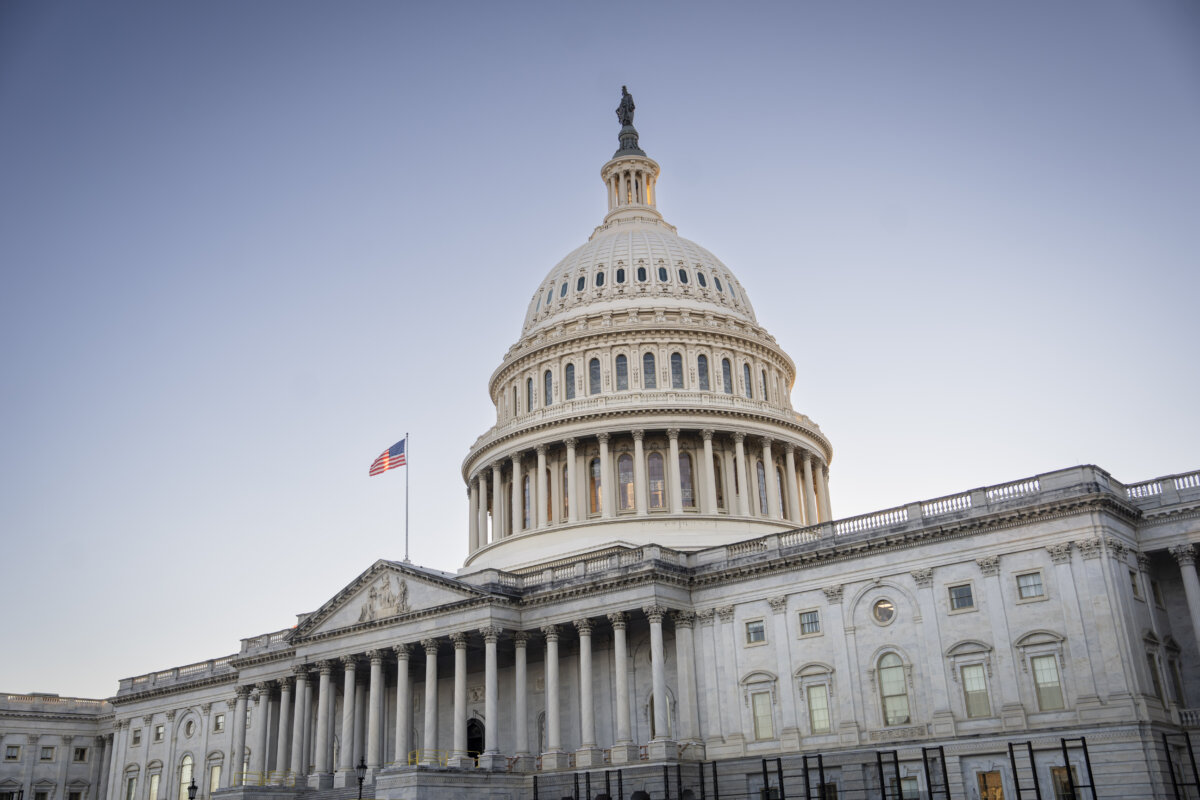

The Senate voted against a war powers resolution that would have directed President Donald Trump to end U.S. military action against Iran.
The Senate’s 48–51 vote on House Concurrent Resolution 93 comes more than two months after the U.S. House of Representatives voted 220–204 to pass the resolution. The House and Senate have held numerous votes on war powers resolutions aimed at ending U.S. military operations in Iran since the start of Operation Epic Fury more than eight months ago.
Nov. 19 marked the first time that either the House or Senate has voted on a war powers resolution since the Nov. 3 midterm elections. Both Trump and Vice President JD Vance previously said that the Iran war played a role in the Republican Party’s election losses.
Sens. Susan Collins (R-Maine), Lisa Murkowski (R-Alaska), and Rand Paul (R-Ky.) joined most Democrats in support of the measure on Nov. 19. Sen. John Fetterman (D-Pa.) was the only Democrat to vote with Republicans against the resolution.
Sen. Thom Tillis (R-N.C.), who previously voted in favor of a war powers resolution, voted against the measure on Nov. 19.
The War Powers Resolution of 1973, which is also known as the War Powers Act, is intended to limit the president’s authority to order military actions beyond 60 days without the approval of Congress.
The Trump administration has argued that the War Powers Act is unconstitutional and is not binding.
“Iran is not a war of choice. It’s a war of necessity. … There is no deal with Iran; they don’t understand deals,” Sen. Tim Sheehy (R-Mont.) said prior to the Nov. 19 vote.
Meanwhile, Sen. Tim Kaine (D-Va.) urged his fellow senators to vote in favor of the resolution during a speech from the Senate floor.
“A unilateral decision to impose tariffs on everything and a unilateral decision to take this nation to war has hurt the economy, hurt our troops, [and] hurt their families,” he said.
Kaine suggested that the Senate had the “capacity to fix” the situation with Iran.
“And voting again that this war is illegal is an important step on the road to doing just that,” he said.
The U.S. military launched Operation Epic Fury against Iran on Feb. 28. The operation included strikes on thousands of Iranian military targets before an April ceasefire largely halted the conflict.
While the United States and Iran signed a memorandum of understanding in June, the agreement ultimately collapsed in early July.
The U.S. military has continued to impose a naval blockade on ships attempting to enter or leave Iranian ports since Trump ordered the blockade to resume in July. The U.S. government has also announced multiple rounds of sanctions as part of the Trump administration’s economic pressure campaign, dubbed Operation Economic Outcast, which was launched in late August.
In addition, U.S. fighter aircraft carried out a precision strike on an Iranian missile launch site on Nov. 17. A U.S. official said the strike was launched in response to aggression from Iran’s Islamic Revolutionary Guard Corps.
“As President Trump and Secretary [Marco] Rubio stated, our economic pressure campaign is devastating Iran to such an extent that the president does not have any need to conduct major combat operations,” a White House official told The Epoch Times on Nov. 19.
“Iran is weaker than ever before thanks to President Trump’s bold actions—and he will ensure that they never have a nuclear weapon.”
Last week, Trump said Washington did not need to make a deal with Tehran.
“Those days have long since passed,” he wrote in a Truth Social post. “We’ve got their money, Hundreds of Billions of Dollars, and we’ve got their Strait!”
The Senate’s vote on the war powers resolution comes as Congress is approaching a potential funding battle, with government funding set to run out on Dec. 11. With Republicans currently holding 53 seats in the Senate, at least seven Democratic votes would be needed to overcome the filibuster and pass a funding bill.
Some Democratic lawmakers have already said they will not support a funding bill that includes money for the Iran war.
In addition, Sens. Kirsten Gillibrand (D-N.Y.), Tammy Duckworth (D-Ill.), and Elizabeth Warren (D-Mass.) have proposed an amendment to any potential funding bill to prevent additional spending on “offensive operations” in Iran.