
ACME, Wash.—Anna Martin met and wed her husband Geoff when they were both students at Seattle Pacific University (SPU). Campus married housing had two parking spots for the couple, but they only had one vehicle for grocery store trips.
“So we thought, oh my gosh, let’s start a garden. How cool would that be?” she told The Epoch Times on Nov. 12, almost three decades later, in the barn of their Osprey Hill Farm, before she gave a tour of her turkey operation.
They planted potatoes and carrots on raised garden beds at SPU, and enjoyed the experience so much that it unsettled their plans. Geoff Martin had been training for a career in medicine; Anna Martin in nutrition.
As the Martins were planting seeds, an idea sprouted: their future should be about working the land. They weren’t quite sure how to do that.
They spent a year after graduation living in a teepee with no running water in Hood River, Oregon, working with people who practice what are called “primitive skills.” They learned a great deal, but decided it was no way to raise a growing family. So they packed up their family’s Volkswagen van to return to civilization.
There was just one snag. The day they started the move back was Sept. 11 “of that infamous year,” Anna Martin said, which made for a great deal of uncertainty.
The family moved up to Washington state’s Skagit Valley, rented a farm, and cultivated it part time. They learned some things about growing and selling crops and eventually bought Osprey Hill Farm in Acme.
The Martins learned an important lesson about farm income. Crops are seasonal, which creates financial gaps. To cash-flow their business year-round, they needed to raise animals. That meant chickens and sheep and, eventually, the subject of our visit, Thanksgiving turkeys.
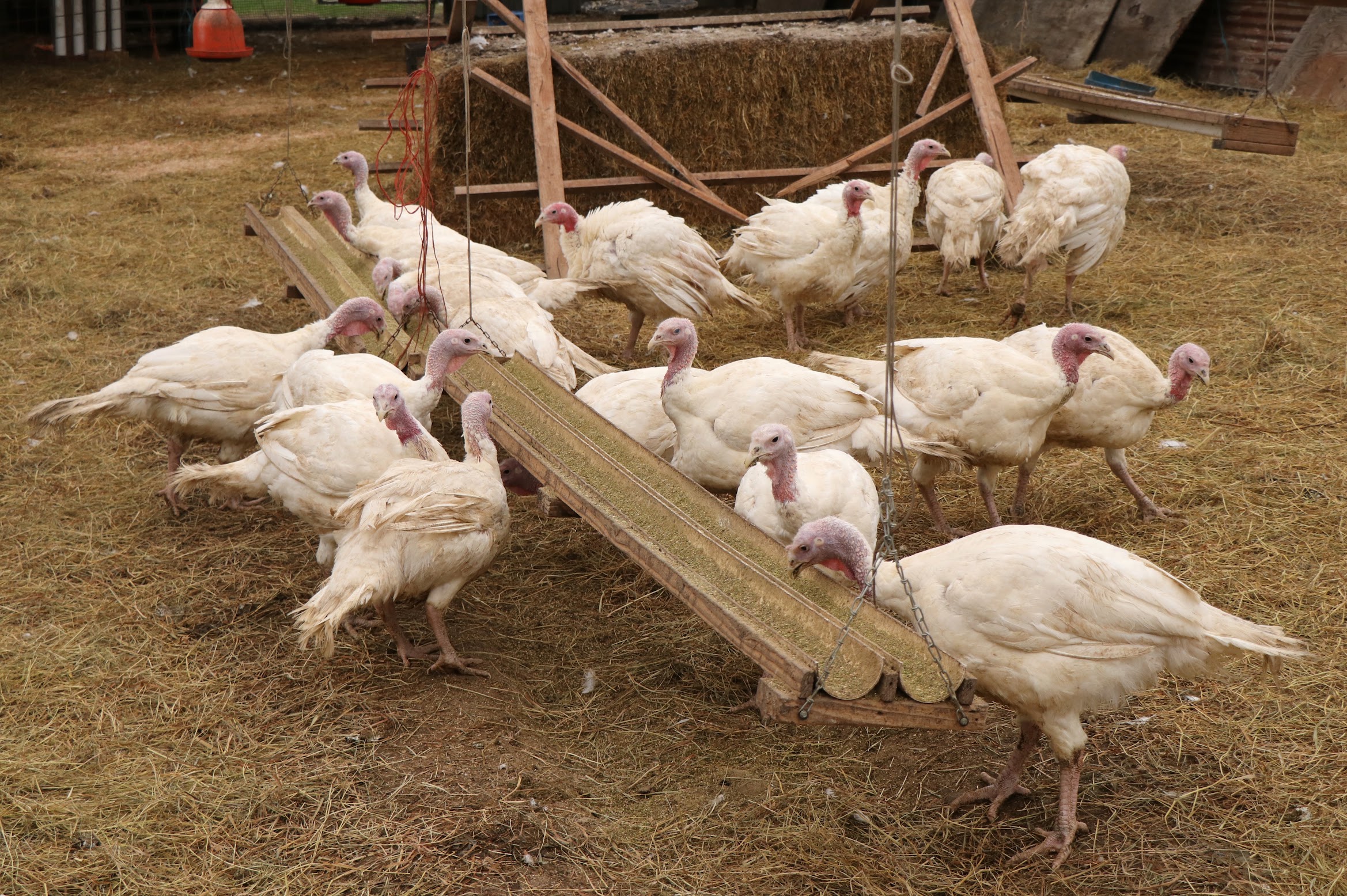 Turkeys feed at Osprey Hill Farm in Acme, Wash., on Nov. 12, 2026. (Matt Benoit for The Epoch Times)
Thanksgiving Turkeys in America
Thanksgiving is such an important holiday to Americans that it’s mentioned during times of national crisis. This year, on Nov. 13, the day after the farm visit, Federal Aviation Administration network maintenance problems led to the largest ground stop of planes in recent memory.
A question put to Transportation Secretary Sean Duffy in the crisis press conference was whether Thanksgiving travel would be affected. He mentioned his own college-age children’s travel home for the holiday, and then offered provisional good news for similarly situated parents: “I think we’re going to be back up and operational as we come into the heat of travel during Thanksgiving.”
Significant Thanksgiving expenses include travel, decorations, food, and drinks. Chime commissioned a survey that found the average American Thanksgiving gathering for 2025 came at a cost of about $1,000.
That price tag included food at $175, drinks at $110, décor at $83, and an average cost of $293 per head for those who travel significant distances by car, bus, train, or airplane to be at the Thanksgiving feast.
Thanksgiving is known alternately as “turkey day” because of the dominance of the bird as a Thanksgiving meal staple. The National Turkey Federation found in a 2025 survey that 94 percent of Americans planned to celebrate Thanksgiving. Of those who celebrate, 87 percent said turkey is usually on the table for Thanksgiving, with a collective national feast that was projected to consume about 30 million roasted, smoked, grilled, fried, or air-fried gobblers last year.
It takes a lot of farms and trucks, not to mention processing facilities, to make that happen. Those tend to be geographically concentrated in the Midwest and the South. North Carolina leads the nation in turkey production by weight, while Minnesota takes the top spot for overall turkey production, according to USDA data. Those two states alone accounted for about 30 percent of total turkey production.
Thanksgiving is also the time when turkey is the cheapest, because grocery stores either give away or sell deeply discounted turkeys as loss leaders and make their money on the fixings.
Americans can and do eat turkey year-round. Yet Thanksgiving, including the next few days’ worth of leftover meals, is the season when roughly 20 percent of the year’s turkey supply is gobbled down.
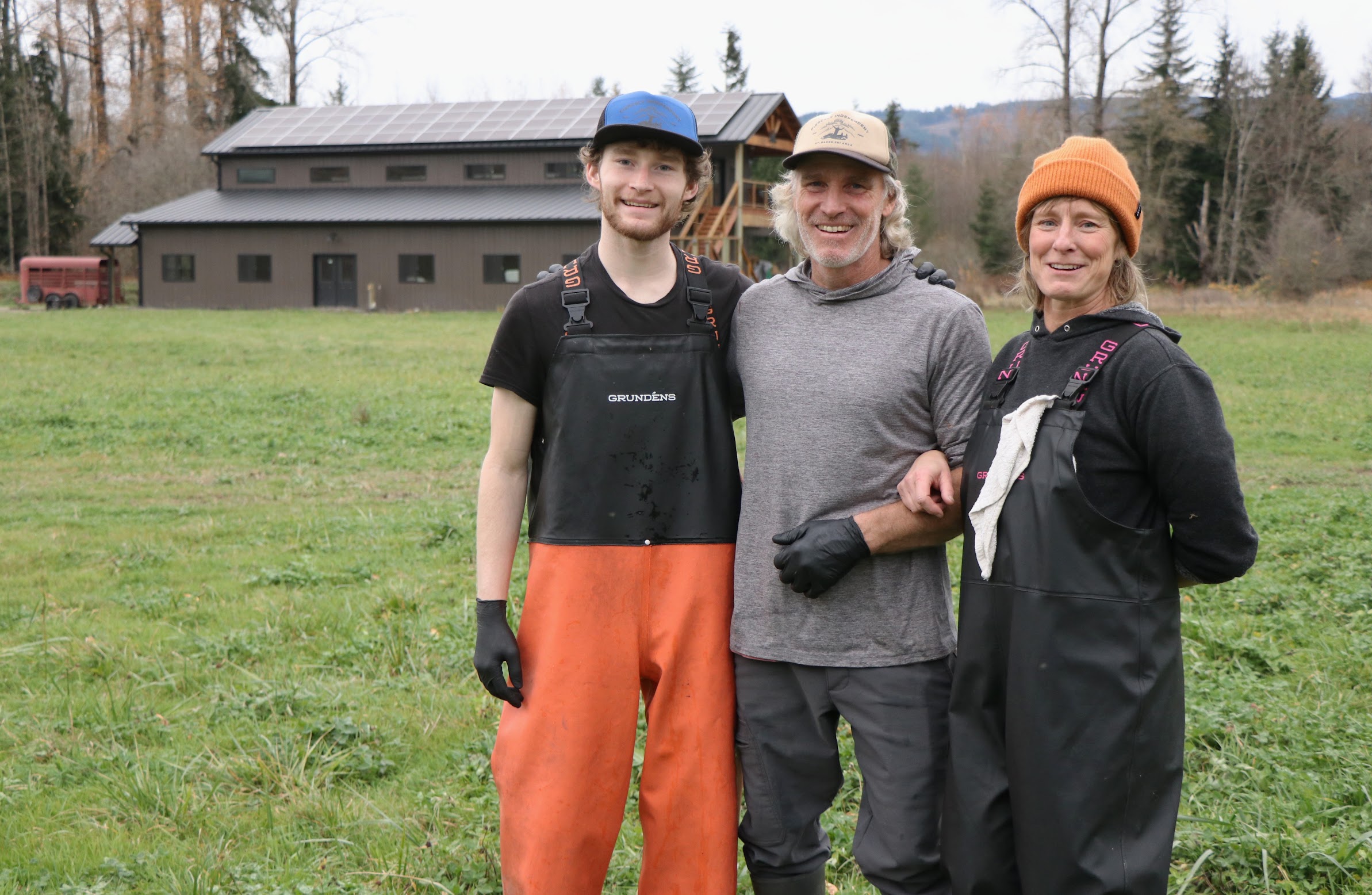 Turkey farmers Geoff and Anna Martin (C and R) and son Oliver, at Osprey Hill Farm in Acme, Wash., on Nov. 12, 2026. (Matt Benoit for The Epoch Times)
A Totally Different Experience
“Over the last 30 years, the turkey industry has gone from mainly marketing a single-product consumed at holidays or special occasions to offering a diverse array of food choices,” the National Turkey Federation says on its website.
The turkey trade group highlighted products such as turkey sausages and turkey burgers, yet there are also other, less mass-produced ways in which the turkey economy has diversified in recent years.
Osprey Hill Farm is part of that diversification. It sits on 70 acres as part of the unincorporated community of Acme, Washington, and does things very differently from large turkey farms.
“Initially when we first started selling turkeys, we were pretty apprehensive about selling them for what it costs to raise them, because it’s a high number,” Anna Martin said.
The farm sells turkey for about $9.50 a pound, which is more expensive than the turkey people buy at supermarkets, thus the couple’s apprehension.
However, as the couple marketed their farm, they came to see that many people “understand and they support what we’re doing.” Those customers are “getting a totally different experience” by buying their turkeys, Anna Martin said.
The birds are treated as humanely as the Martins can manage. Domesticated turkeys have been bred for decades to maximize their meat for Thanksgiving meals, at an average slaughter weight of almost 32 pounds.
Because the Martins charge more than the usual market prices per pound, they don’t bulk up their birds as rapidly or as much as they could. That cuts down on some joint problems that come from rapid weight gain, something domesticated turkeys are prone to.
The farm also does whatever it can to keep the turkeys active. Asked if the birds ever fly, Anna Martin said, “Our turkeys take a stab at it. They definitely run.”
“It’s kind of like an airplane,” she added, but with the aerodynamics all wrong.
“They’ll run down the pasture and they’ll flap their wings and they’ll get a little liftoff, but they can’t technically fly,” she said.
Gobbling Up Profits
The farm created its own separate business to do slaughtering and processing, and hires that service out to neighbor farms as well.
Osprey Hill Farm meat is much fresher than the meat people can buy in store freezers.
The farm also helps with some Thanksgiving prep, if customers want that. One way for customers to order their birds is already brined in buttermilk.
“I think that’s what we’re going to try with our turkey this year,” Anna Martin said.
Even with the elevated price tag, she underscored the rising costs, uncertainty, and hard work involved in raising turkeys.
“A day-old turkey poult at the hatchery is $5.30 a bird versus a chicken that’s maybe $1.65 as a chick,” she said, and shipping them across the country is an extra $1.20 on top of that.
Then they have to feed the birds, mostly males, which are called toms.
“A big tom will eat about 80 pounds of food over the course of its life, and livestock feed has never been more expensive than it is right now. So I think that works out to about $40, $45,” per bird, she said.
Not all of those turkeys will live long enough to become someone’s Thanksgiving dinner.
“We calculate that we’re probably going to lose anywhere from 10 to 20 percent of those birds,” Anna Martin said.
Predation is one issue. Turkeys have poor night vision, so they’re “sitting ducks” after sunset for other animals that want to eat them. The Martins take care to close their turkey shelter tight at night and put a net over it.
Most other input costs are up as well. Labor costs have risen significantly because of hikes to the minimum wage—currently at $17.13 statewide in Washington state, $2 more for businesses in Bellingham, the county’s most populous city. Businesses nearby, including the farm, have to match that to attract workers.
The Martins do what they can to slim those costs down at the same time as they are bulking the turkeys up. One barn is covered with solar panels to help with power, for instance, but that did not entirely solve the problem.
“Our utility bill for the last 2-month period was $1,800. In the previous year, our most expensive months were $900, maybe $1,000,” Anna Martin said.
Cultivating Thankfulness
Still, Anna Martin found some things to be thankful for.
She had warned The Epoch Times there might not be any turkeys left for a farm visit because of scheduled processing. That turned out not to be true because of lower-than-usual predation rates this year. More birds meant more revenue for the farm.
A few farms in Washington were just starting to experience bird flu. Because of the timing of the turkey processing and the fact that most migratory birds fly clear of Acme, that hasn’t been a problem for Osprey Hill Farm.
The Martins are also happy about new customers, just over the 49th parallel, whose orders help to thin the flock out a bit earlier in the season.
“This year we actually extended the processing range and made turkeys available for Canadian Thanksgiving,” which took place on Oct. 12, Anna Martin said.
“We’re right on the border, so we have a lot of customers that come and go.”