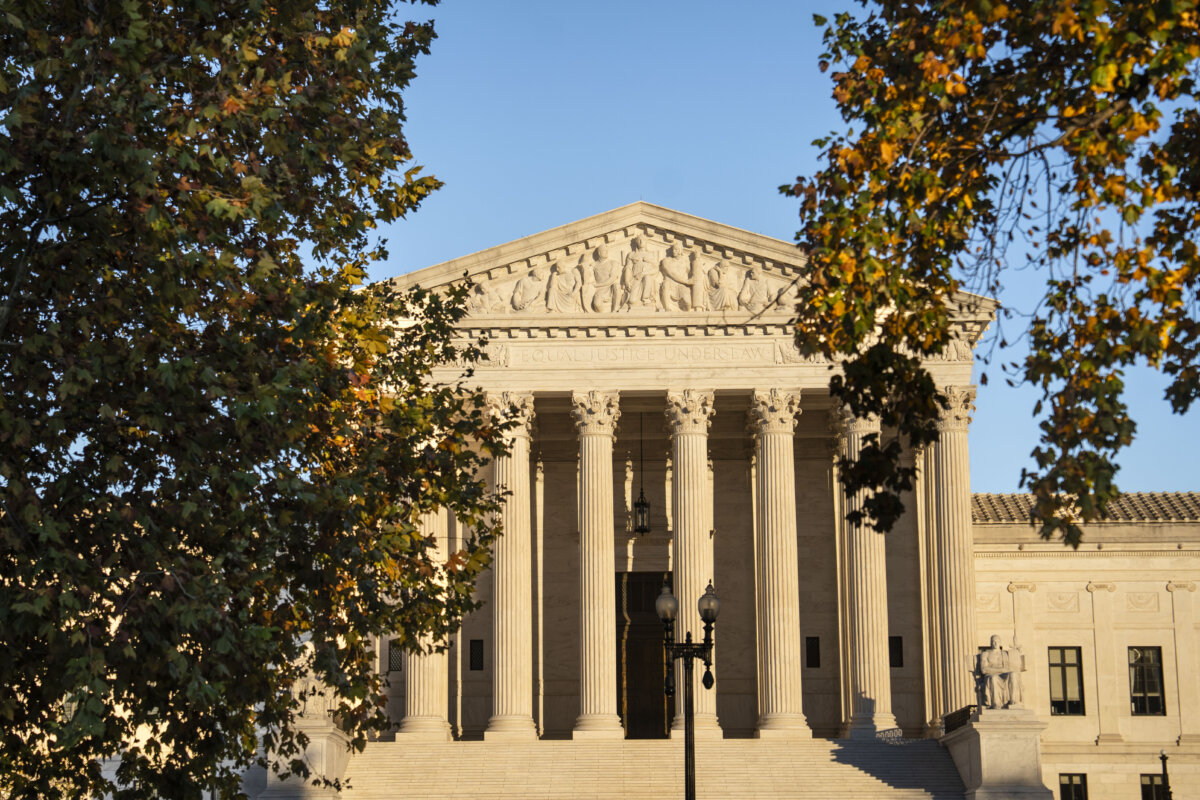

The Trump administration asked the Supreme Court on Wednesday to block temporary protected status (TPS) from being restored to hundreds of thousands of Venezuelans.
Earlier this year, the justices ruled in two similar cases, allowing the federal government to end the deportation protections for Haitians and Syrians. The high court also ruled twice last year on Venezuela’s TPS designation, permitting the Trump administration to terminate it.
Those previous Supreme Court decisions on Venezuela were only temporary as litigation proceeded.
In requesting the high court to block a district judge’s ruling that would restore the program for Venezuelans on Nov. 20, U.S. Solicitor General D. John Sauer said that the reasons for issuing a decision in favor of the administration are overwhelming.
“This application marks a remarkable third trip to this court in the same case involving the termination of Venezuela’s 2023 temporary protected status (TPS) designation,” Sauer wrote to the Supreme Court.
“Giving effect to the district court’s order for even a moment at this late date will gravely harm the government, compelling it to release removable aliens into the country with no guarantee of ever successfully locating them and returning them to detention.”
The Supreme Court last month had remanded the matter to the Ninth Circuit Court of Appeals in light of its previous decision allowing the termination of Haitian and Syrians’ TPS.
At first, that appeals court denied the request to block the lower district judge’s ruling, then four days later, granted an administrative stay until Nov. 20.
With only days until that Ninth Circuit pause ends, the Trump administration wants the Supreme Court to get involved again.
Sauer argued that allowing Venezuela’s TPS to go back into effect would be “enormously disruptive.”
The solicitor general said he was informed by the administration that if the protected status were resumed, authorities could be immediately forced to release about 1,800 Venezuelans from detention back into the country.
“Those aliens would have an overwhelming incentive to flee in the period between their release and this court’s resolution of this stay,” Sauer wrote.
Furthermore, allowing the reinstatement of TPS would prevent the Trump administration from fulfilling 332 final orders of removal.
It would also cause mass confusion for thousands of Venezuelans having their work authorizations flipped on and off.
“This Court already balanced these very equities twice before and found that they tilted in the government’s favor; that should be dispositive this third time,” Sauer wrote.
TPS was created in 1990 to allow foreign nationals to temporarily reside in the United States if they cannot return to their home countries due to a natural disaster, armed conflict, or extraordinary circumstances. Those under the program are protected from deportation and have a pathway to work authorization.
The Department of Homeland Security (DHS) secretary, after proper consultation and deliberations with appropriate agencies, has the authority to review a TPS designation for termination or continuation.
The statute says that a DHS secretary’s designation decisions are not subject to judicial review.
The Supreme Court confirmed that measure in its June decision to allow the Trump administration to end TPS for Haiti and Syria, barring all nonconstitutional claims that challenge a Homeland Security secretary’s decisions on a country’s status.
Then-DHS Secretary Kristi Noem announced on Feb. 1, 2025, that she was terminating Venezuela’s TPS.
A group called The National Temporary Protected Status Alliance, including individuals who benefited from Venezuela’s designation, sued to stop Noem’s decision under the Administrative Procedures Act, which dictates how federal agencies propose and adopt regulations.
The district judge ruled in favor of the group and postponed the termination of Venezuela’s protected status.
The Trump administration has maintained that the lower judge never had authority to issue a ruling on a DHS secretary’s TPS determinations.
“The short-term disruption of having to comply with the district court’s order, the strong risk that aliens will flee upon release, and the ‘irrevocable expenditure’ of government funds to undo” everything the federal government has already carried out in terminating Venezuela’s TPS, Sauer wrote, constitutes irreparable harm that requires immediate relief.
“This is a paradigmatic case for an immediate administrative stay, as well as an ultimate stay of the district court’s judgment.”