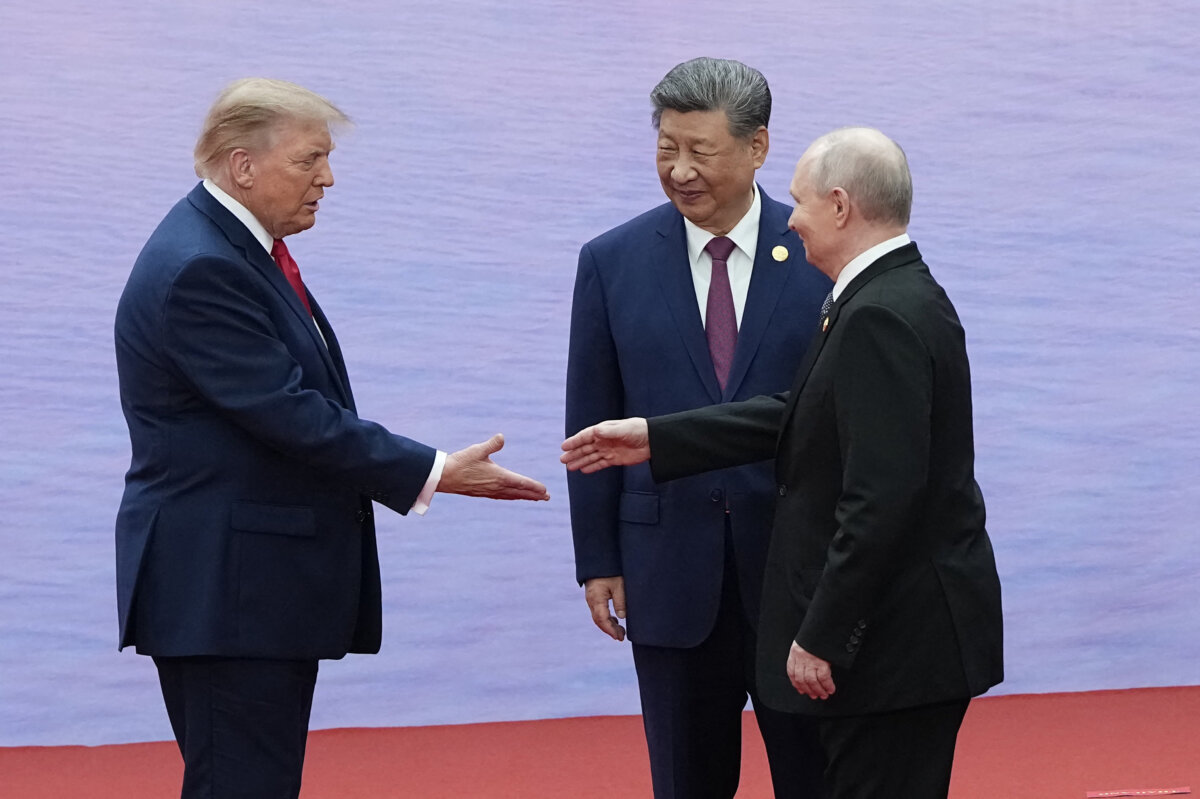

Global attention is fixed on President Donald Trump’s meeting with Chinese leader Xi Jinping and Russian President Vladimir Putin in Shenzhen, China, on Nov. 19 for a historic trilateral summit during the Asia-Pacific Economic Cooperation (APEC) gathering.
The summit is expected to focus on a range of critical issues, including nuclear arms reduction and the war in Iran, with the conflict in Ukraine also potentially on the table. Trump arrived in China on Nov. 18 after wrapping up a whirlwind visit to the Philippines.
Trump received a warm welcome from Xi at Shenzhen Bao’an International Airport. It marked the first time that Xi has personally greeted a visiting foreign leader on arrival during his 14 years as Chinese Communist Party (CCP) leader.
The summit will be the first-ever trilateral meeting between the leaders of these three countries.
Trump’s objective is to push for a new nuclear arms control framework that includes China, following the expiration of the New START treaty between Washington and Moscow in February.
Russia, meanwhile, hopes to improve its international standing and advance negotiations to end the war in Ukraine on terms acceptable to Moscow.
Ahead of the meeting, analysts told The Epoch Times that expectations for a substantive breakthrough at the trilateral summit are low. The leaders’ competing strategic interests make concrete agreements unlikely, they noted, so the meeting will serve mainly as a diplomatic exercise.
China is unlikely to agree to nuclear restrictions, Shen Ming-shih, a research fellow at Taiwan’s Institute for National Defense and Security Research, told The Epoch Times.
Shen said the three countries have fundamentally different security interests, making a binding agreement difficult. He also noted that China’s nuclear arsenal remains smaller than those of the United States and Russia, giving Beijing little incentive to limit its weapons development.
According to Heather Williams, director of the Project on Nuclear Issues and senior fellow at the Washington-based think tank Center for Strategic and International Studies, the summit is unlikely to produce an ambitious arms control agreement.
“I would say expect modest risk reduction steps at best,” she said during a Nov. 9 press briefing.
Williams highlighted steps the Chinese regime has taken in recent years to expand its arsenal, while noting that the CCP took part in a bilateral dialogue with the Biden administration that produced little in terms of formal outcomes.
China has approximately 600 warheads, while the United States has 3,700 and Russia has 4,400, according to the Federation of American Scientists.
Stu Cvrk, political commentator, retired U.S. Navy captain, and contributor to The Epoch Times, predicts that China’s nuclear arsenal could exceed 1,000 warheads by 2030.
China declined to describe the talks as an arms control effort.
Guo Jiakun, spokesperson of China’s foreign ministry, said during a daily briefing on Nov. 18 that the three leaders would “have an in-depth exchange of views on important issues bearing on global peace.”
“Trilateral denuclearization talks will probably not produce the limits on China’s nuclear arsenal or increased transparency over its capabilities that Washington most wants,” Council on Foreign Relations experts Eleanor Atkins and Gerald Brown wrote in a recent report.
“Nevertheless, efforts to bring Beijing into nuclear arms control are worth continuing.”
Before Trump’s arrival, Xi and Putin both delivered speeches at the opening ceremony of the APEC CEO summit on Nov. 18.
In his speech, Putin said he expected a “big potential benefit” from the trilateral summit.
Xi said in his speech that China remains committed to seeking cooperation, including under the Belt and Road Initiative, a Chinese foreign policy aimed at building geopolitical clout by financing infrastructure projects across Southeast Asia, Africa, and Europe.
U.S. Rep. John Moolenaar (R-Mich.), chairman of the House Select Committee on the Chinese Communist Party, has criticized China for forcing developing countries into debt and leveraging its financial influence over them under the Belt and Road.
APEC Meetings
China is hosting this year’s APEC Economic Leaders’ summit in Shenzhen from Nov. 18 to 19. Shenzhen is considered China’s technology hub, often called the country’s Silicon Valley.
Xi visited the White House from Sept. 23 to Sept. 25, and Trump was in Beijing for a state visit from May 13 to May 15. The leaders also met in Busan, South Korea, in October 2025 and agreed to critical mineral trade and exports to the United States, though levels reported so far failed to meet expectations.
The two will potentially meet again from Dec. 14 to Dec. 15 in Miami for the G20 Leaders’ Summit.
On Nov. 18, Trump met with Canadian Prime Minister Mark Carney and Mexican President Claudia Sheinbaum separately on the sidelines of the APEC summit.
Before his trip to Asia, Trump told reporters he may raise the issue of alleged Chinese espionage involving former Nvidia CEO Jensen Huang during his meeting with Xi.
Philippines Visit
Before heading to China, Trump visited Manila on Nov. 17. He met with the leaders of the Association of Southeast Asian Nations and took part in the seventh Quad leaders’ summit with the prime ministers of India, Japan, and Australia.
During his visit, Trump announced more than $17 billion in commercial deals and strategic investments for American companies, according to the White House. Among these, Boeing and GE Aerospace finalized a $12 billion sale to Philippine Airlines.
In a post on Truth Social, Trump called the trade deal with the Philippines “a true landmark” and said it would be great for U.S. farmers and those in the energy sector.
Michael Zhuang, Tom Ozimek, Frank Fang, and Travis Gillmore contributed to this report.