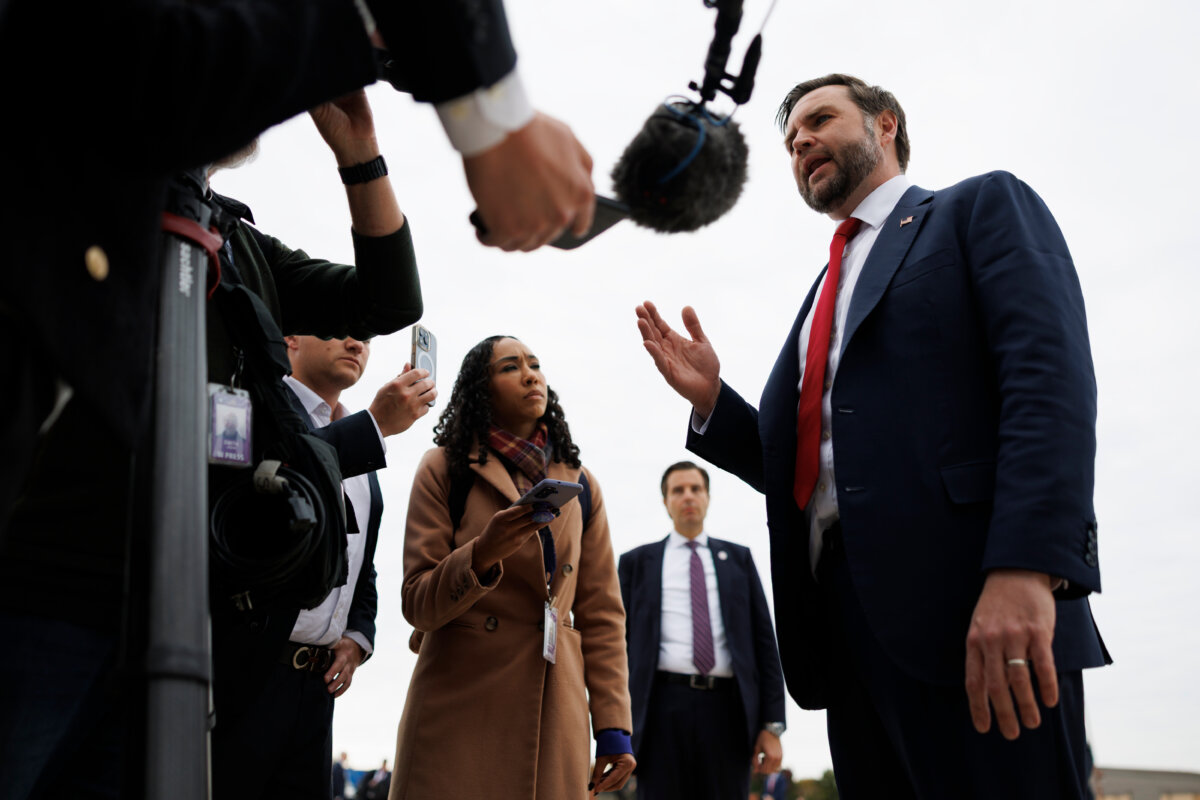

Vice President JD Vance said Americans shouldn’t worry about an imminent crisis, but should “be prepared for everything” after a series of major technology outages across the United States.
“I’ve had a lot of my friends reach out and say, ‘Should we be preparing to build a bunker or to stock up on food and water?’ And my answer to that is no,” Vance told Fox’s “The Ingraham Angle” on Nov. 16.
“We do not see some crisis coming down, but you have to be prepared for everything.”
The vice president said the government was taking precautions to ensure the military could continue operating during an emergency.
“What we want to do is make sure that we prevent the worst outcome, but we’re also prepared for the worst outcomes,” he said.
He said that the preparations were “basic good government.”
Vance’s remarks come after the United States has suffered several outages and cyberattacks.
At the 49th ASEAN Summit, President Donald Trump was asked whether he was concerned about the outages.
“It’s life. When you’re big and powerful and have all the money, things like that happen—it’s fine,” he said.
The Pentagon also recently confirmed that it is pursuing a goal of enabling major bases to sustain essential operations for at least 90 days without outside support.
“FORTRESS is strategic deterrence in action, ensuring our defenses are hardened, proactive, and ready,” Parnell said in an X post sharing the article on Oct. 25.
The 90-day standard includes access to electricity, water, fuel, communications, and other essential services needed to sustain military operations.
On Nov. 13, the Federal Aviation Administration (FAA) ordered a nationwide ground stop.
The FAA said airlines canceled approximately 12,462 flights on Nov. 13, although not all were directly attributable to the ground stop. By Monday morning, cancellations since Friday had exceeded 19,000, according to aviation analytics firm Cirium.
Friday’s ground stop began at about 3:30 p.m. ET, shortly after the FAA found a critical technical issue, and the agency didn’t lift it until 8:15 p.m. ET that night. This makes it the longest period of time flights have been grounded nationwide since the Sept. 11, 2001, terror attacks.
The FAA said it found no evidence of a cyberattack and traced the disruption to old equipment becoming unstable after data flooded its telecommunications infrastructure network, causing system disruptions and instability in radar and aircraft communications.
United Airlines experienced a separate technical outage on Monday, Nov. 16, delaying flights. The airline said there was no indication of a cybersecurity issue.
A series of technical disruptions also recently affected Microsoft services.
Microsoft’s Outlook, Teams, and Copilot services were slowly recovering on Friday after an outage lasted more than 24 hours—one of the longest in the company’s history—disrupting government and business communication systems worldwide. Microsoft said on Nov. 14 that it had restored services.
The Redmond, Washington-based tech giant blamed server problems for the outage and denied it had been the victim of a cyberattack.
Separately, Google’s Threat Intelligence Group said on Nov. 16 that it had identified hackers using AI frameworks capable of discovering and exploiting software vulnerabilities without human intervention.
The company said it had “identified threat actors using LLM frameworks to fully automate vulnerability discovery and exploitation without a human in the loop for the first time.”
Google also reported that Chinese state-linked cyber-espionage actors were using AI tools for reconnaissance and exploit development.
It said that in the third quarter of 2026, “PRC [People’s Republic of China]-nexus cyber espionage actors used LLM tools and models for reconnaissance, front-end scanning, researching targets across various sectors and geographies, and weaponizing exploits.”
The report did not establish any connection between these AI-enabled attacks and recent outages.
Former national security adviser and retired Army Lt. Gen. Michael Flynn raised concerns about recent incidents in a Nov. 16 post on X, saying “this looks and smells like a massive cyber attack.”
“If nothing else, our adversaries are getting a hard look at vulnerabilities and if there is any effective, cross talk between governmental and nongovernmental institutions. It appears there is little to none,” he added.
The Associated Press, Aldgra Fredly, and Chris Summers contributed to this report.