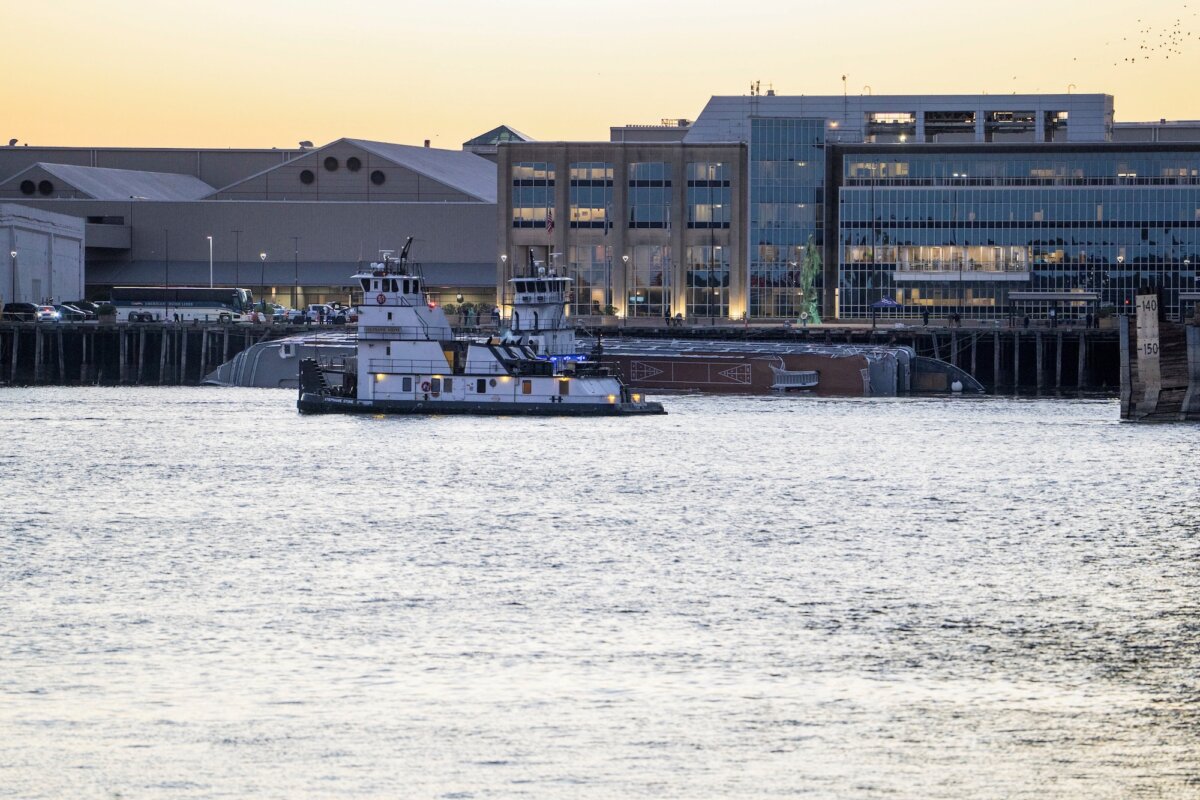

The tanker that struck the American Heritage river cruise paddleboat on the Mississippi River in New Orleans experienced a steering problem, U.S. transportation safety officials said on Nov. 15.
American Cruise Lines paddlewheeler American Heritage had 140 passengers and 50 crew aboard when it capsized at the dock on Nov. 13. No one was killed.
National Transportation Safety Board (NTSB) senior marine accident investigator Bart Barnum told a news conference in New Orleans that the Atlantic Asphalt tanker was headed upriver when it experienced a “steering casualty” in which its rudder stayed in a starboard position. The vessel then veered toward the river’s east bank.
NTSB officials said they do not know what caused the steering problem. The tanker’s voyage-data recorder was recovered on Saturday.
Investigators downloaded more than nine hours of data and began analyzing information that includes bridge audio, rudder angle, propulsion performance, and vessel speed, Barnum said.
He added that recorder data showed the asphalt tanker was traveling upriver on Nov. 13 near the Crescent City Connection Bridge at about 12:26 p.m. local time, two minutes before the collision, when it experienced the steering issue.
Audio captured by the recorder included the vessel’s whistle, radio warnings, and requests for assistance, as well as commands to deploy anchors and other emergency ship-handling orders, he said.
The cruise ship capsized in about 22 minutes, NTSB board member John DeLeeuw said on Sunday.
Eyewitness video posted online showed that the green-and-orange vessel, called the Atlantic Asphalt, hit the paddlewheel cruise boat at the dock.
The paddleboat could be seen slowly turning onto its side as some passengers swam toward shore and others clung to the capsizing leisure vessel. A person on the tanker threw a life preserver to passengers in the water.
DeLeeuw said that they saw that the tanker’s anchors were deployed but “as far as which anchors and how far they were down we’re still investigating that part, but the order was given.”
Interviews of the Atlantic asphalt crew are scheduled for today and the remaining days of the week, Barnum said. A preliminary report will be issued in about 30 days, the agency said.
On Friday, the mayor’s office said that all individuals involved in the collision have been accounted for, with no fatalities.
A total of 32 people were transported to area hospitals, with no critical injuries reported.
On Nov. 13, Homeland Security Secretary Markwayne Mullin said it was a “miracle” that nobody was killed.
“This looks like it was a major engineering defect that took place,” Mullin said before the initial investigation.
“I do want to announce, though, by the grace of God, we have not lost one soul.”
U.S. President Donald Trump announced in a post on Truth Social on the same day: “Thank you to the United States Coast Guard for doing such an incredible job of rescue, and other work, having to do with the crash of the two ships in Louisiana.”
“Likewise, all of Law Enforcement and First Responders were fantastic!” he added.
Jacki Thrapp and Reuters contributed to this report.