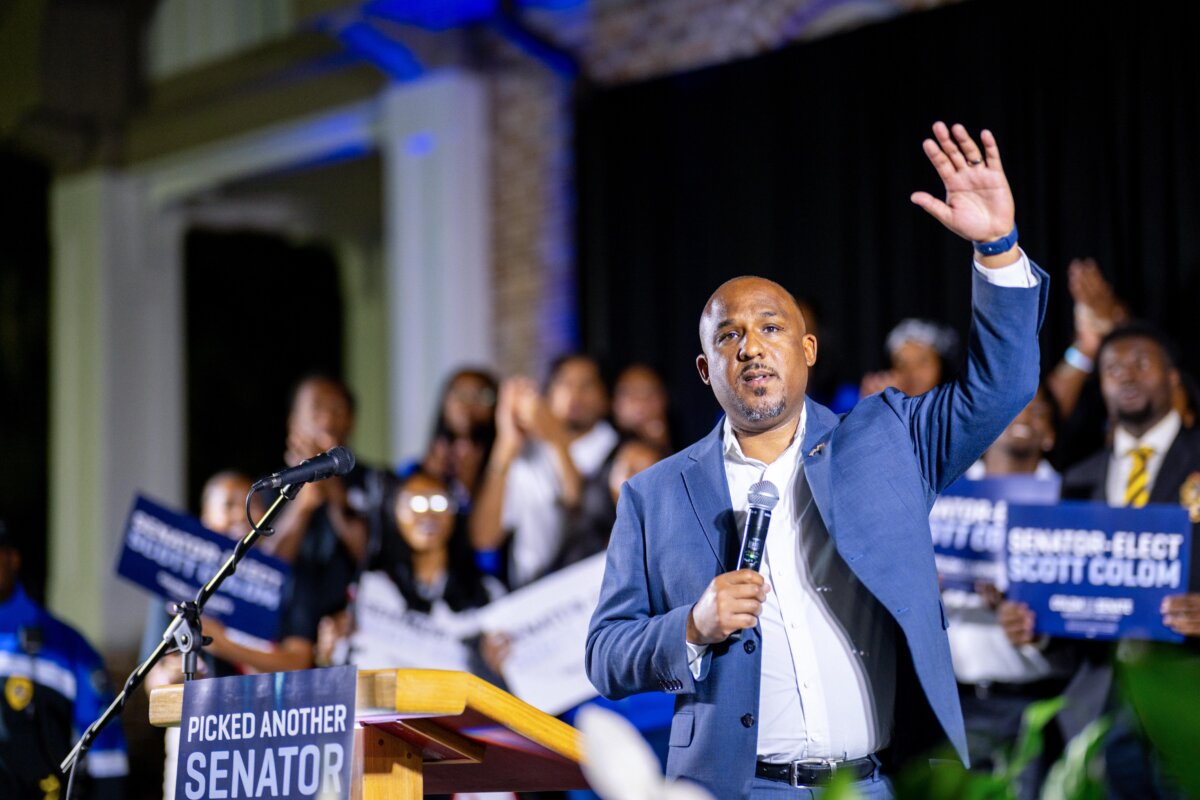

Mississippi elected its first black U.S. senator since Reconstruction on Nov. 3. Democrat Scott Colom defeated Sen. Cindy Hyde-Smith (R-Miss.) after more than a week of ballot counting.
The incoming senator is a stark contrast to the previous Democratic senator from the Magnolia State. The last time Mississippi sent a new Democrat to the Senate was 1947, and that winner was a segregationist.
Colom is a 43-year-old local prosecutor and the son of a former Republican who worked for President Ronald Reagan. He campaigned on the economy, the Iran War, and tariffs.
His win was the latest Senate seat to flip in a midterm year that also put Democrats into office in South Carolina, North Carolina, and Texas.
For most of the past century, Democrats who won in the South did so by running more conservatively than the national party.
In 1981, about 50 conservative Southern House Democrats known as the Boll Weevils helped pass Reagan’s economic agenda. The fiscally conservative Blue Dog Coalition later carried that approach forward.
Former Rep. Joe Cunningham (D-S.C.)—a member of the Blue Dogs—flipped South Carolina’s First Congressional District in 2018 but lost it two years later. Cunningham described himself as “probably one of the more conservative Democratic members” sworn in with that 2019 class.
He said this year’s class is different. In his view, these winners stood out because they were candidates who “looked like and spoke like the people that they represent, not somebody who climbed down from their ivory tower and spoke a different language.”
The new winners, he said, do not fit a left-or-right label so much as a populist one.
“It shouldn’t be the Democratic Socialists of America,” he said. “It should be the Democratic Populists of America.”
Kirsten England, a political scientist and assistant professor of instruction at the University of South Florida, reached a similar conclusion.
In written responses, she told The Epoch Times that this year’s winners appear to be “a meaningful break” from the Boll Weevil and Blue Dog approach, which she said often emphasized fiscal conservatism and cooperation with Republicans.
England said candidates such as James Talarico in Texas and Richard Ojeda in North Carolina did not mainly move to the right, though they were not on the far-left Democratic Socialist wing of the party’s candidates either. They paired economic populism with identities rooted in faith, military service, and working-class experience, she said.
She added that how they govern will show how deep that break goes.
How Colom Won
The race was called for Colom just before 6 p.m. ET on Nov. 11, after an update from Jackson County. At that point, he led by 4,669 votes out of more than 962,000 counted, or 0.5 percentage points, leading to a concession from his opponent and a victory speech for Colom.
Colom won more than 67 percent in the Jackson and Delta regions, the strongest Democratic showing there in a race for Senate, governor, or president in at least 10 years, according to an AP analysis.
He was also competitive in the Republican-leaning Northeast and Southeast, where Hyde-Smith ran more than 10 percentage points behind President Donald Trump’s 2024 vote share.
When Trump rallied with Hyde-Smith in Corinth in late October, Colom walked the line of supporters waiting to get in, introduced himself, and asked about their concerns—something Trump praised in a podcast appearance recently.
In his victory speech at Tougaloo College, Colom said he was warned early not to count on outside help.
He said Rep. Bennie Thompson (D-Miss.), NAACP President Derrick Johnson, and a political mentor told him on a video call last December, “We don’t think the cavalry’s coming,” and that his only chance was to get out and campaign.
Colom said that is what he did. He told the crowd about a soybean farmer in Oktibbeha County who lost a customer because of tariffs, and a single mother in George County who he said leans on family at the end of each month because of gas prices driven up by the war in Iran.
“All I did was have the courage to imagine a night like this,” Colom told supporters.
He closed by pledging to work for every Mississippian, including those who voted against him and those who did not vote.
Hyde-Smith conceded in a video posted after the call. She said the result was not what her campaign had worked for, but that she respected the decision of Mississippi voters, and she wished Colom well.
Joseph Lopez, 37, is a Republican strategist in Dallas who works with local GOP candidates in Texas. This year he voted for Democrat Gina Hinojosa for governor and for Democrat Vikki Goodwin over Republican Lt. Gov. Dan Patrick, and he left the Senate race blank.
Lopez said several things changed his vote. He cited Patrick’s push against hemp, the baggage Texas Attorney General Ken Paxton, the Republican nominee, carried into the Senate race, promises from the Trump administration that he said went unkept, and property taxes.
He said he wanted Republicans to “get humbled, regroup and come back as a fresher coalition for 2028.”
Lopez called Republicans losing ground in the South in the midterms “a perfect storm from all angles.”
He said the young voters who helped return Trump to office had voted for no new wars and got a war in Iran, with no protection for their jobs as artificial intelligence reshaped the job market.
Older voters, he said, were hit by cuts to Affordable Care Act subsidies, the rising cost of living, and tariffs.
Lopez said Latinos in the South support a closed border and immigration enforcement, but that the “images and noise” around events in Minnesota, Houston, and Austin pushed them back to Democrats.
He also faulted Trump for choosing the party’s candidates in South Carolina and Texas.
“We could tell Paxton didn’t care if he won this thing or not,” Lopez said. “That malaise spread down-ballot.”
A Different Coalition
In South Carolina, pediatrician Annie Andrews defeated Sen. Darline Graham (R-S.C.) and became the first Democrat the state has elected to the Senate since 1998.
Republican Alan Wilson won the governor’s race on the same ballot, and seven counties that backed Wilson also voted for Andrews, according to official results from the South Carolina Election Commission.
England said Southern Democrats of the 1980s and 1990s often won with black voters plus conservative or working-class white voters, including many in rural areas.
She said the South Carolina results point to a newer mix that leans more on suburban voters and college graduates and draws some Republicans.
Andrews won a majority of women, according to the AP Voter Poll. About 8 in 10 Republican voters backed Graham, down from about 9 in 10 who supported her brother, the late Sen. Lindsey Graham, in 2020.
Retired Navy Vice Adm. Nancy Lacore flipped the Charleston-area seat that Cunningham once held. Cunningham said Lacore “met every single voter and spoke to them with dignity and respect,” and he contrasted that with how he says her party has treated Trump voters.
“The Democratic Party has spoken down to Republicans who supported Trump,” he said.
In North Carolina, Ojeda defeated Rep. Richard Hudson (R-N.C.), the chairman of the National Republican Congressional Committee. Hudson conceded the day after the election.
In Texas, Talarico, a state representative, won a Senate seat and Hinojosa, also a state representative, defeated Gov. Greg Abbott.
Cunningham said the winners shifted to “kitchen-table issues that affect all Americans.” He said the Republicans who lost had not taken a single policy position that broke with Trump.
Juven Jacob, a Democratic strategist in Washington who is from Texas and served as an appointee in the Biden administration, said the party should not reduce the wins to a choice between moving left and moving right.
He said a candidate can advocate for abortion access and healthcare while speaking plainly about grocery bills and utility costs, and that the test is whether voters believe the candidate understands their lives.
Will It last?
Cunningham said he received “essentially no support from the establishment” when he ran in 2018. He said that presidential candidates have treated South Carolina as a stepping stone to the nomination and that “you can’t invest once every four years.”
North Carolina Democratic Party Chair Anderson Clayton made the same case on Nov. 12 in Denver, at a post-election gathering of Democrats. She said organizers across the South are being laid off now that the election is over, and that her own state party can keep only 25 full-time staff after having hundreds of people working this year.
“When we’re looking at the investments that we make as a party, and we say that black voters are the base of our party, then I ask, why are we not investing in a region of the country that on Tuesday night just proved everybody wrong of what is possible?” Clayton said.
She said Colom’s win showed what years of grassroots organizing can produce, and she urged the party to fund that work year-round and to “never take the South for granted again.”
Democratic National Committee Chair Ken Martin said during a virtual briefing for supporters on Nov. 6 that the DNC began investing in every state party last year, with a bonus for states under Republican control. While Colom’s race was still uncalled, Martin said upcoming governor’s races in Kentucky, Louisiana, and Mississippi were “now in play.”
DNC National Political Director Shelby Wiltz said on the same call that the South has long seemed like something Democrats “just can’t seem to crack.”
“I hope that 2026 has taught everyone that investing in the South is more important now than ever,” she said.
Cunningham was not ready to call the gains permanent.
“I don’t believe that all of our defects have been polished or cured after these midterms,” he said. “I think voters in 2028 are going to hit the reset button.”
England said the gains could carry into 2028 if Democrats deliver on affordability, healthcare, and education, but that one favorable election “does not establish a lasting regional realignment.”
Jacob drew the same line between an opening and a realignment, and said rejecting Republican leaders does not mean voters have come to trust Democrats.
Lopez said the speed of the swing is what gives him hope as a Republican. “The Latino men and Gen Z voters who powered Trump’s win shifted to Democrats in just two years, and they can shift right back,” he said.
He said Republicans can win those voters back if they move beyond Trump, return to the economy, and lead by example, but that the party will lose time to its own fight over who leads it next. His advice to his own party was to “lead with receipts, not enemies.”
Tom Gantert and Zachary Stieber contributed to this report.