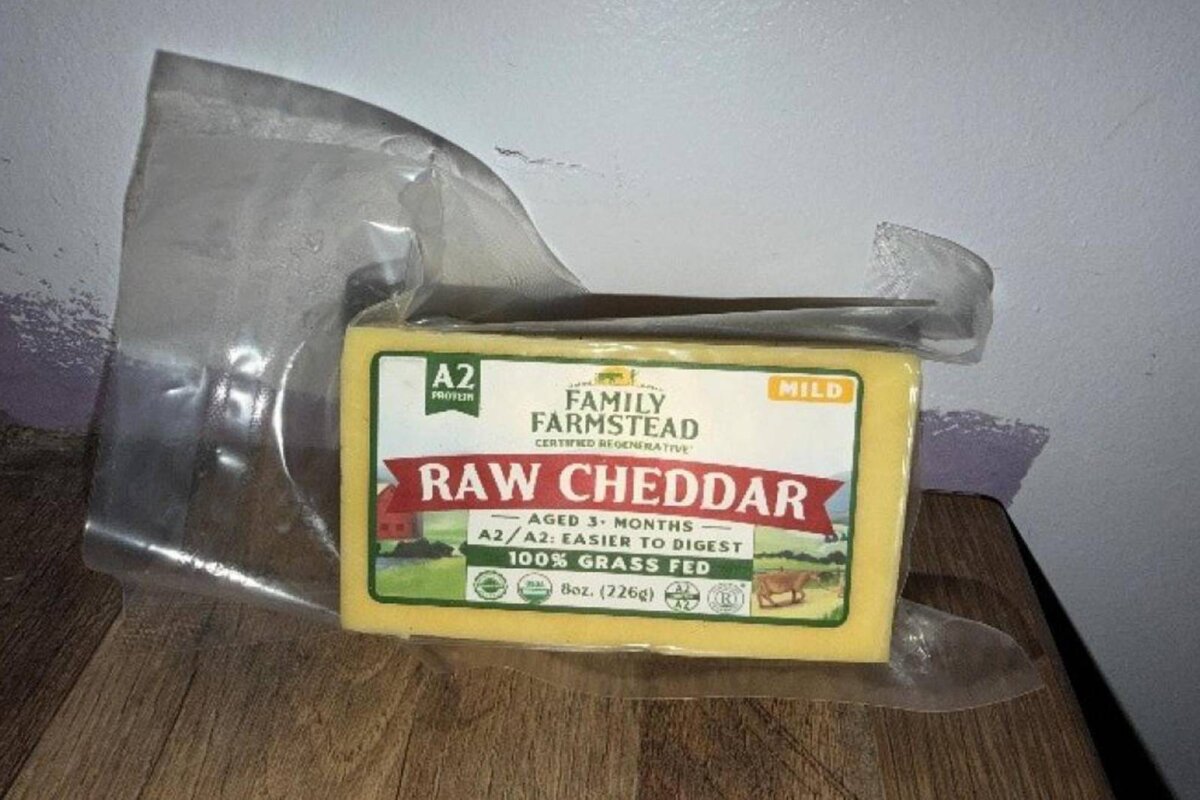

New York-based Family Farmstead Dairy is recalling all its cheddar cheese products from 12 U.S. states due to potential bacterial contamination.
The recall is applicable to Raw Mild Cheddar and Raw Sharp Cheddar, both 8 oz., plastic-wrapped, and with lot codes dated Oct. 16, 2027, and earlier, the company said in a Nov. 10 announcement published by the Food and Drug Administration (FDA).
The items were distributed through retail stores across New York, New Jersey, Vermont, New Hampshire, Massachusetts, Pennsylvania, Rhode Island, Connecticut, Delaware, Virginia, West Virginia, and Tennessee.
The recalled items could potentially be contaminated with Listeria monocytogenes, bacteria that can cause “serious and sometimes fatal infections in young children, frail or elderly people, and others with weakened immune systems,” the announcement said.
“Although healthy individuals may suffer only short-term symptoms such as high fever, severe headache, stiffness, nausea, abdominal pain and diarrhea, Listeria infection can cause miscarriages and stillbirths among pregnant women,” the company said.
Family Farmstead clarified that no other products are affected by the recall. The company asked customers who have bought the recalled items to return them to the place of purchase.
The recall “is being taken as part of our ongoing commitment to continuous improvement and product excellence,” the company said. Last month, the business had recalled certain raw cheddar products, citing the potential presence of E. coli bacteria.
The Epoch Times reached out to Family Farmstead Dairy for comment but did not receive a response by publication time.
People infected with listeria can suffer from an intestinal illness, which typically begins within 24 hours after the consumption of contaminated food, with the sickness usually lasting for one to three days, according to a February 2025 report from the Centers for Disease Control and Prevention (CDC).
While symptoms of intestinal illness tend to be mild, some people may end up developing an invasive illness.
“Invasive listeriosis happens when Listeria spreads beyond the intestines. Symptoms of invasive illness usually start within 2 weeks after eating food contaminated with Listeria,” the CDC said.
The CDC has tackled multiple listeria outbreaks over the past year, with a recent one linked to the consumption of soft cheese, according to an Aug. 26 update from the agency. A total of 15 people across four states were infected in the outbreak, which included 14 hospitalizations and one death.
Another listeria outbreak, linked to prepared pasta meals, ended up infecting 28 individuals from 19 states, resulting in 27 hospitalizations and seven deaths, the agency said in a Feb. 12 update.
CDC has declared both outbreaks to be over, with the agency closing its investigations.
Certain foods are likely to be more susceptible to listeria contamination than others.
They include cheeses made with unpasteurized milk, unheated deli meats or cold cuts, fermented or dry sausages, premade deli salads, refrigerated smoked fish, cut melon left out for over two hours, and raw or lightly cooked sprouts, the CDC said in a January 2025 report.
The agency advised avoiding consuming these foods as a precautionary measure to prevent listeria infection.