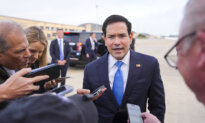
Secretary of State Marco Rubio escalated pressure on the International Criminal Court (ICC), saying the United States could adopt a tougher stance against the judicial body.
“The ICC is a court that continues to claim—elements of it continue to claim that they have jurisdiction over individuals and—from countries that are not members of that treaty,” Rubio said in Nov. 9 remarks to the press in Paris.
“We’ve tried for a year and a half to get them to reform [in] a nice way, and they haven’t been willing to do so, so we’ll have to try a different approach.”
Headquartered in The Hague, the Netherlands, the ICC was established by the Rome Statute, an international treaty that gives the court jurisdiction over crimes against humanity, crimes of aggression, genocide, and war crimes, and currently has 125 member states.
The ICC issued arrest warrants for Israeli Prime Minister Benjamin Netanyahu and former Israeli Defense Minister Yoav Gallant in 2024, alleging war crimes committed between Oct. 8, 2023, and May 2024 in Gaza.
The alleged war crimes were Israel’s response to the Oct. 7, 2023, Hamas attacks, which killed more than 1,200 Israeli citizens and foreign nationals and wounded more than 5,500.
The ICC also made efforts to investigate or prosecute American military and intelligence officers for actions in Afghanistan and other operations.
The United States and Israel are not parties to the Rome Statute or members of the ICC.
President Donald Trump issued an executive order in February last year clarifying that the ICC has no jurisdiction over the United States or Israel.
The Trump administration imposed sanctions on several ICC officials in 2025 for the arrest warrants against the Israelis leaders.
U.S. Attorney General Todd Blanche wrote a letter to the ICC president in July, asserting that the Department of Justice rejects any jurisdictional claim by the ICC over Americans.
ICC argues that the Rome Statute gives it the authority to prosecute war crimes committed on the territory of its member states by people from non-member nations.
ICC Sanctions, Response
In July, Rubio said the administration would seek to dismantle the ICC through various measures, including sanctions, visa revocations, and diplomatic pressure on ICC member states to withdraw from the group.
“Read the words of our Declaration of Independence. We fought a revolution against a foreign power, transporting us beyond seas to be tried for pretended offenses. Independence is our birthright. We will never let foreign bureaucrats take that away from us,” Rubio said.
The State Department imposed new sanctions against the ICC on Oct. 9, under which all property and financial interests of the court in the United States or in the control of U.S. individuals are frozen.
U.S. nationals are prohibited from carrying out transactions with the ICC without authorization. Such transactions include providing ICC with services, goods, or funds.
The ICC rejected the sanctions in an Oct. 9 statement, arguing that these measures aim to disrupt its operations and intimidate those who choose to work or cooperate with the court.
“It is an attempt to obstruct the course of justice and to prevent the Court from doing what it was created to do. It is an assault on the rule of law and on the very foundations of the international legal order which strikes at the simple principle that no one stands above the law,” the ICC said.
The ICC prosecutor and judges have wielded enormous, unchecked power, with the Rome Statute’s safeguards either failing or being ignored, U.S. Ambassador to the United Nations for Management and Reform Jeff Bartos said in a Nov. 2 statement.
Bartos accused the ICC of making politicized decisions and warned that the court’s actions set a dangerous precedent that threatens state sovereignty.
Bartos said neither the ICC nor state members have taken meaningful steps to address the various concerns raised by the United States.
“We believe we can inflict tremendous damage on the ICC unless they see the error of their ways,” Rubio said in Paris.