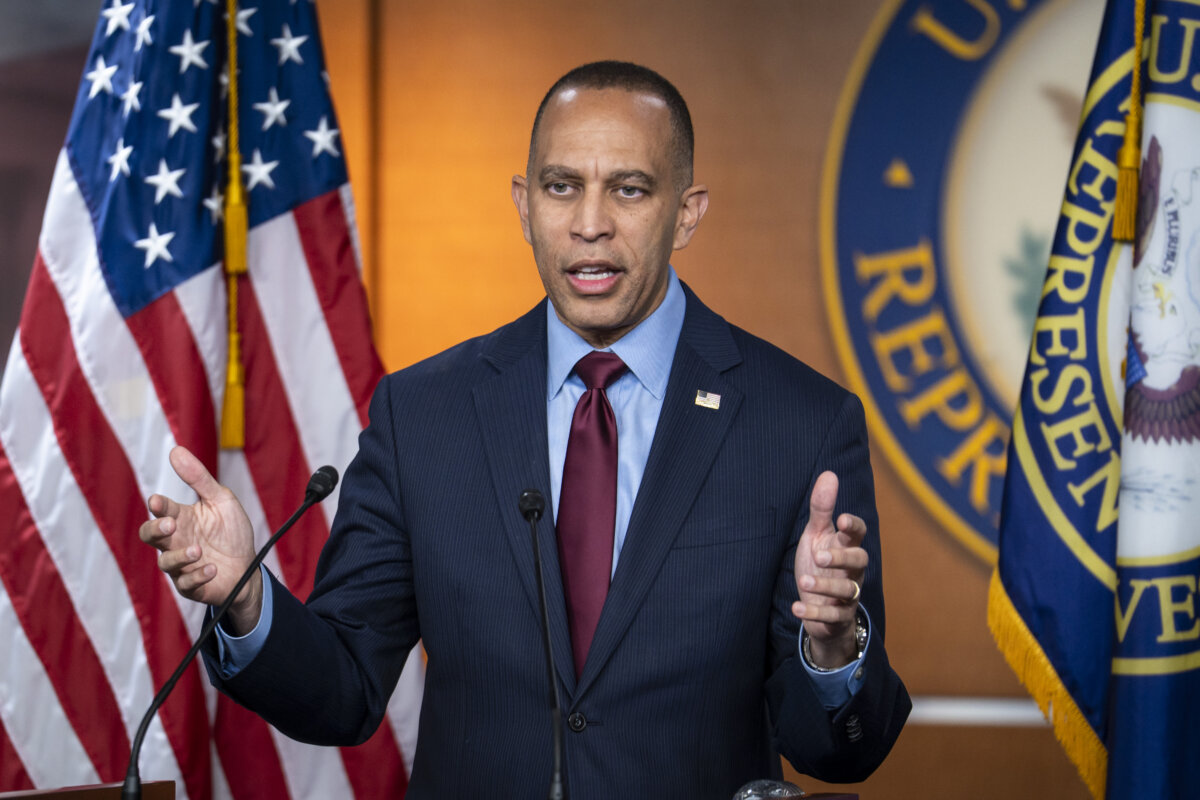

House Minority Leader Hakeem Jeffries (D-N.Y.) said he supports tighter restrictions on advanced chip exports to China in the final version of the annual defense bill, after Nvidia’s CEO admitted to an affair with a woman accused of being a Chinese spy.
Jeffries made the comments during his weekly press conference on Nov. 9. The House passed its version of the fiscal year 2027 defense bill in July, while the Senate has yet to pass its own version.
Jeffries said he strongly supports provisions in the Senate version of the National Defense Authorization Act (NDAA) that would restrict China’s access to chips and that Democrats would work to see them included in the final bill.
On Nov. 8, Nvidia said its board was launching an independent investigation in light of reports that Nvidia CEO Jensen Huang was the target of a foreign intelligence effort. Huang had apologized to employees that day for being unfaithful to his wife and for falling short of his responsibilities to the company. The board said in a statement that it had no reason to believe that national security or Nvidia secrets were compromised.
The woman, Alice Huang, was an executive at Singapore-based data center company Megaspeed, which has purchased Nvidia chips. U.S. authorities suspected that she had links to Chinese intelligence and investigated allegations that Megaspeed had helped China obtain advanced artificial intelligence processors subject to U.S. export restrictions.
Jeffries’s remarks add a prominent House Democratic voice to a bipartisan Senate push for tighter chip export restrictions, as the Senate’s version of the NDAA remains stalled after a procedural vote failed 50–46 in July, falling short of the 60 votes needed to advance.
Legislation
The Senate effort includes the AI Overwatch Act, introduced by Sen. Jim Banks (R-Ind.) in April, with Sen. Elizabeth Warren (D-Mass.) among its original cosponsors. As introduced, the bill would require a license for exports of advanced AI chips to China and other countries of concern and require the Commerce Department to submit each proposed license to Congress at least 30 days before approval.
Banks and Warren said the case involving Jensen Huang and the suspected Chinese spy made “national security concerns even more urgent,” according to a joint statement released by Banks’s office on Nov. 9.
Nvidia had “reportedly received approvals to export hundreds of thousands of advanced AI chips to China,” including firms with ties to China’s military, they said.
Banks’s office noted that the AI Overwatch Act was included in the Senate version of the NDAA.
“It is time for Congress to take decisive action to pass key bills like the AI Overwatch Act in the NDAA that will cut off the various pathways through which China accesses advanced chips,” the two senators said.
A bipartisan group of senators, including Banks and Warren, has cosponsored the Chip Security Act, which was introduced by Sen. Tom Cotton (R-Ark.) last year. The legislation would require advanced chips to carry security mechanisms that are aimed at preventing smuggling.
Another bipartisan effort is the Multilateral Alignment of Technology Controls on Hardware (MATCH) Act, which was introduced in the Senate in April. The legislation would prohibit the sale or servicing of key chipmaking equipment to countries of concern, including China, and press U.S. allies to adopt similar controls.
Congress
Jeffries also said Congress needs more information about what happened at Nvidia, and that the situation raises concerns that need to be addressed.
On Nov. 9, a classified briefing was held for congressional leaders, during which CIA Director John Ratcliffe and Director of National Intelligence Jay Clayton discussed Iran, Jeffries said, noting that the Nvidia issue did come up.
“We’re going to need a full briefing specifically as it relates to the Nvidia issue, so we could all get to the bottom of what has happened and what the implications are in terms of America’s national security,” Jeffries said.
Rep. John Moolenaar (R-Mich.), chairman of the House Select Committee on China; Rep. Brian Mast (R-Fla.), chairman of the Foreign Affairs Committee; and Rep. Rick Crawford (R-Ark.) sent a letter dated Nov. 4 to Jensen Huang, requesting the Nvidia chief attend a joint, closed-door briefing on Nov. 18 to discuss his interaction with the alleged Chinese spy. They asked for a reply by Nov. 11.
“The issue of PRC infiltration and access to cutting-edge U.S. technology is core to the investigative work of our three committees this Congress,” the letter reads, referring to the People’s Republic of China, the name of China under the Chinese Communist Party.
“It is vital that Congress determines the extent to which U.S. national security has been placed at risk.”