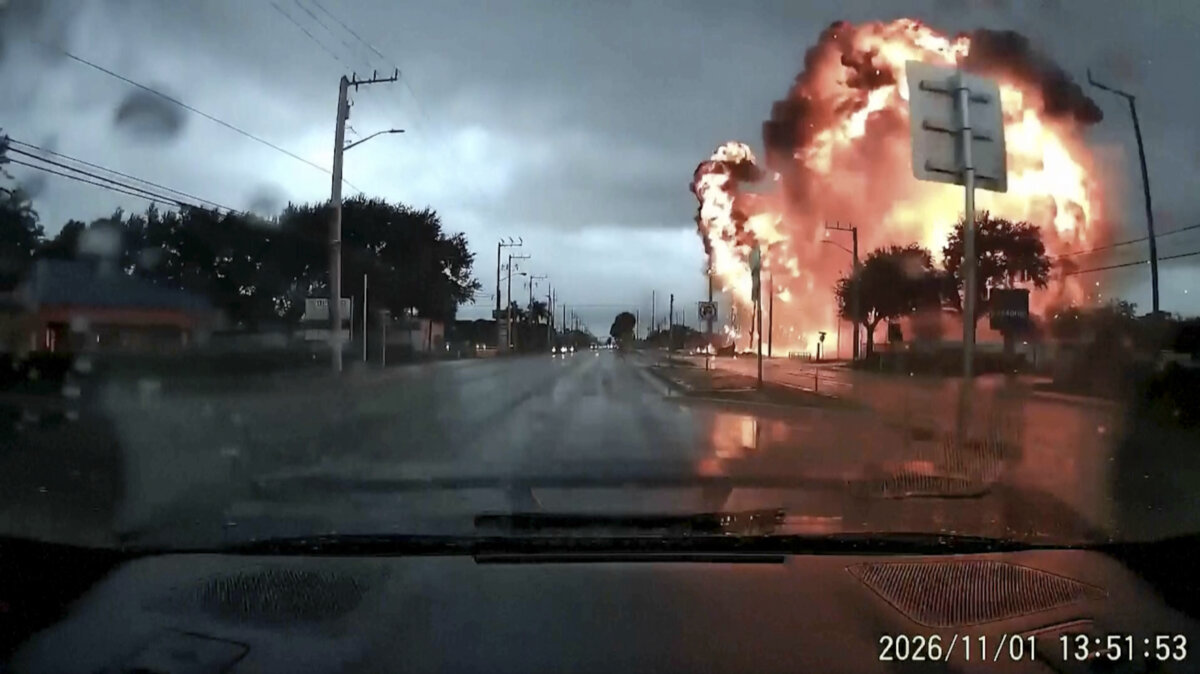

Investigators have recovered most of the left elevator from the Learjet that crashed in Greenacres, Florida, confirming the aircraft began breaking apart in flight before it struck the ground and killed all nine people on board.
National Transportation Safety Board (NTSB) member Tom Chapman said at a news conference Tuesday that the elevator, which controls the plane’s pitch, was found in three separate pieces between roughly 1.3 and 3.8 miles from the impact site near West Palm Beach.
The discovery established that the jet was coming apart before the final impact, he said.
Key components of the jet’s tail may have been lost during the turbulence or as it nose-dived, making the plane impossible to control, according to Jeff Guzzetti, a former investigator for the NTSB and the Federal Aviation Administration.
Chapman noted that it remains unclear whether the missing elevator helped trigger the loss of control or simply tore away under the extreme forces of the dive. Even if it had remained attached at those speeds, he said, it is uncertain whether it would have been effective.
The finding, however, gives investigators a clearer direction for further examination of the wreckage and flight data.
The nosedive began shortly after the co-pilot reported ice buildup and intensifying turbulence as the Learjet entered a rapidly developing thunderstorm. Weather conditions are expected to remain a central focus of the probe.
Still images from video of the final moments appear to show the entire horizontal stabilizer missing from the top of the tail before the aircraft hit the ground.
The business jet, a Learjet 60 traveling from Austin, Texas, to the Bahamas, went down around 12:50 p.m. ET on Nov. 1. It struck a residential area, carving a large crater and scattering debris across a wide field amid heavy rain.
The impact produced a fireball and dense black smoke; little of the airframe remained intact.
Florida Gov. Ron DeSantis described the scene as a cataclysmic crash that resembled a missile striking the ground. Roughly 600 nearby residents were displaced, though only one person on the ground was injured.
Among those killed were technology entrepreneur Adam Robinson; his wife, Helen Sharp; their two young children; and the family’s nanny, Ana María Ramírez Cetina.
The captain was identified as 55-year-old Jeff Gregory. The co-pilot, 20-year-old Nathalia Gadelha Filgueiras, was the first victim publicly named.
In the final two minutes of the flight, the co-pilot’s radio calls shifted from routine exchanges with air traffic control to urgent reports that ice was accumulating and that turbulence had thrown the aircraft up and down by more than 700 feet.
She then stated the plane was going to crash into the ground as it descended at a rate exceeding 20,000 feet per minute, ending with the words “We’re out of time!” before the transmission cut off.
Her stepfather later said she had texted her boyfriend about 10 minutes earlier, mentioning turbulence and ice.
Investigators planned to begin examining the crater on Wednesday once water removal was completed, expecting to recover additional key components.
A preliminary NTSB report is anticipated in about a month, while a determination of the probable cause is expected to take more than a year.
The Associated Press contributed to this report.