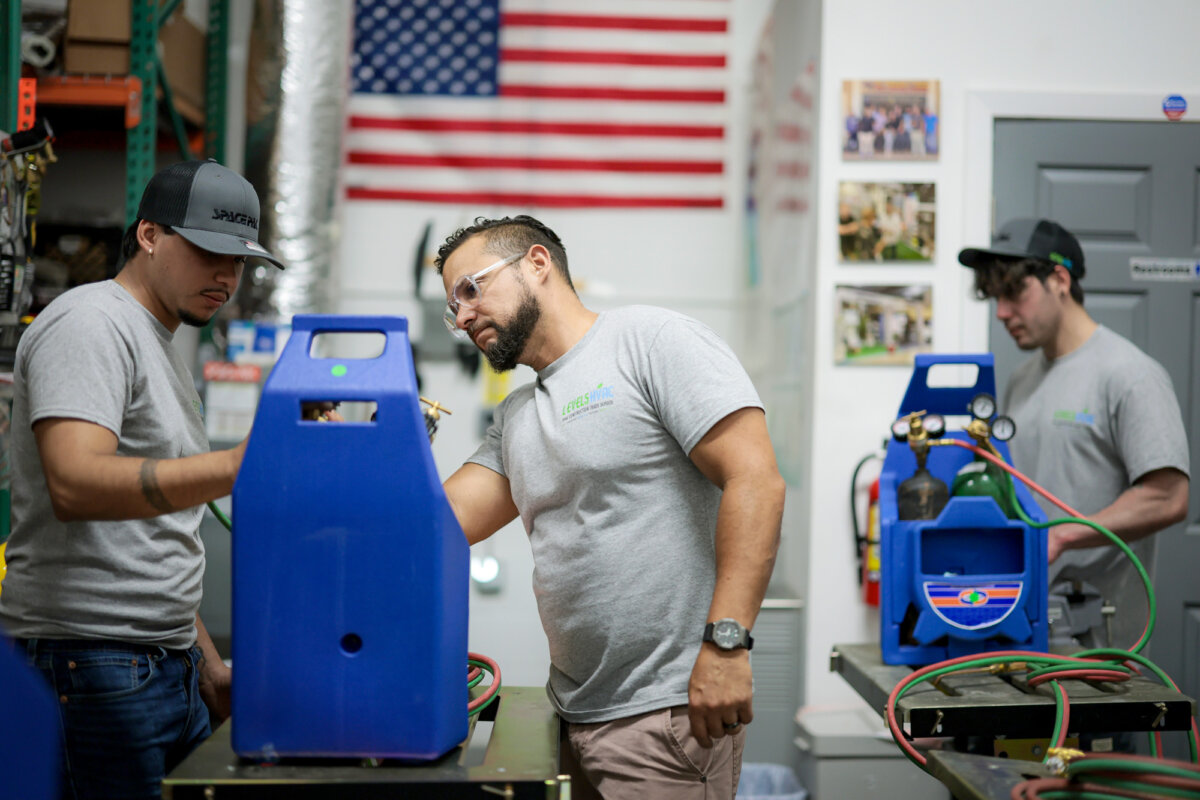

By middle school, Tyler Doege had already ruled out college.
“I knew I liked to work with my hands,” Doege, 22, of Lunenburg, Massachusetts, told The Epoch Times. He enrolled in a vocational high school, chose plumbing, and went straight to work after graduation.
Four years later, he is a licensed journeyman plumber earning between $80,000 and $100,000 a year, with no student debt.
Doege is part of a growing number of Gen Z Americans who are skipping the traditional four-year degree in favor of trade school, apprenticeships, and short-term training.
Public confidence in college has fallen sharply. Just 31 percent of U.S. adults now say a college education is “very important,” a record low, according to a Gallup poll released Oct. 1. That figure stood at 70 percent in 2013.
Young people such as Doege are drawing their own conclusions.
In an online poll of 1,140 adults ages 18 to 29, more respondents picked trade school or an apprenticeship (34 percent) than a four-year degree (23 percent) as the path most likely to bring financial stability by age 30.
The SimplyWise Trades & Technology Index, released in June, drew from an opt-in panel, and its authors say the results should be treated as “directional.”
Preparation is another concern. Only half of high school students who do not plan to attend college feel prepared for the future, according to research from Gallup and the Walton Family Foundation released on Aug. 25.
Ryan Jenkins, a Wall Street Journal bestselling author who studies generational dynamics and the future of work, told The Epoch Times that Gen Z has flipped the old career model.
“The model used to be learn and then earn, right? Go get your four-year degree and then put that to practice for the rest of your career, and that is just totally gone,” said Jenkins, author of “The Generation Z Guide: The Complete Manual to Understand, Recruit, and Lead the Next Generation.”
“Gen Z is shortening the distance between learning something and earning something,” he said.
Debt weighs heavily on that choice. “Gen Z wants an education that opens doors without debt that would close a door,” Jenkins said.
He said a four-year degree “just feels like a big bet” to young people, especially as artificial intelligence reshapes the job market “at a breakneck speed.”
Doege said he did not want to spend four years and “all that money” on a major he might never use.
“It made sense to just go right into working and making money instead of spending all that money and gaining all that debt,” he said. He said he earns enough to save to purchase a house.
Jenkins said Gen Z defines career security differently than earlier generations did. Older workers found security in a stable employer or a proven industry, he said.
“For Gen Z, the new career security is having skills you can take with you and put to use right away,” he said. Young workers, he added, are “treating their careers like free agents.”
The trades also offer a measure of protection from AI. Doege, who works for Denron Hall, a Manchester, New Hampshire, company that handles new construction and multi-residential and commercial projects, said no machine will replace what he does.
“It won’t be able to go into people’s houses and change a toilet, fix a shower valve when it could be 20 different issues,” he said. “Everything is so unique and complex.”
At Northwest Mississippi Community College, enrollment in career-technical and health science programs is rising, said Tonyalle Rush, vice president of student services and enrollment management.
“Today’s students are really looking for the fastest, most affordable path to a meaningful career,” Rush told The Epoch Times. “They’re really asking some questions about the cost of college, the amount of debt that they would be in, and they’re really looking at what that return on investment is.”
Some programs take as little as 16 weeks. Nursing, surgical technology, welding, robotic welding, HVAC, construction management, and cybersecurity are drawing strong interest, she said.
A new residential and commercial electrical program at the college’s DeSoto campus is at full capacity and is enrolling students for fall 2027.
University transfer students still make up the college’s largest group, Rush said, but most technical programs post high job placement rates.
“They’re making a very good wage to take care of themselves and their families, and that’s what we want to do,” she said.
The shift could ease a long-running labor shortage in the trades. Jenkins, who works with clients in the trade industry, said employers “would welcome this.”
But generational friction is likely. Veteran workers spot young workers’ weaknesses most easily in the areas where they themselves are most skilled, he said. They also tend to compare newcomers “to a polished version of themselves.”
He urges older workers to “trade certainty for curiosity” and ask what the generations can learn from each other.
Parents and counselors may be slow to catch up. Jenkins pointed to Gallup research showing that 52 percent of students say adults have talked with them a lot about college, compared with 17 percent who say the same about vocational training or apprenticeships.
“That’s a massive gap,” Jenkins said. “College remains a valuable path, no doubt, but it deserves a deliberate decision rather than an automatic one.”
Rush’s advice to students who want to work with their hands is simple. Take a campus tour.
“Many times our students, if they’re able to see what that profession is doing, they’re more than likely to commit to it,” she said.
Doege admits the work has hard days, especially when he cuts into a live sewer line.
“Those were the days I wish I was in a desk job,” he said. “But other than that, I don’t really have any regrets.”
He said many people he knows started in the trades in their late 20s or 30s, after college and a job they did not like. He plans to start his own plumbing business.