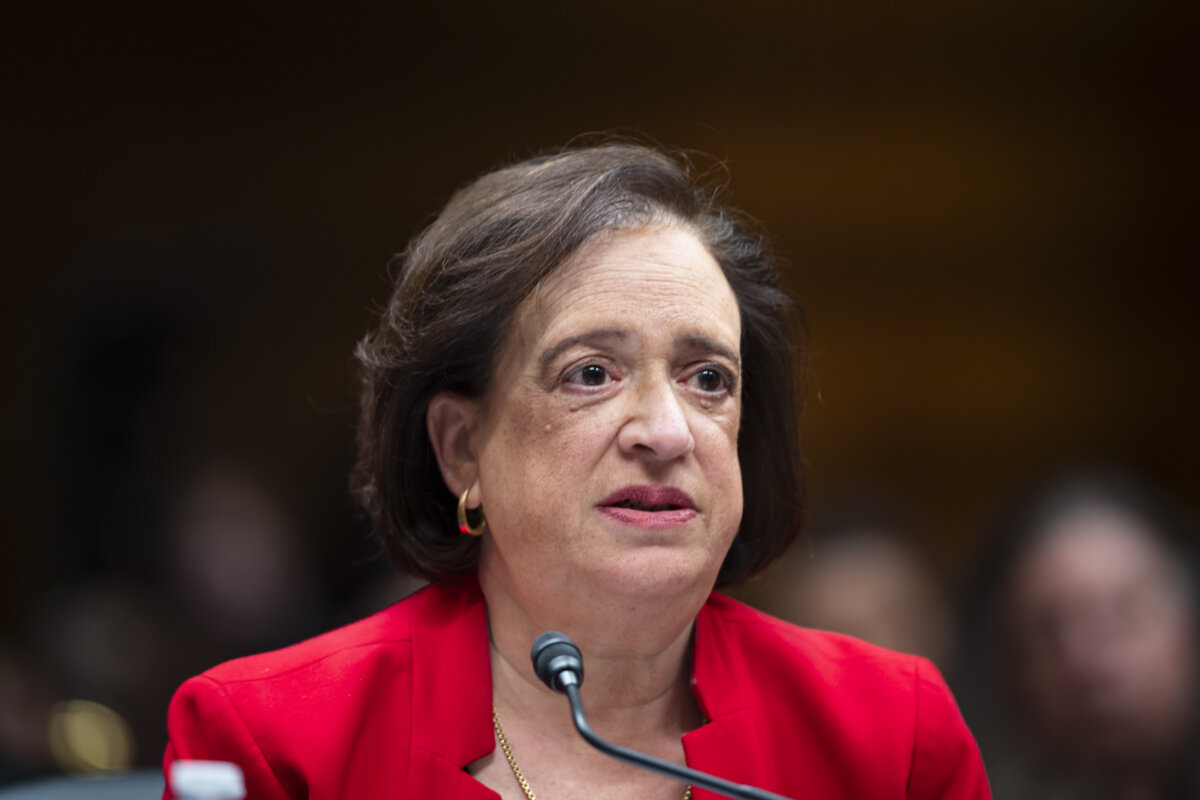

Justice Elena Kagan said during a talk on Oct. 20 that justices in the Supreme Court’s majority often do not take into account how their decisions will impact the real world.
All of the justices appointed by conservative presidents ruled in April that states cannot use race when drawing boundaries for electoral districts. Courts had previously held that the Voting Rights Act lets states take race into account.
The same justices—Justices Samuel Alito, Amy Coney Barrett, Neil Gorsuch, Brett Kavanaugh, John Roberts, and Clarence Thomas—in June struck down federal limits that had restricted political parties from coordinating spending with candidates.
“I think part of the reason why the court got it wrong was a lack of the appropriate concern or understanding of the consequences of their decisions,” Kagan said during a Tuesday talk to students at Catholic University’s law school after referencing those two decisions.
“I do think in all these areas the court has blinded itself to the very deleterious effects of their rulings on how the political system works and has created a democracy that doesn’t work as well as it should.”
Other justices have not addressed the April decision during their rare public appearances.
Alito, who wrote the ruling for the majority, did say during a 2022 appearance at Catholic University that he was aware judicial decisions impacted people.
“It’s important to keep in mind that these decisions are not abstract discussions—they have real impact on the world,” he said at the time.
Several states, such as Texas and California, had already started or finished redrawing congressional maps before the April ruling, but others took advantage of the decision to begin or adjust redistricting, including Florida and Tennessee.
“Both political parties have been engaged in a race to the bottom in terms of doing these partisan gerrymanders, effectively depriving masses of citizens of their rights to voting equality,” Kagan said during the talk.
She said that partisan gerrymandering was driving political candidates toward the extreme, due to concerns about winning primary races.
“It is making what I think is unfortunately a too polarized country even more so,” Kagan said. “In this election, and the next election, we are seeing large states with substantial numbers of people who vote for Republicans and who vote for Democrats, and the states are going to be tried to turn all red or all blue in a way that I think is very destructive to our democracy.”
Kagan is one of the three justices who were appointed by Democratic presidents. She was picked in 2010 by then-President Barack Obama.
In her previous public appearance, over the summer, she said that the Supreme Court is “very conservative” but that it was not acting as a rubber stamp for President Donald Trump. Kagan, at the time, pointed to how the court ruled against Trump’s tariffs.
“Tariffs is probably the key policy issue for this president—I mean something he campaigned on, he ran on, he cared an enormous amount about,” Kagan told lawyers and judges during a conference in Washington state. “I don’t think there are all that many decisions in recent times where a court strikes down such an important policy to a sitting president.”
Reuters contributed to this report.







