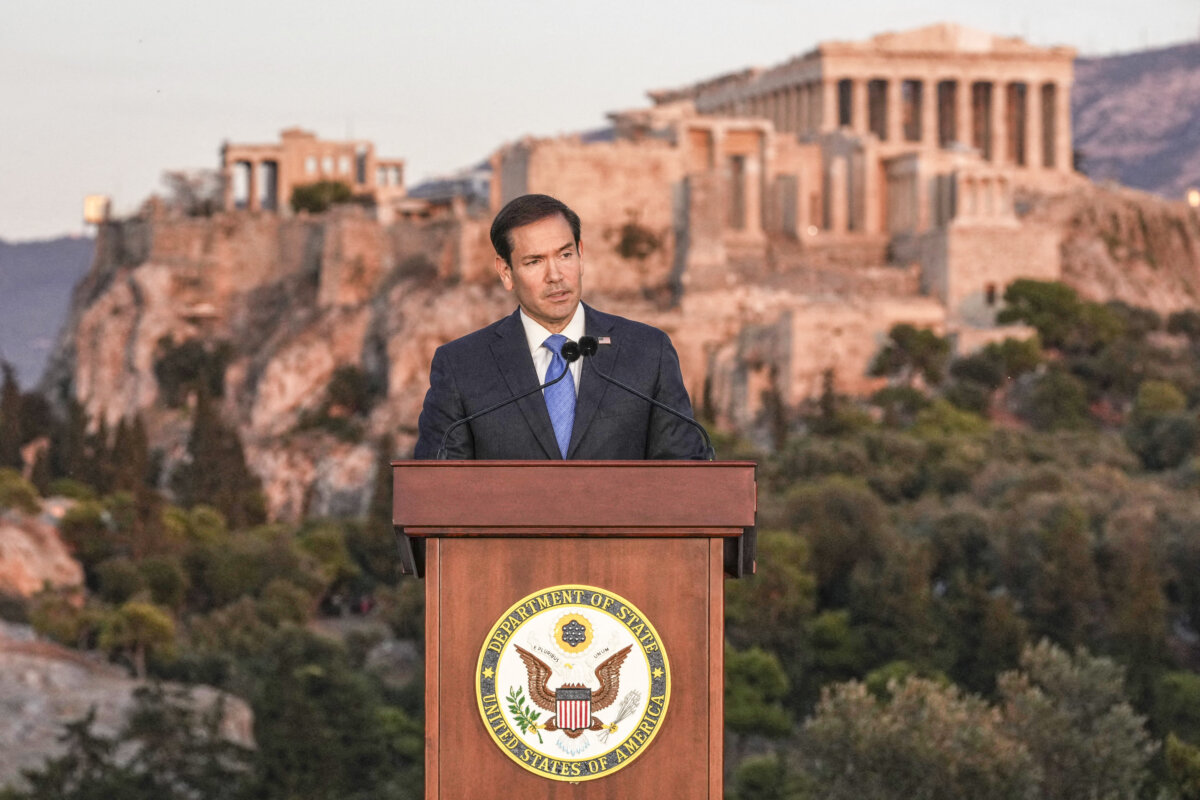

U.S. Secretary of State Marco Rubio delivered a speech in Athens, Greece, on Oct. 7, warning that Western nations are surrendering their sovereignty and neglecting the values that built their civilization.
He emphasized that the United States and Europe are at a critical crossroads.
“The course we take will determine whether the West maintains its place at the head of the world, or resigns itself to a future of atrophy, and servitude, and decline,” he warned.
Rubio delivered his remarks from the Pnyx in Athens, an elevated hillside facing the Acropolis. The site had served as the meeting place of the ancient Athenian democratic assembly and today symbolizes the birthplace of democracy.
Continuing a theme from his address in Munich earlier this year, which sent ripples throughout the West for its criticism of Europe’s “managed decline,” Rubio criticized what he characterized as a trend among Western leadership of guilt for Western prosperity.
“Over time, we in the West came to feel ashamed of the very things that made us exceptional,” he said. “We felt embarrassed that our achievements set us apart from the rest of the world. Our prosperity somehow became a source of guilt.”
Throughout his remarks, Rubio drew heavily on the legacy of ancient Greece, describing it as the foundation of Western civilization. He argued that many Western nations have lost touch with the qualities of their ancient roots.
“We no longer believed we deserved and had earned our greatness. The word ‘nationalism’ became a dirty word, and so we tore down our monuments,” Rubio said.
“We condemned our own history, and in too many places, we taught our children to be ashamed of the countries they would inherit. In the process, we opened our borders and outsourced our industry and allowed our militaries to wither and to decay.”
Rubio argued that Western countries have slowly handed over their governance to outside “global bureaucracies.”
He said this led to weakness and a power gap that adversaries exploited, boosting their economic and geopolitical strength as Western influence faded.
He then praised U.S. President Donald Trump’s “America First” policies, noting that the United States is taking decisive steps to strengthen national power by securing critical supply chains, rebuilding the industrial base and national defense, and boosting energy production.
Rubio said the Trump administration “hopes to reclaim” the classical ideas of politics and statecraft from ancient Greece. He said that this effort is meant “not just for [the United States], but for the whole of … civilization.”
He urged Europe to awaken from its “long slumber.”
“I think here too we have much to learn from the men of ancient Greece,” he said, “because they knew that there was nothing selfish or wrong about loyalty to your nation, nor anything selfish or wrong about fighting to defend its interests above all else.
“It is from the Greeks that the West inherited its sense of duty, an unbreakable loyalty to one’s code, one’s cause, one’s country.”
He also emphasized that the transatlantic relationship should not be viewed as a “zero-sum” game, in which one side gains only at the other’s expense.
Trump administration officials have repeatedly raised this issue when addressing defense burden-sharing.
Rubio praised the recent agreement among the United States, Greenland, and Denmark to enhance the island’s defense.
“All three partners in that deal emerged victorious,” he said.
Before concluding his speech, Rubio warned about emerging global power competition, without naming any countries.
“There is vulnerability, aggression, terrorism, a whole universe of new threats and attacks again,” he said, “and so we must rebuild our institutions and our alliances to face these threats together.”
Correction: A previous version of this article misstated the year of U.S. Secretary of State Marco Rubio’s address at the Munich Security Conference on Feb. 14, 2026. The Epoch Times regrets the error.