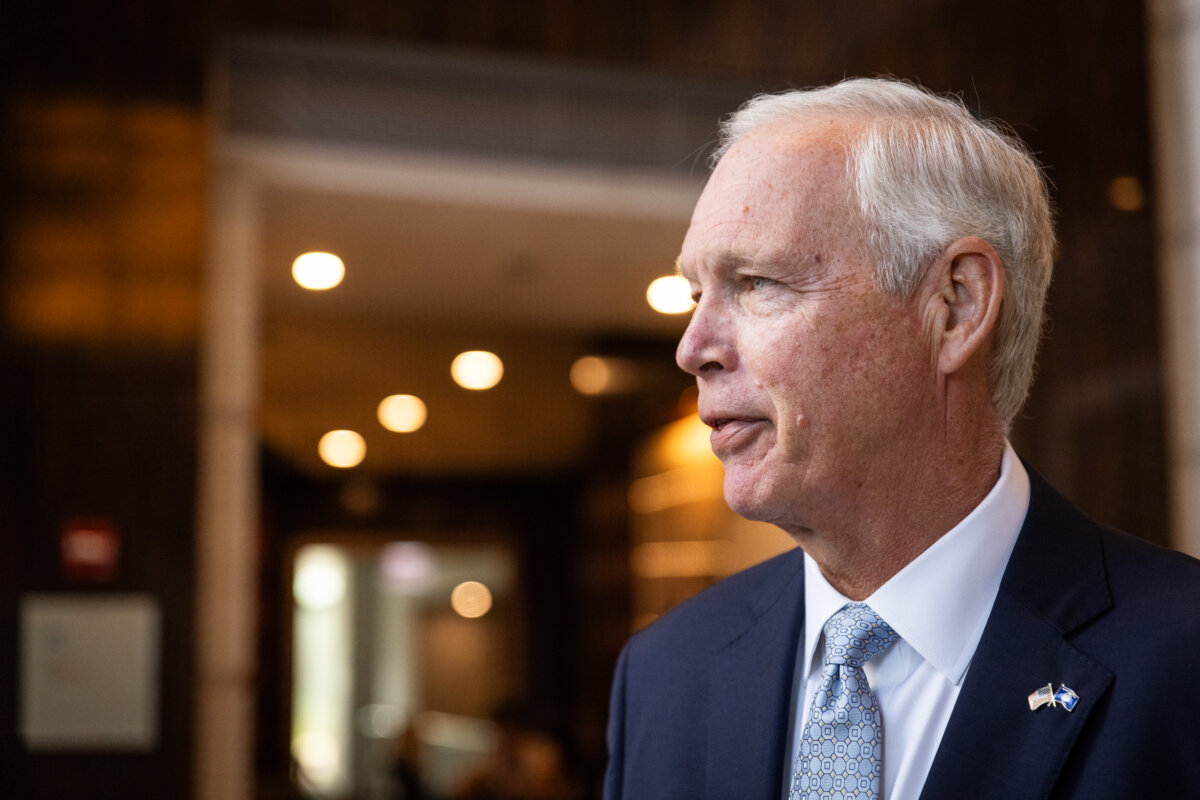

Sen. Ron Johnson (R-Wis.) says he’s investigating recent rejections of drug applications by the Food and Drug Administration (FDA).
Johnson told reporters in Washington on March 10 that he’s learned the FDA allegedly has a blacklist of companies that “make too much noise” and that rejections of drug applications have sometimes acknowledged not reviewing information submitted by applicants.
Johnson also said that he spoke with Dr. Marty Makary, the FDA’s commissioner, about the issue.
“He’s saying all the right things, but his agency continues to say no, and he seemed to be quite proud of the fact that he has not overruled his career researchers,” Johnson said. “And I suggested to him, Well, he’d better start.”
Andrew Nixon, a spokesperson for the Department of Health and Human Services, the FDA’s parent agency, told The Epoch Times in an email on Wednesday that “the FDA stands by the scientists evaluating these applications.” He noted that the FDA outlines its rationale in letters to companies that are also being published by the agency.
The briefing was held alongside several families that have been using drugs that the FDA recently turned down.
Cheri Gunvalson told reporters that her son Jacob, 34, has been using a drug called ataluren for Duchenne muscular dystrophy, a disease that causes muscle degeneration, for almost 20 years.
PTC Therapeutics said in February it was withdrawing its application for approval of ataluren, after the FDA informed the company it would likely not approve the drug.
“This drug has enabled him to graduate from college, become a social worker, work for the governor of Minnesota, work as a high school social worker,” Gunvalson said.
The development means Jacob will be losing access to ataluren, because he had been receiving it through clinical trials, according to his mother.
“There’s no question this drug works,” she added later. “Without it, Jacob will decline and die.”
Makary and other top officials have in recent months loosened certain barriers to approval, but rejections for ataluren, a therapy for Huntington’s disease from uniQure, and some other drugs prompted Johnson’s announcement.
As chairman of the Senate Homeland Security and Governmental Affairs Committee’s Permanent Subcommittee on Investigations, Johnson has subpoena power.
Johnson said he’s going to obtain rejection letters sent to the companies and find out what issues the FDA cited in the rejections. He said that one letter he saw admitted that FDA personnel did not look at much of the information submitted by the applicant.
“They just said no. So I can’t explain it,” Johnson said. “I’m going to learn a whole lot more about it over the next couple months. And then, once we get these complete response letters, then I will start inquiries into the FDA, ‘explain yourself,’ and hopefully they’ll cooperate. Hopefully explain yourselves. Hopefully they will reverse some of these decisions.”
Makary said in a television appearance on Feb. 26 that regulators were evaluating whether drugs work and rejected drugs that showed no efficacy in testing.
“The process is pretty simple: If your drug works, it’s going to get approved by the FDA,” he said at the time.
Nixon, the spokesperson for the health department, said that the numbers of FDA approvals and rejections during the Trump administration are consistent with previous years, and that the department’s obligation is to approve safe, effective treatments for patients.
Johnson said he was not sure whether the recently announced resignation of Dr. Vinay Prasad, the head of the FDA’s Center for Biologics Evaluation and Research, would have an impact. “I don’t know whether he was the problem,” he said.
Johnson also said he has not approached President Donald Trump about the issue yet, preferring to start at the FDA level. And he noted Health Secretary Robert F. Kennedy Jr.’s stated commitment to transparency.
“The problem is, it’s very difficult to control these agencies,” he said.