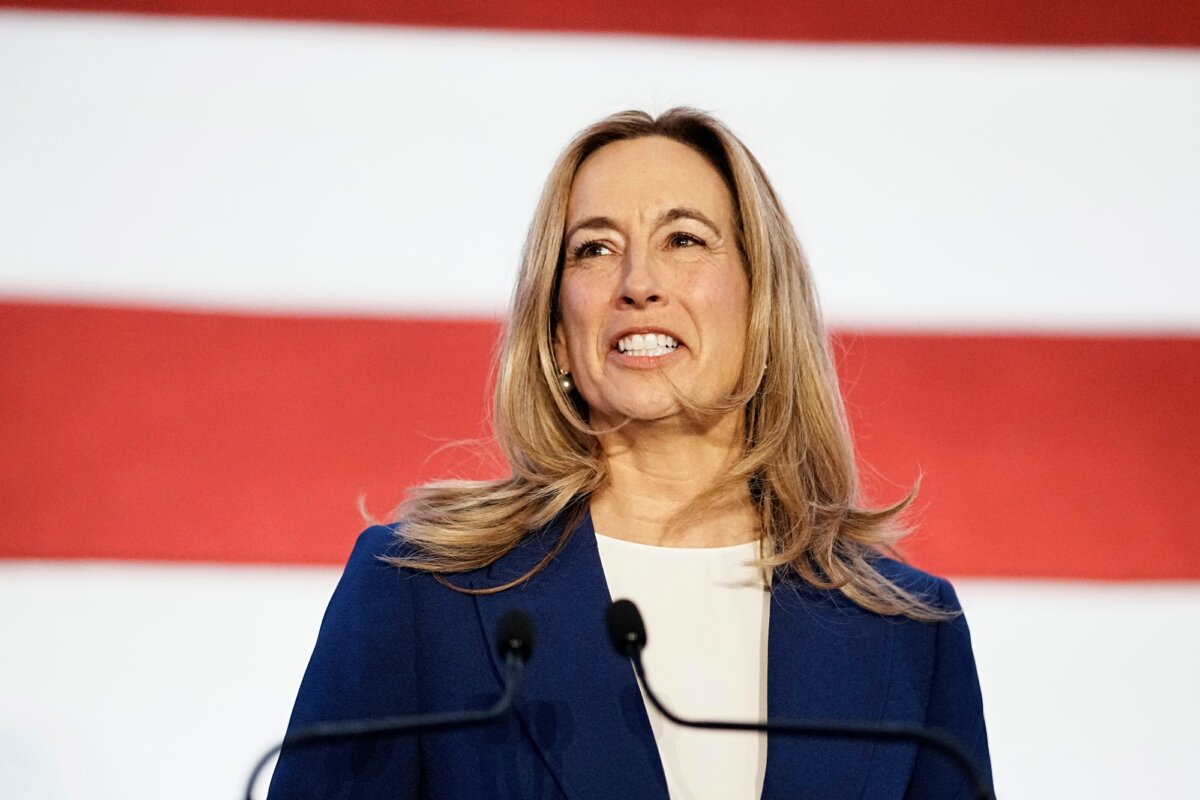

Newly inaugurated New Jersey Gov. Mikie Sherrill spent her first minutes in office signing a pair of executive orders, both aimed at addressing the rapidly rising utility costs in the state.
The first order allows the New Jersey Board of Public Utilities (BPU), which regulates the state’s electric companies, to block utilities from increasing electric bills.
Specifically, the order grants the BPU the authority to “set just and reasonable public utility rates, to investigate any matter concerning any public utility, and to require any public utility to furnish safe, adequate, and proper service.”
The order also directs the agency to provide bill credits to help offset power prices that are expected to rise again this June, though it does not specify the amount. Those credits would be funded in part through a state fee on electricity providers.
Sherrill’s second executive order declares a state of emergency in New Jersey because of its high electricity prices. It directs the BPU to fast-track bids for new solar projects, energy storage, and energy distribution infrastructure, and to submit plans to modernize existing natural gas–fired power plants.
It also instructs the state to require electric utilities to report how much power is being requested by data centers, which have been rapidly multiplying across New Jersey and are widely blamed for helping drive up household utility costs.
The order further establishes a Nuclear Power Task Force to oversee “new advanced nuclear generation” in New Jersey, evaluate financing options, explore opportunities with the federal government, and look for ways to coordinate with other states and jurisdictions on issues such as supply chains.
“I hope, New Jersey, you’ll remember me when you open your electric bill and it hasn’t gone up by 20 percent,” Sherrill said in her inauguration speech.
Sherrill, a Democrat, won last year’s gubernatorial election by 14 points over Republican Jack Ciattarelli, who had hoped to ride President Donald Trump’s momentum a year after Trump delivered the strongest performance of any Republican presidential candidate in New Jersey in 30 years.
On the campaign trail, Sherrill made utility prices a centerpiece of her platform, as energy costs have surged in recent years in part due to the boom in data centers that the Big Tech companies are building to train artificial intelligence systems.
According to online marketplace Datacenters.com, more than 100 data centers now operate across the state. They are mostly concentrated in Secaucus, Newark, and Piscataway because of strong network infrastructure and connectivity to major Northeastern markets.
New Jersey’s electricity transmission system is part of the larger network managed by PJM Interconnection, the nation’s largest power grid operator. On Jan. 16, the Trump administration and a bipartisan group of governors, including Sherrill’s predecessor, Phil Murphy, asked PJM to hold a one-time “emergency” auction to provide data centers with new sources of power.
Under the proposal, data center owners would bid on 15-year power purchase agreements. PJM’s most recent auction, held in December for the 2027–2028 delivery year beginning June 1, 2027, hit a record price of $333.44 per megawatt-day. Prices set in such auctions typically flow directly into customer bills and help determine whether power plants are built or stay online.
The emergency auction could support as much as $15 billion in new power plants, according to the U.S. Department of Energy. Data centers would be required to pay for the new generation built for them, whether they use the power or not, the department said.
It remains unclear how Trump’s proposed auction would affect Sherrill’s plans. The Epoch Times has reached out to Sherrill’s office for comment.