
A semi-truck originating in Mexico was caught carrying more than 380 pounds (more than 170 kilograms) of cocaine earlier this month, according to Florida Lt. Gov. Jay Collins.
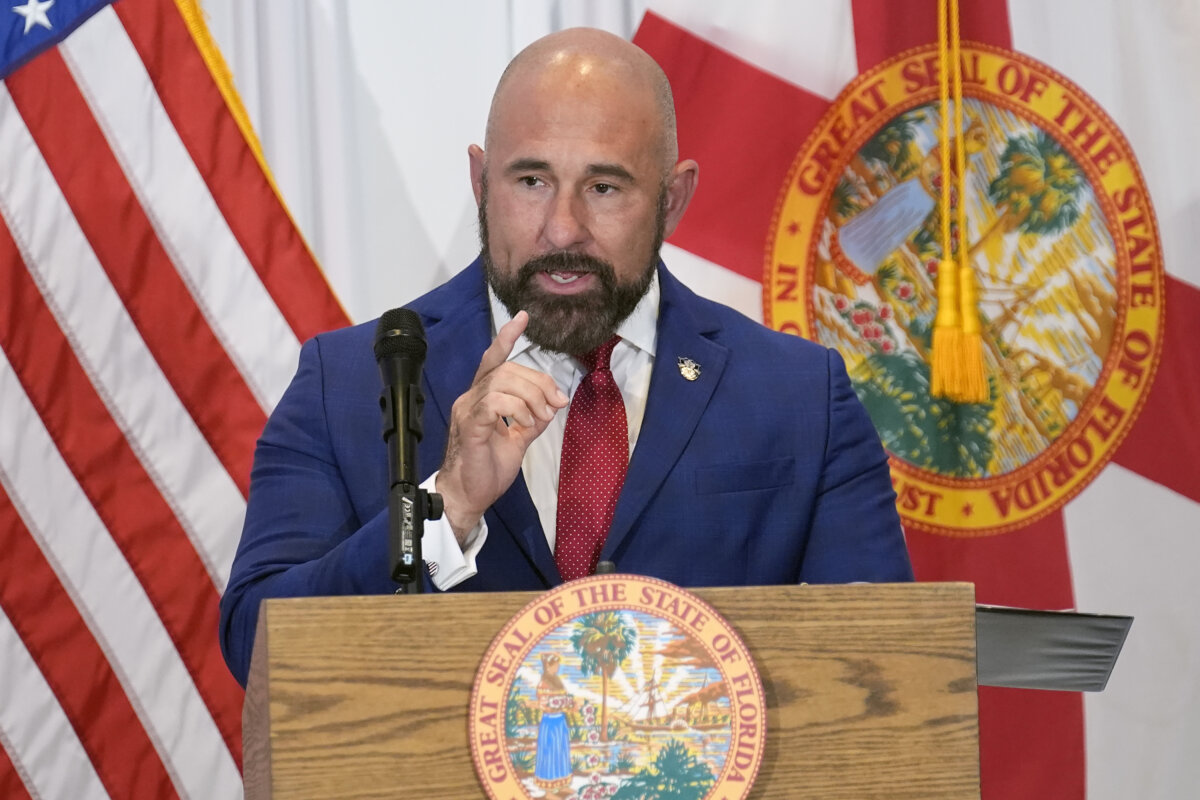
At a press conference on Oct. 15, Collins explained that the truck was stopped on Oct. 5 by the Florida Highway Patrol, who had been told by the Drug Enforcement Administration’s (DEA) West Palm Beach office that it had crossed the Mexico–Texas border and was suspected of transporting narcotics to South Florida. It was found by the highway patrol’s Criminal Interdiction Unit traveling south on the Florida Turnpike, and 146 bricks of the illegal drug were discovered hidden under a trap door during a lawful traffic stop for inspection.
An investigation is ongoing, and no further details about the stop were disclosed during the press conference.
Those bricks were stacked on two tables placed on either side of the lieutenant governor’s podium. The street value of the 381.4 pounds (173 kg) of the drug was estimated to be $14.7 million.
This was only the latest example of Florida’s ongoing statewide crackdown on illegal drugs since Florida Gov. Ron DeSantis took office.
Collins said that since 2019, the Florida Highway Patrol has recovered more than 30,864 pounds (14,000 kg) of illegal narcotics, which includes 2,039 pounds (925 kg) of cocaine, 21,164 pounds (9,600 kg) of marijuana, 51.8 pounds (23.5 kg) of fentanyl, nearly 31 pounds (14 kg) of heroin, and nearly 42 pounds (19 kg) of MDMA, also known as ecstasy.
“Florida will continue to lead with decisive action, unwavering enforcement, and strategic partnerships to dismantle the [drug] traffic and operations under Governor DeSantis,” he said. “We remain committed to protecting our communities and ensuring the criminal enterprises have no safe haven in this state.”
Collins said this was an example not just of Florida’s capabilities, but of what can be accomplished when a range of law enforcement agencies work together to tackle drug trafficking.
“This is what happens when our local, state, and federal assets work together,” he said. “Teamwork makes a dream work. All the best things we learned in kindergarten, right?
“It’s amazing what happens in our nation and in our state when the federal government and the state government are aligned on principles, on values, and on action.”
Collins was joined by Dave Kerner, the executive director of the Florida Department of Highway Safety and Motor Vehicles, who oversees the Florida Highway Patrol. Kerner expressed his gratitude to the federal partners in the DEA and the FBI for working with the highway patrol on this case, as well as to the local law enforcement assistance from Palm Beach County.
Kerner also celebrated the “whole-of-government approach” to stopping crime.
“When the President’s [law] enforcement priorities are aligned with the governor’s priorities in enforcement, as we have here, between Governor DeSantis and President [Donald] Trump, those are the people’s priorities,” he said. “That is public safety … where things like this can get stopped in their tracks and bad people can go to jail.”
Kerner also said he saw the drug traffickers’ failed utilization of a semi-truck as an example of how they are now required to adapt their smuggling operations due to the closed southern border, and a means by which law enforcement can track the shipments back to their original sources.
“With the southern border shut down, transnational narco cartels can no longer simply walk across the border with guns, drugs, and human couriers,” he said in a statement.
“This forces cartels to attempt to move large amounts of narcotics in a way that allows the full weight of law enforcement efforts to not just interdict, but to investigate the supply chain back to their point of origin.”