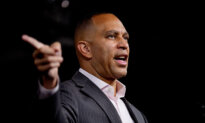
House Minority Leader Hakeem Jeffries on Thursday said Democrats have already started to embrace generational change, pointing to leadership transitions and more recent retirements as evidence. He said the shift was concrete, not hypothetical, and that further renewal is up to voters.
“It’s not hypothetical that they embraced generational change,” Jeffries said during a Capitol press conference on Sept. 4, referencing former House Speaker Nancy Pelosi, Majority Leader Steny Hoyer, and Whip James Clyburn stepping aside in 2022. “They all decided not to seek reelection to their leadership positions voluntarily, and were very explicit that they were going to open the door for a new generation of Democrats to lead the caucus moving forward. That happened. It’s not hypothetical. No one’s making that up. That’s what’s called embracing generational change.”
Those transitions, Jeffries said, had unanimous backing across the caucus. He pointed to subsequent committee leadership contests—natural resources, judiciary, agriculture, oversight—as clear signs younger lawmakers are now leading panels.
The party’s last standard bearer—President Joe Biden—was 82 when his term ended in January. Biden faced criticism and questions around his age throughout his presidency, as he was the oldest president in history—though President Donald Trump will also be 82 years old when his second term is over in January 2029.
Jeffries, 55, took over in 2022 after Pelosi, 85, stepped down. He also pushed back on activist criticism that internal shifts aren’t enough without broader turnover. He said voters—not caucus insiders—should drive change.
“That’s an individual decision that should be made by voters in these congressional districts all across the country,” he said.
He cited recent resignations as signs of voluntary renewal.
“It’s not hypothetical,” he said again.
Rep. Jerry Nadler (D-N.Y.) announced this week he won’t run for reelection in 2026, citing a need for generational change. In Illinois, Rep. Danny Davis (D-Ill.) also said in July he won’t seek another term, after already serving 15 terms.
In recent years, Davis had faced competitive primary challenges, with questions raised about his age and whether he remained the best fit for the district. Throughout the challenges, he consistently emphasized the value of his experience rather than his age.
“I’m not running to be the quarterback for the [Chicago] Bears. I’m not running to carry the torch in the Olympics,” he said in 2024. “I’m running to use my knowledges, my expertise, my intellect.”
Jeffries also noted the wave of younger Democratic challengers across the country as further refreshing party dynamics. Progressive groups and young candidates are launching more primary campaigns, arguing the party needs new voices and a rebrand.
One of those groups is Leaders We Deserve—a grassroots organization by Gen Z activist and former DNC Vice Chair David Hogg—who left his position with the party after he floated plans to oust incumbent Democrats.
“Young Progressive candidates face systemic barriers,” Leaders We Deserve says on its website. “At every level of government, the average politician is older than the average American. Our political system is stacked against young people—in favor of those who are older, wealthier, and white. In 2020, millennial and Gen-Z individuals only held 21 percent of state legislative seats despite representing 45 percent of the electorate.”
Jeffries framed senior members like Rep. John Larson (D-Conn.) not as obstacles but as respected lawmakers facing electoral scrutiny by design.
“House Democrats and every single member of this great institution, we’re on a two-year employment contract,” he said. “We have to constantly go back to the voters to have that contract renewed, based on whether we are doing a good job or not.”
He said that the institution—the House—was constructed for frequent turnover and accountability. Renewal, he said, happens through elections.
“That’s an individual decision … made by voters,” he said.
He gave credit for the leadership transition and ongoing renewal to previous Democratic leaders.
“We can thank Nancy Pelosi and Steny Hoyer and Jim Clyburn for that in 2022,” he said.
“That has continued as we’ve seen races for committee leadership positions.
“Our caucus led on generational change. [series_posts_list][/series_posts_list]And we will continue to facilitate the next generation of leaders.”