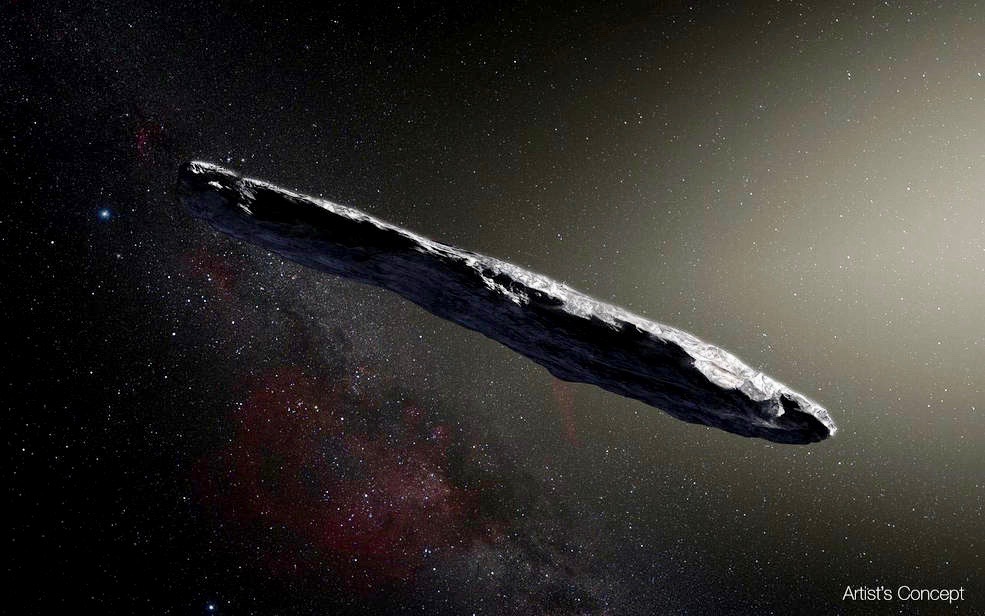

Harvard University Astronomy Department chair Avi Loeb has defended his hypothesis that a strange object—the Oumuamua—found in the solar system might be an alien probe.
“As soon as we leave the solar system, I believe we will see a great deal of traffic out there,” Loeb told Israeli newspaper Haaretz.
“Possibly we’ll get a message that says, ‘Welcome to the interstellar club.’ Or we’ll discover multiple dead civilizations—that is, we’ll find their remains.”
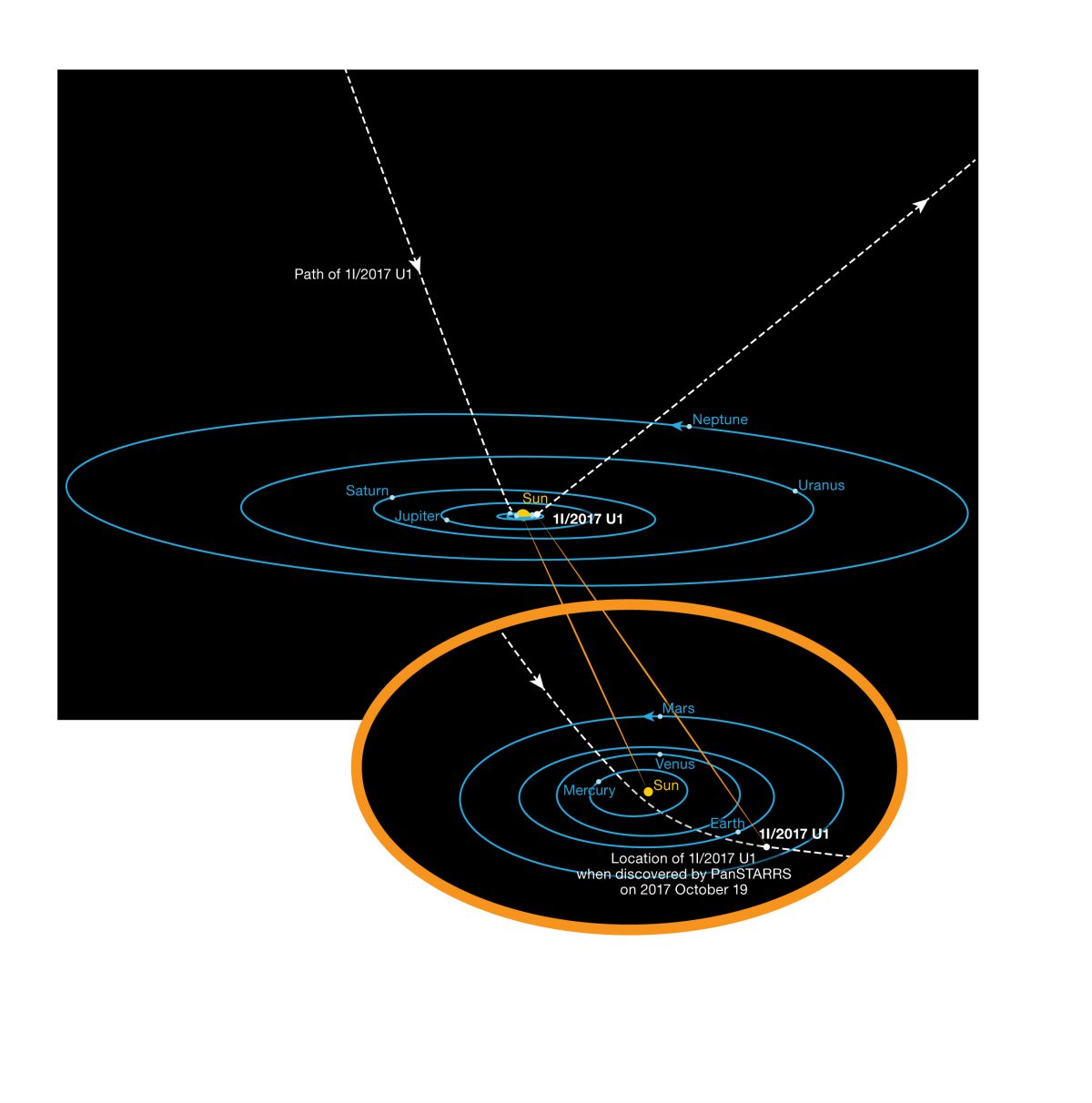 This diagram shows the orbit of the interstellar asteroid ‘Oumuamua as it passes through the Solar System. Unlike all other asteroids and comets observed before, this body is not bound by gravity to the Sun. (ESO/K. Meech et al)
Loeb, 56, and fellow researcher Shmuel Bialy published a paper a few weeks ago speculation that the object isn’t a comet or asteroid.
Due to its strange trajectory, it might be an artificial light sail.
According to the report, the Search for Extraterrestrial Intelligence checked to see if the object emitted any radio messages or frequencies. However, none were found.
Loeb said he isn’t discouraged by the finding.
“I don’t care what people say,” he told the newspaper.
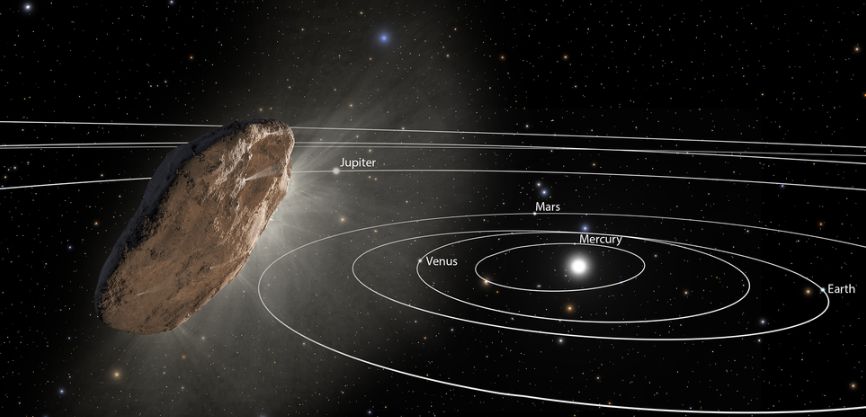 This illustration shows ‘Oumuamua racing toward the outskirts of our solar system. As the complex rotation of the object makes it difficult to determine the exact shape, there are many models of what it could look like. (NASA/ESA/STScl)
“I say what I think, and if the broad public takes an interest in what I say, that’s a welcome result as far as I’m concerned, but an indirect result. Science isn’t like politics: It is not based on popularity polls.”
He elaborated further on his hypothesis, which will likely draw more controversy in the astronomy community.
“We have no way of knowing whether it’s active technology, or a spaceship that is no longer operative and is continuing to float in space,” the newspaper quoted him as saying. “But if Oumuamua was created together with a whole population of similar objects that were launched randomly, the fact that we discovered it means that its creators launched a quadrillion probes like it to every star in the Milky Way.”
Loeb said he thinks the universe is littered with alien debris.
The Head of Astronomy at Harvard asserting that Oumuamua was a non-human solar sail. Great read that reflects on both (1) the lack of academic freedom with which most scientists work (2) further evidence that we haven't passed the Great Filter yet https://t.co/z3NdIJHVtA
— Saam Motamedi (@saammotamedi) January 12, 2019
“Our approach should be an archaeological one,” he added. “In the same way we dig in the ground to find cultures that no longer exist, we must dig in space in order to discover civilizations that existed outside the planet Earth.”
In November, the physicist and astronomer who discovered the Oumuamua, the first interstellar object ever discovered in the solar system, said a theory that the object is “a lightsail of artificial origin” is wild speculation.
A study from the Harvard Smithsonian Center for Astrophysics released this month suggested the 1,300-foot-long object might be a “lightsail.”
1st Interstellar Visitor 'Oumuamua Is Actually Not That Special https://t.co/2q9iVCN5vi pic.twitter.com/WAH8Bw56b7
— #TechNews (@reviewpunk) January 16, 2019
“There’s a maximum speed that you can be traveling to be bound gravitationally by the sun,” astronomer Robert Weryk told the CBC.
“When we first saw this object, it was traveling faster than that, so we know for a fact that it’s from outside our solar system. We decided that it was a comet that had a bit of outgassing that wasn’t visible from the ground, which is why it didn’t appear to be a comet.”