Commentary
Joshua Wong was sentenced on Nov. 5 to another 10 years in prison in Hong Kong. The sentence is devastating, not only for Wong and his family, but also for everyone who still believes in freedom, justice, and the promises once made under the principle of “one country, two systems.”
At 8:30 a.m. Hong Kong time, one hour before the sentencing hearing began, I organized an online global prayer meeting to pray for Wong, his family, and all political prisoners in Hong Kong. At 9:30 a.m., the hearing began. The judge spent more than an hour explaining the reasons for the severe sentence.
I followed the proceedings with a heavy heart. Another 10 years is an extraordinarily long time, especially for a young man who is only 30. Wong had expected to be released in January 2027.
I Have Known Wong Since He Was Young
I have watched his journey from being a student activist to becoming one of the most recognizable faces of Hong Kong’s pro-democracy movement.
This is about more than one individual. It is about what kind of society Hong Kong has become, what remains of the promises made to its people, and whether the international community is prepared to stand up when fundamental freedoms are taken away.
Over the years, Wong spoke to the international media, met foreign politicians, and sought support for Hong Kong’s freedoms.
People may disagree with some of his political positions or the tactics the broader movement adopted. But surely a society should be able to accommodate young people with different political views who want their voices heard.
Wong is not merely a political name in the headlines. He is a human being, a son, and a young man whose adult life has been shaped by imprisonment and political prosecution. I cannot look at this sentence as just another legal development. I see his future being taken away, year after year.
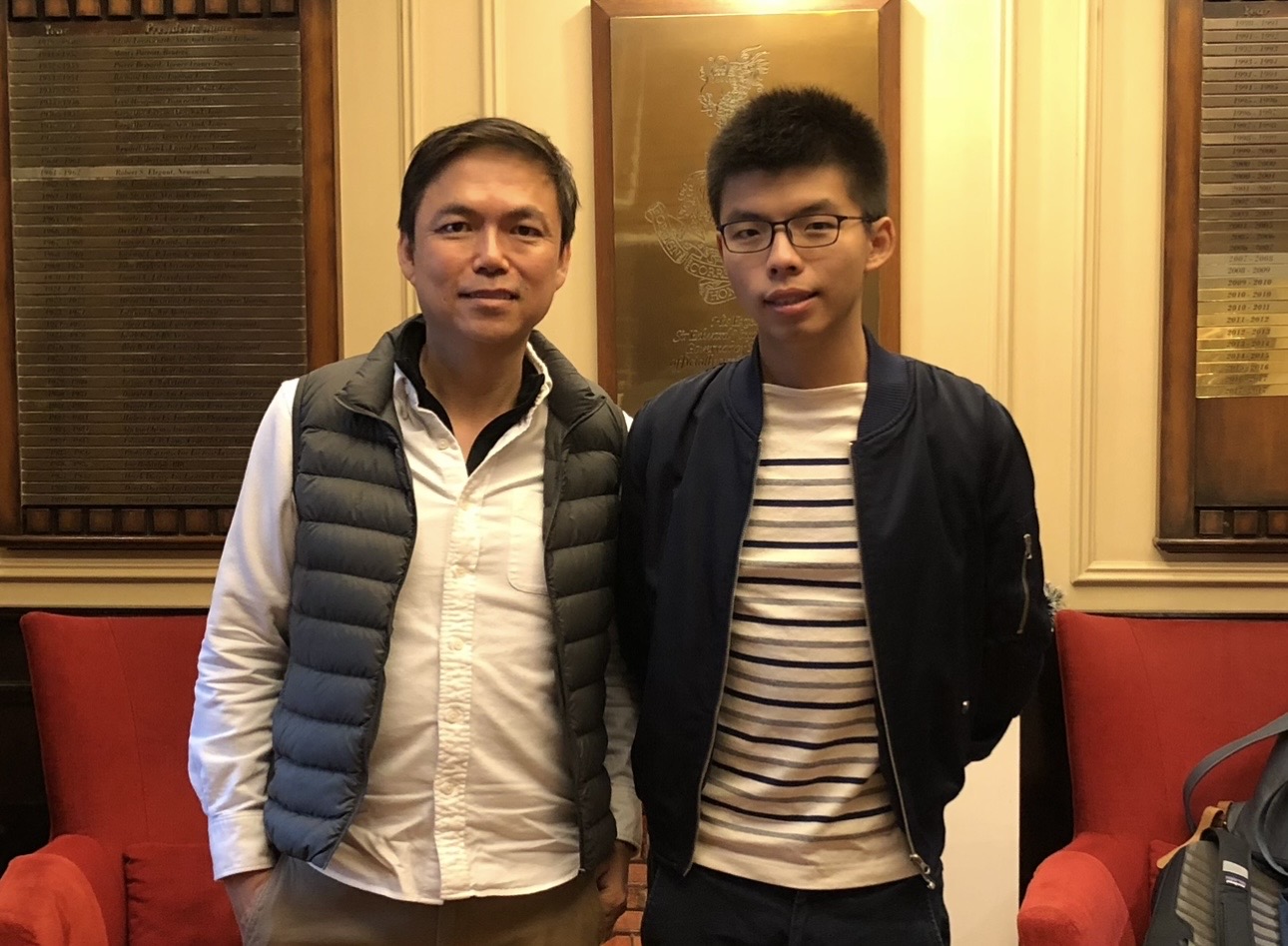 Edward Chin (L) and Joshua Wong at the Foreign Correspondents’ Club Hong Kong in Hong Kong on Dec. 13, 2017. (Courtesy of Edward Chin)
Punishing Young People Is Not the Way to Build Trust
I do not believe that punishing young people for expressing their aspirations builds a stable or trusting society.
What did Hong Kong’s younger generation want? Many grew up believing that “one country, two systems” meant that Hong Kong would retain a meaningful degree of autonomy, its freedoms, an independent legal system, a vibrant civil society, and its distinct way of life.
They wanted these promises to mean something in practice. They wanted to express their opinions, participate in public affairs, and have a say in their city’s future. These were not unreasonable aspirations. They were closely connected to the freedoms and institutions that Hong Kong had been promised.
If young people raise concerns about their future, should the response be to imprison them for years?
If they believe that their freedoms are being eroded, should their voices simply be treated as threats?
A political system that has confidence in itself should allow disagreement. It should be able to listen to criticism, accommodate different opinions, and address grievances through dialogue and meaningful reform.
Punishment may create silence, but silence is not genuine stability. Fear is not trust. If “one country, two systems” is to retain any real meaning, Hong Kong must allow differences, protect freedom of expression, and let its people hold their government accountable.
A generation should not have to choose between remaining silent and sacrificing its future.
10 Years Is a Very Long Time for a Young Man
Wong is still at the beginning of his adult life. Another 10 years in prison would take him close to 40. Think about what those 10 years mean.
Most people spend those years building careers, establishing relationships, starting families, traveling, pursuing personal interests, and contributing to society. They are years that cannot simply be recovered once a prison sentence ends.
Wong has already spent years behind bars. He could have started planning for a new chapter of his life.
His family will also bear the consequences. They will continue to live with separation, uncertainty, and the emotional burden of knowing that someone they love is spending his best years in prison. This is why I find the sentence so difficult to comprehend. Ten years is not just a number on a court document—it represents a substantial part of a human life.
A justice system should never become an instrument for destroying someone’s future because of his political convictions.
Will Wong Become Another Panchen Lama?
Another thought has troubled me deeply. Two months ago, when I shared my reflections in my article “From the Panchen Lama to Joshua Wong: How the CCP Silences a Generation,” I raised this concern: Could Wong become another symbol of a generation silenced and erased by the Chinese Communist Party (CCP)?
In that article, I wrote about Gedhun Choekyi Nyima. He was only 6 years old when Chinese authorities took him and his family away on May 17, 1995, just three days after the Dalai Lama recognized him as the 11th Panchen Lama.
More than 30 years later, the outside world still does not know where he is or what happened to him.
 Tibetan Buddhist members of the Tibetan Women Association hold posters as they take part in a silent march on April 29, 2019. Tibetans living in exile in the northeastern areas of India organized a peaceful march on April 25 on the occasion of the 30th birthday celebration of the 11th Panchen Lama, who disappeared into Chinese custody in 1995. (Dipendu Dutta/AFP via Getty Images)
By the time he regains his freedom, the world may have moved on, a new generation may have grown up, and the Hong Kong he once knew may have changed beyond recognition.
What happens when a government uses its power to remove individuals who represent an alternative voice, identity, or vision for the future?
Imprisonment does not simply take away physical freedom. It can also separate people from their generation, community, opportunities, and ability to shape society.
The CCP may control the prisons, the police, and much of the information available within its territory. But it should not be allowed to control what the rest of the world remembers.
We must not allow Wong to become a forgotten name. Nor should we forget the Panchen Lama, Jimmy Lai, Chow Hang-tung, and the many others whose freedom has been taken away.
Silence Is Not an Option
The international community must not respond with statements of concern that are quickly forgotten. Nor should governments let commercial interests, diplomatic convenience, or economic dependence on China take precedence over fundamental human rights.
The international community must defend the commitments made under the Sino-British Joint Declaration.
The Joint Declaration was an international treaty registered with the United Nations. “One country, two systems” was not merely a political slogan. It was part of the framework under which Hong Kong’s future was promised to its people.
The UK government, in particular, has an ongoing responsibility to monitor the agreement’s implementation and hold Beijing accountable for its commitments. Other signatories and international partners should not treat the erosion of Hong Kong’s freedoms as something they can simply ignore.
Political Prisoners Must Not Become Bargaining Chips in Diplomacy
When democratic leaders meet Chinese officials, they should raise the cases of Wong, Lai, and other political prisoners. Their freedom should not be quietly traded away for better trade relations, investment opportunities, or short-term diplomatic gains.
Most importantly, governments and global organizations should keep these cases visible. Public attention matters. Authoritarian governments benefit when the world becomes distracted, and political prisoners gradually disappear from international headlines.
We Must Not Allow a Generation to Be Erased
I return to the question I raised in September: How does the CCP silence a generation?
It can imprison activists. It can restrict the media. It can close down civil society organizations. It can make public discussion of certain events increasingly difficult. It can also create an environment in which people are afraid to speak.
Wong, Lai, the Panchen Lama, and other political prisoners must not become forgotten names. Their stories must continue to be told, their cases must continue to be raised, and their families must know that they have not been abandoned.
I also believe that people of faith have a responsibility here. That is why, before Wong’s sentencing on Nov. 5, I brought people together from different parts of the world for an online prayer meeting. We prayed for him, his family, all political prisoners, and the people of Hong Kong.
We must continue to speak up, even when those behind prison walls can no longer speak for themselves. A regime may imprison individuals and try to erase their stories, but it cannot extinguish the truth, the hope for freedom, or future generations’ determination to remember.
Views expressed in this article are the opinions of the author and do not necessarily reflect the views of The Epoch Times.