
Commentary
The economic and social consequences of the West’s drop in fertility rates have taken an unexpected and somewhat perplexing turn.
In the United States, the total fertility rate has fallen well below the replacement level of 2.1 needed to sustain the population without immigration, reaching a historic low near 1.6 children per woman in 2024–2025. Against that backdrop, the 2017 bankruptcy of Toys “R” Us was predictable. So, too, was this month’s Chapter 11 filing by The Children’s Place, a clothing chain of about 500 stores in the United States and Canada that is seeking a sale of substantially all its assets.
Not predictable was the toy industry’s recovery—global toy sales reached roughly $123 billion in 2025, up 8 percent that year. Nor was the source of the new demand predictable. The Millennials and Gen Zers who have largely stopped producing the babies the toy industry once counted on have nevertheless come through as consumers. According to Circana, the retail industry’s leading analyst, childless (adult-only) households accounted for 55 percent of U.S. toy sales in the first half of 2026, with sales to those households up 16 percent year-over-year.
The Kidult market—a term coined in the 1950s by the television industry to describe programming and viewers that appealed to both children and adults—is no longer considered a niche. A 2026 Harris Poll found that 65 percent of U.S. adults spent $100 or more on playful products or activities for personal enjoyment in a recent 12-month period, and 13 percent spent $500 or more. Kidults have become a primary engine of recent growth.
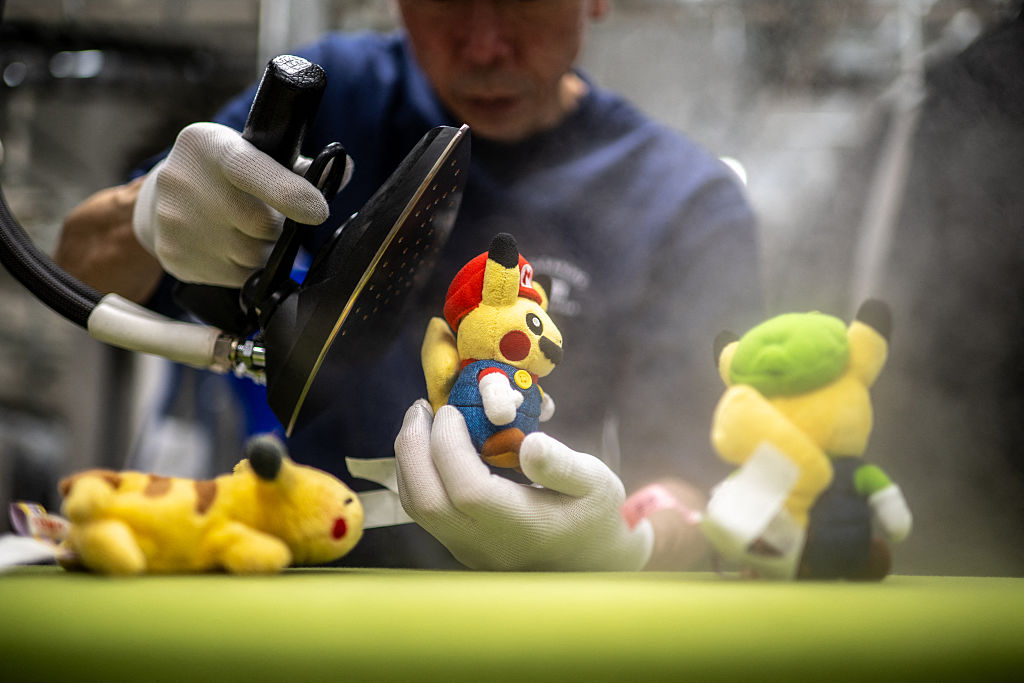
Retail analysts attribute the Kidult demand primarily to nostalgia for childhood experiences as well as the emotional and stress-reducing benefits of tactile play and the growth of licensed fandom products and premium “hobby” toys designed for adults. Top sellers include Lego sets, which double as home decor or display pieces when completed; stuffies, which also work as home decor; and Pokémon, which Millennials and Gen Z grew up with. To the retail industry, play and collecting have become legitimate adult consumer categories.
The Kidult phenomenon has roots in Japan. After the collapse of the asset-price bubble in the early 1990s, the country entered a prolonged period of economic stagnation known as the “lost decades.” Job insecurity rose and traditional career paths weakened, particularly for young adults. Many (especially men in their 20s and 30s) turned more of their time and money toward anime, manga, video games, and character goods. These relatively affordable hobbies offered escapism and community when larger economic ambitions stalled. Delayed marriage, fewer children, and more single-person households left a segment of adults with both free time and residual disposable income for collecting. Toys, figures, and plush items gradually moved from purely children’s products into adult hobby and lifestyle categories—patterns Japan later exported and that the rest of the world now calls “Kidult.”
In Japan today, notes Taiwan-based Toy People News, a leading pop-culture media outlet, “it is perfectly normal to see people carrying plushies on their bags, bringing them along for company, and snapping photos of them at every stop. Some even cherish them like a partner or their ultimate favorite. Known as ‘nuikatsu,’ this plushie-centered fandom has become an everyday sight.”
The trend of adults identifying with childhood objects, which some dub “The Great Regression,” has drawn sharp criticism. In a recent article in Shukan Shincho, an influential weekly, Japanese psychiatrist and best-selling author Tamami Katada described adult attachment to plush toys as “a form of psychological infantilization.”
Drawing on the psychoanalytic concept of transitional objects—items such as blankets or dolls that young children use to manage separation anxiety—she argued that an adult’s strong fixation on such objects can serve as a substitute satisfaction. “At its root is an intense sense of loneliness,” she said. “If someone had a partner or children to travel with, there would be no need to bring a plushie along. Carrying a plushie from place to place provides a substitute form of satisfaction, allowing the person to avoid confronting their loneliness in real life.”
Dr. Katada, author of the 2010 book A Society of 100 Million Kids (subtitled “the disease of refusal to mature”), has long viewed prolonged attachment to childhood objects and aesthetics as a symptom of delayed emotional development.
Other observers are more sanguine. Clay Routledge, a psychologist who has studied nostalgia for more than two decades, sees adult play as a healthy way to manage stress and strengthen a sense of self. He has written that “nostalgic memories are meaningful memories that make you feel that you matter—that I have an important role to play—I have something to offer,” and that “when we engage in nostalgia, we are not moving toward the past. We are bringing the past to the present to help us plan for the future.” Brenda K. Wiederhold, in a 2024 psychology editorial, described adult interest in toys and collectibles as a form of self-care that can support a sense of continuity and healthy fantasy.
Whether the Kidult phenomenon is positive, benign, or concerning, it has arrived. The toy industry has survived the aftermath of major retail bankruptcies and is now thriving on adults returning to childhood play. Whether society as a whole can thrive under a regime of low fertility and high levels of adult-oriented childhood consumption remains an open question.
Views expressed in this article are the opinions of the author and do not necessarily reflect the views of The Epoch Times.