Commentary
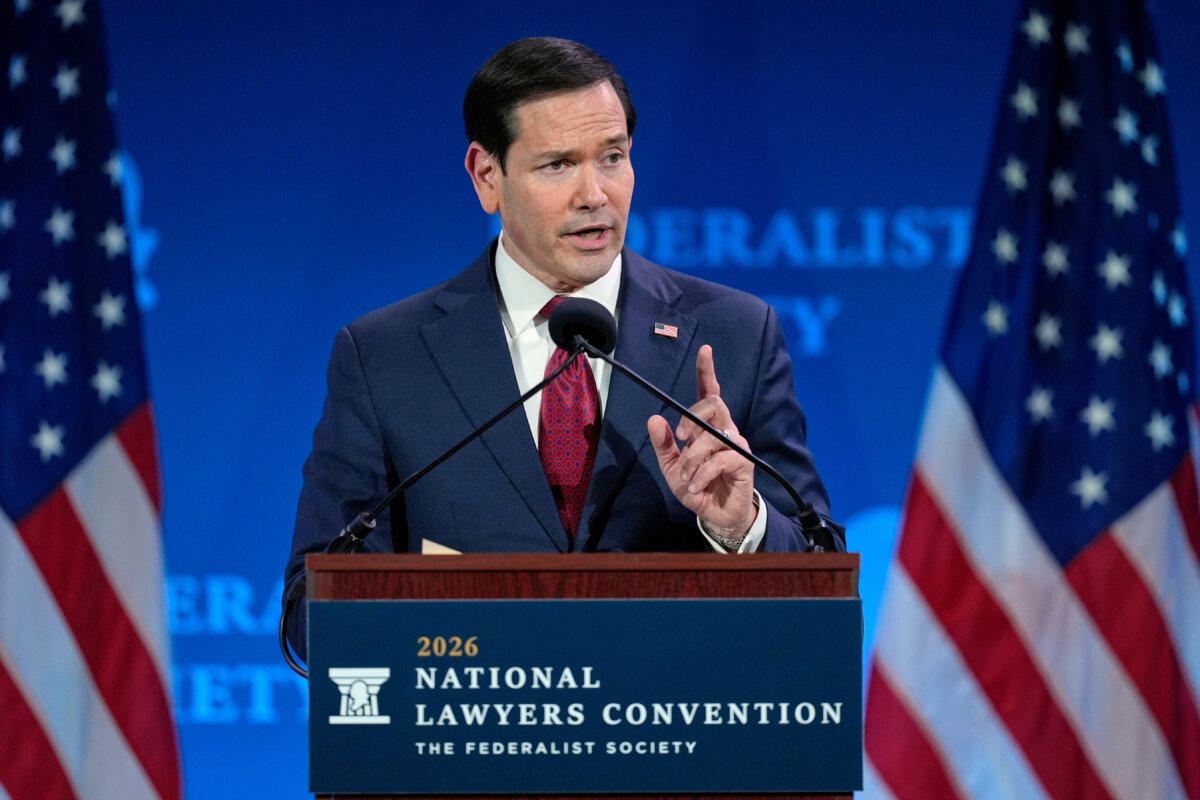
U.S. Secretary of State Marco Rubio gave another very substantial address on Nov. 13 to the Federalist Society in Washington, a sequel to the thoughtful remarks he gave a month earlier standing in front of the Parthenon in Athens and celebrating the Greek contribution to the now-general Western embrace of individual rights and democratic government.
Secretary Rubio must now be considered a serious contender for the Republican nomination for president in 2028. He has a strong public-service background starting in Miami, then as a state legislator and speaker of the Florida House of Representatives and a three-term senator from that state, now the third most populous in the country. In an astonishing demonstration of the regard in which his colleagues hold him, he was confirmed in his present office by a unanimous Senate vote of 99 in favour, while he himself graciously abstained. Such demonstrations of bipartisan confidence are extremely rare now.
The person who had been considered the front-runner for the Republican presidential nomination, Vice President JD Vance, seriously compromised his position by stating on the day after the defeat suffered by the governing party in the midterm elections that the Iran war was responsible for the setback. Vance had been the chief negotiator of the so-called memorandum of understanding with Iran, which he declared to be a great breakthrough for peace but which soon lay in tatters with both sides resuming armed combat. In 2022, when he was running for the U.S. Senate in Ohio, Vance said of the war in Ukraine that he didn’t “really care what happens to Ukraine one way or another.” He thus stated his indifference to Russia regaining the largest single jurisdiction that it lost as a result of the disintegration of the Soviet Union, and didn’t care if the Kremlin made a farce and a mockery of the Western Alliance.
President Trump implicitly rebuked his vice president by publicly inviting him to focus his efforts on exposing and ending corruption in (mainly) Democratic governed states. He added that there is no point to any negotiations with Iran since no agreement with that country is of any value, and that his existing policy of blockade and sanctions would eventually strangle the regime and bring comparative peace to the region and substantial victory in the war on terror, at minimal cost in American casualties and expenditure of ordnance. Stating that these vital objectives could be obtained by doing precisely what the vice president recommended against is a political cutting off at the knees of an incumbent vice president with presidential ambitions with few precedents: Spiro Agnew in 1973, John C. Calhoun in 1832, Levi P. Morton in 1892, and Henry Wallace in 1944.
Marco Rubio seems to be reviving the fine tradition of a potential presidential candidate giving unusually thoughtful and not overly partisan speeches in sequence in the two years preceding a presidential election. It was by this means that Abraham Lincoln, a former one-term congressman but the quasi-victor in the great Illinois Senate race of 1858 against the leading Democratic figure in the Congress, Stephen A. Douglas, became a prime candidate for the nomination of the newly formed Republican Party. To some extent, the governor of New York, Franklin D. Roosevelt, did this in 1931 and 1932. It is the most dignified form of campaigning, and Secretary Rubio is clearly gaining stature in the eyes of the public and of the media as a result of it.
Rubio already has the appearance of the best possible combination of the strongest elements of Trump’s policy with none of his abrasions or apparent ethical inconsistencies; an authentic conservative but not an outsider inciting the sociopathic animosity of the political establishment.
Rubio’s principal points in his Nov. 13 speech were that it is not only the instruments of government that rule but a large number of nongovernmental influential groups and organizations, including the media, the academy, the corporate world, and many nongovernment organizations. He pointed out that Ronald Reagan had cut taxes in his first few months in government in 1981 and still suffered significant losses in public support and in Congress the following year. Yet he was overwhelmingly reelected in 1984 when his policies had fully taken hold, indicating that this could be a precedent for the present time.
Rubio specifically denounced in stentorian terms those organizations that endlessly attack the United States and resent American power in the world, while professing to be supporters of national independence and human liberty. He singled out the United Nations and the International Criminal Court—the U.N. for its cowardice and hypocrisy, dominated as it is by corrupt, poverty-stricken despotisms, and the ICC for having no legitimacy whatever, answerable to no one, with no natural jurisdiction.
The ICC is a “fake court” which had investigated (not the normal function of a court) the United States for committing crimes against humanity in intercepting drug importations by sea and air into the country and by seizing the president of Venezuela and formally charging him with the illegal importation of lethal drugs into the United States on a colossal scale.
The secretary is correct on both counts. The United Nations is a fraud and should be drastically reformed. The ICC is an outrage, a minor agent of Western self-destruction, and the United States is right to ignore it.
Views expressed in this article are the opinions of the author and do not necessarily reflect the views of The Epoch Times.