
Commentary
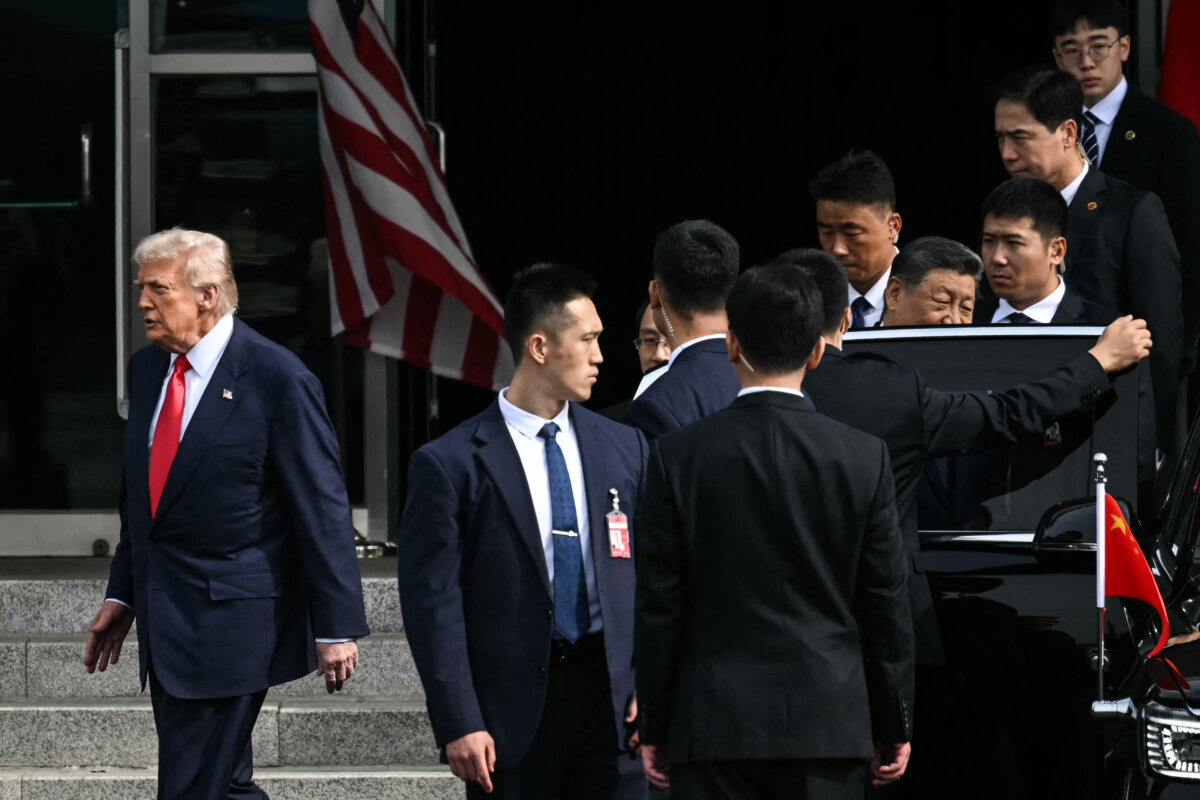
China on Nov. 9 formalized an extension of the trade “truce” that looks more like troops eyeing each other warily across a no-man’s-land of barbed wire, cratered businesses, and agreements going up in smoke.
The U.S.–China trade truce reached in Busan, South Korea, last year relied on promises that China would buy more agricultural products from the United States and ship more rare-earth elements. China did buy soybeans, but supplied only two-thirds of the rare earths it promised. The regime in Beijing continues to short supplies of rare earths to U.S. allies like Japan.
The truce extension means that despite Beijing’s broken promises, Washington is standing pat in its tariffs, while escalating against Canada. Some Canadian imports pay as much as 50 percent. It makes little sense to tariff some products of a democracy and treaty ally more than those from the world’s most powerful threat to democracy.
Washington has a point that Ottawa should increase its defense spending and stop selling out to China. But Washington should do the same. Unity among democracies is required to defend against the Chinese Communist Party (CCP).
Part of that threat is the way the CCP divides and conquers by making deals with democratic leaders and then consistently reneging on them without consequence.
In 2015, CCP leader Xi Jinping made two major promises to then-President Barack Obama. Xi personally said he would not militarize China’s artificial islands in the South China Sea. He violated that the next year.
Xi also promised not to engage in state-sponsored cyber theft of intellectual property. By 2018, Xi violated that, too.
Two years later, the regime promised President Donald Trump that China would import an extra $200 billion from the United States. None of that $200 billion came through.
America keeps falling for the CCP’s broken promises, indicating that new legislation is needed to make repercussions for reneged deals automatic. Otherwise, U.S. leaders keep seeking the democratic limelight through big deals while failing to make them enforceable. The autocrats profit through their lies, time and again.
The CCP’s broken promises are not limited to the United States or recent history.
To get their support in the 1930s and 1940s, the CCP promised the Chinese people prosperity and the protection of human rights. Yet, in the first five years of its rule, as many as 4 million people died from CCP campaigns to promote land reform and suppress counterrevolutionaries.
The state took the land of the peasants by force, collectivized it into large farms, and failed so miserably in the process as to create famines starting in 1958. This “Great Leap Forward” would kill as many as 45 million people.
Then the CCP had the audacity to redefine human rights as economic prosperity while delivering lackluster GDP per capita compared to its peers in Japan, South Korea, and Taiwan.
The CCP is deadly, untrustworthy, and totalitarian, yet the United States keeps making unenforceable deals with the devil that are becoming so bad as to be mercantilist.
The CCP controls access (through force) to one of the world’s three largest economies, home to 1.4 billion people. It uses that control to push the United States and other countries toward raw materials rather than technological production. This is mercantilism of the worst kind.
More U.S. agricultural exports and technological imports would allow China to dominate the future global economy through its own technological exports and military power. Selling more American soybeans should, therefore, not be a major U.S. priority in negotiations with China. It serves the CCP’s mercantilist plan for future growth and the direction it wants to channel America: into a backwater of economic and military irrelevance.
Most trade with China empowers the CCP. There is no reason to keep throwing good money after bad. The United States should impose immediate consequences on China by law for failing to live up to its Busan agreement. Given what we know about the CCP’s lack of credibility, these consequences should have been hard-baked into the agreement to deter the CCP from reneging in the first place.
Part of the consequences Beijing pays should include using all trade tools at Washington’s disposal, including higher general tariffs on China, to encourage a refocusing of U.S. trade relations toward democratic countries with a better track record of integrity.
The new trade with democratic countries should be contingent on their freezing China out as well. (Canadian complaints about sovereignty will have to take a back seat here.) Friendshoring is now an old strategy proposal, but a good one. We have not yet given it a chance to work.
Higher tariffs on China will not be easy. The CCP is likely threatening a raft of reciprocal tariffs against the United States, along with further cuts to U.S. and allied access to refined rare earths.
If democracy is to maximize its chance of survival, democracies will have to accept the risk that tariffs and countertariffs will eventually decouple their economies from China’s. First and foremost, the United States and allies should make their rare-earth supply chains independent of the CCP.
Decoupling from China will be painful, but necessary. Democracies trading with the enemy of democracy is not a sustainable strategy.
Views expressed in this article are the opinions of the author and do not necessarily reflect the views of The Epoch Times.