Commentary
The results of the November U.S. midterms suggest that a disturbing number of Americans no longer value the economic and social principles associated with the founding of their nation. Socialists won unanticipated victories, and MAGA candidates suffered defeats from sea to sea.
There was, however, one notable exception: Florida.
Vote margins were less definitive than in campaigns led by Gov. Ron DeSantis, but the GOP retained control of crucial Florida offices. Rep. Byron Donalds (R-Fla.) was elected governor, James Uthmeier attorney general, and Republican majorities were returned in both chambers of the legislature.
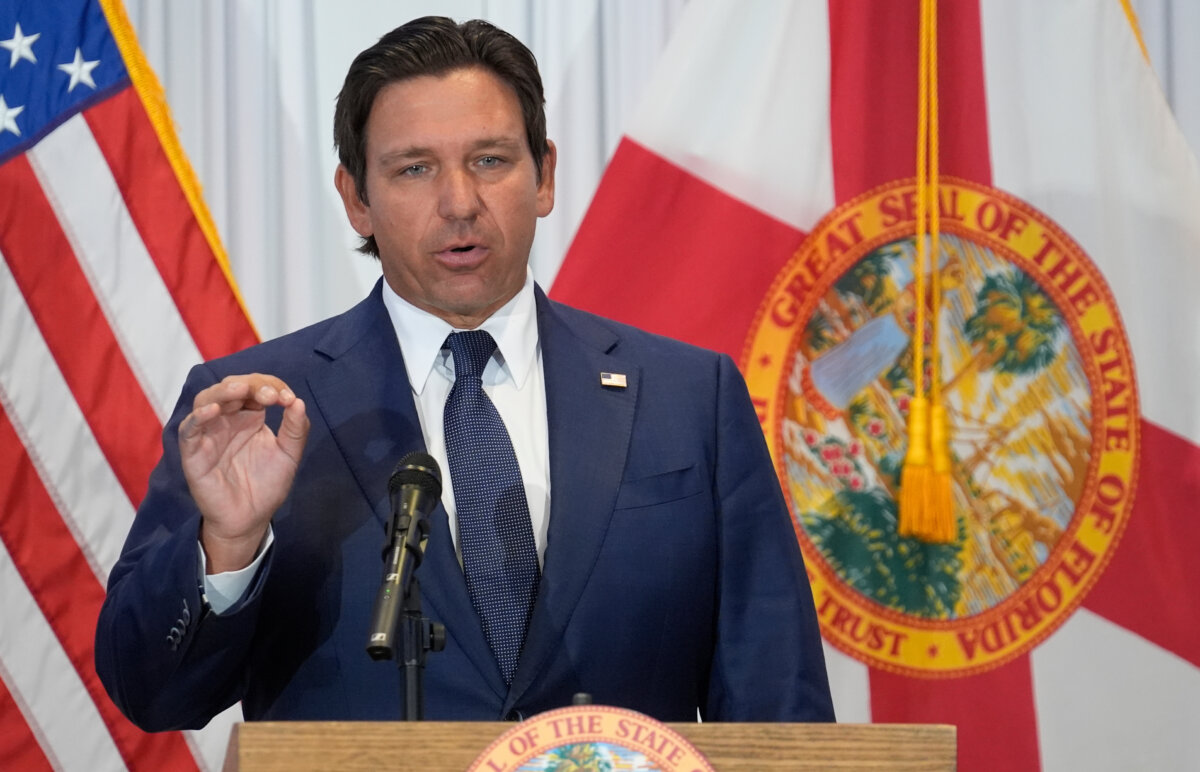
When the smoke cleared, Florida remained a conservative outpost—and the contrast with nationwide results was striking. Mr. DeSantis, the outgoing governor, asserted that his state had withstood a national Republican collapse.
This raises an intriguing question: What was it about Florida that allowed a distinctly conservative political model to survive while conservatism itself was suffering such a major defeat?
The Florida Model
Perhaps it’s because Florida offers some strong clues as to where the United States should be heading.
Florida may not have all the answers, but it has developed political and economic features that are well worth imitating. The state could serve as a reliable laboratory for a workable model of national conservative governance.
The state’s most important feature is limited government intervention in the economy. Florida has no state individual income tax and generally promotes a business-friendly environment. It encourages tourism, construction, private investment, and entrepreneurship. Florida conservatives understand that economic growth does not fare well in an ever-expanding regulatory regime.
The Florida experiment combines cultural conservatism with economic dynamism. This has attracted hardworking individuals who vote for the Florida model not only at the ballot box but also with their feet. Over decades, millions of productive people have moved to the Sunshine State, including substantial numbers from higher-taxed and heavily regulated progressive constituencies. This voluntary movement of families and businesses toward the Florida economic environment is ample proof of its popular appeal.
Another important part of the Florida model is the school system. State educational authorities strive to respect the rights of parents. Under Mr. DeSantis, the state became nationally prominent for school choice and restrictions on radical approaches to race, gender, and sexuality in public education. People see Florida’s policies as an attempt to put parents back at the center of decision-making in their children’s schools.
Florida is challenging an assumption that has perversely influenced Western culture for over half a century: that free societies are constitutionally obliged to tolerate moral chaos. Florida has demonstrated that progressive ideology is not the path to general well-being.
The Sunshine State has staunchly resisted left-wing institutional power. The DeSantis years produced a particularly sound argument that corporations, universities, professional organizations, and other institutions should not use their economic and cultural influence to impose woke political agendas on the public.
With regard to law and order, Florida has cultivated a position that emphasizes policing, public safety, immigration enforcement, and robust criminal-justice policies. Floridians generally understand that government has a fundamental responsibility to maintain order and protect citizens, rather than prioritize the imagined victimhood of habitual criminals.
In short, Florida has consistently presented itself as a counterweight to America’s leftward drift. The underlying proposition is simple: If others will not govern according to traditional American principles, Florida will strive to demonstrate what a reliable conservative government can accomplish.
Whether or not one agrees with all of these policies, their political significance is difficult to ignore. Florida leaders have been willing to challenge progressive developments that many Democrats and Republicans have been reluctant to confront. In this sense, Florida is more than just another red state. It has become a test case for the credibility of conservative governance.
The Sunshine State Could Show the Way
This all leads to an intriguing rhetorical possibility: MAFA—Make America Florida Again. It’s an echo of MAGA that suggests something cautiously different.
MAGA was generally understood to be an attempt to recover an earlier version of America. MAFA would propose examining a successful state-level experiment and applying its lessons to the nation.
The policy platform would be attractive to hardworking Americans: lower taxes, less regulation, economic growth, parental authority in education, cultural conservatism, immigration law enforcement, public order, skepticism toward progressive institutional power, greater state autonomy, and an explicitly American, rather than European, social model.
The Free State of Florida would provide a strong working model from which a sound national conservative program could be reconstructed. This makes the concept particularly relevant to the question of what happens to the Republican Party after President Donald Trump.
Potential Leadership
There are some obvious choices for MAFA leadership that would come directly out of Florida itself. At least two of the most popular choices to run for president in 2028 are well-known Floridians—Mr. DeSantis and Secretary of State Marco Rubio.
Mr. DeSantis created much of the political architecture of the Florida model. His administration combined economic conservatism with sound cultural development, education reform, immigration management, and resistance to progressive institutional influence. He is widely recognized as a resolute leader and a talented manager.
Mr. Rubio represents a more nuanced side of the Trump legacy—more traditionally Republican, a polished communicator in two languages, and more tempered in style. His October remarks from the Acropolis in Athens were highly regarded, and his national standing is exceptional. At the March 2026 Conservative Political Action Conference straw poll, Mr. Rubio drew support from 35 percent of the attendees. He was bettered only by a slim majority who chose Vice President JD Vance. Mr. Rubio could become the leader who translates the Florida experience into a national and international conservative program for 2028.
Conceivably, the next GOP ticket could combine the Florida domestic model with a traditional Republican disposition toward fair trade and free-world alliances. Such a combination would offer a way of moving beyond the more divisive moments of President Trump’s second term in office.
One Important Caveat
There is, however, one very important caveat. The GOP victory in Florida was not overwhelming. Mr. Donalds won with only about half the vote. Republicans lost their legislative supermajorities—and Florida voters continue to express serious concerns about matters like the cost of living and immigration policy.
The lesson is not that Florida has solved everything. But the state has preserved a sound conservative governing philosophy. Now it must prove that American conservatism can continue to deliver affordable living, economic opportunity, competent government, and social stability for ordinary people.
If Mr. Donalds, the governor-elect, can meet this test between January 2027 and November 2028, “Make America Florida Again” might become more than just a clever rhetorical offshoot of “Make America Great Again.”
It could provide a serious paradigm for the future direction of the United States.
Views expressed in this article are the opinions of the author and do not necessarily reflect the views of The Epoch Times.