
Commentary
Beijing is betting that artificial intelligence (AI) can do what Gosplan never could: see everything, predict everything, and steer 1.4 billion people without the information failures that sank Soviet planning.
The bet will probably make the Chinese Communist Party (CCP) better at control than any regime before it. But it will not make socialism work.
The flaw in every planned society was never a shortage of data. It was human nature: people lie to those who watch them, officials protect themselves, and nobody can be ordered to care. AI does not cure those problems. It inherits them, scales them, and hides them behind a dashboard.
The Machine in Brief
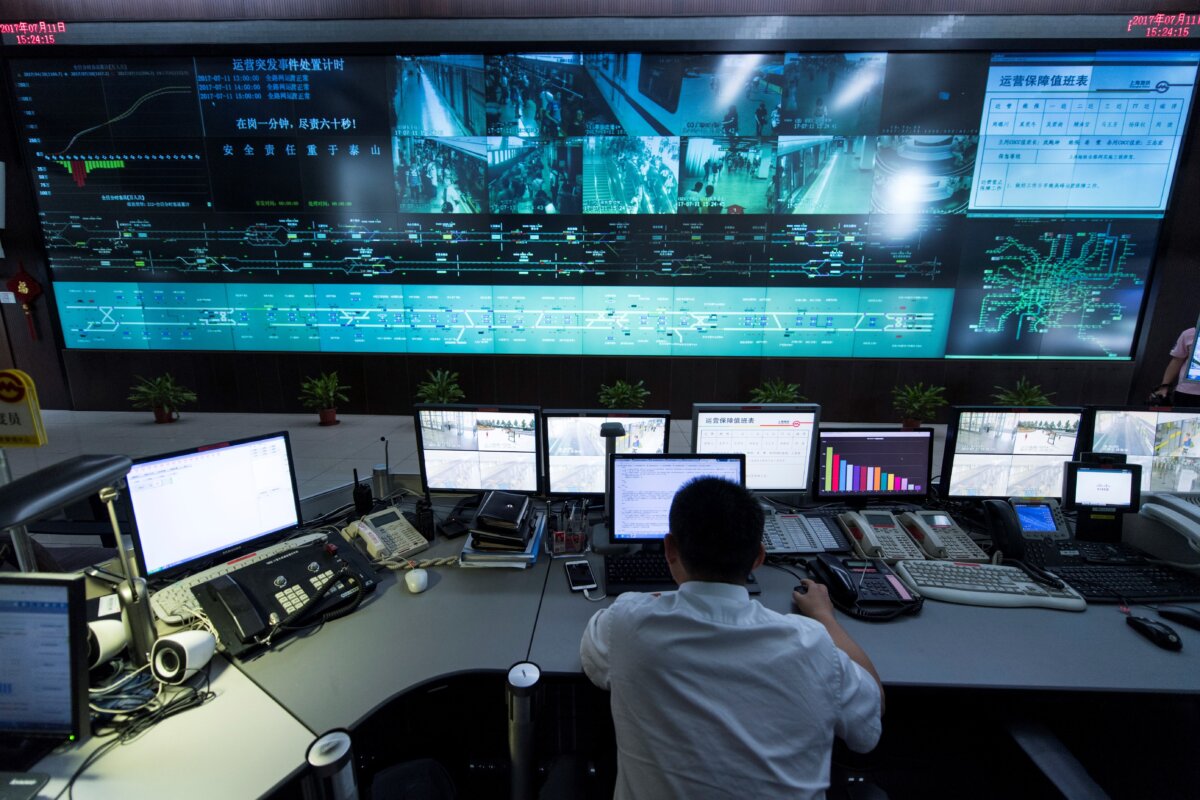
The control apparatus already in place is vast. Some 600 million to 700 million cameras feed municipal “city brain” platforms that use face and gait recognition and flag crowds. Grid workers and volunteer informants watch neighborhoods of a few hundred households each.
Blacklists bar “untrustworthy” people from planes, trains, and loans. Contrary to Western myth, though, there is still no single national personal score.
Launched nationwide in July 2025, China’s National Internet Identity gives authorities a centralized credential to track users across platforms—though adoption remains voluntary and limited so far. Critics warn that consolidating digital identities risks expanding the kind of algorithmic surveillance seen in Xinjiang, where automated data flags led directly to mass detention.
The State Council’s 2025 “AI+” directive and the 15th Five-Year Plan (2026–2030) aim to fuse these layers. AI is meant to be the connective fiber, correlating the grid worker’s notes, the camera’s track, the payment trail, and the chat log into risk alerts that trigger action before dissent forms. The programmable digital yuan adds visibility into money itself.
That is the theory. The practice runs through people.
Human Nature Fights Back
Beijing’s machine has a flaw no software update can fix: it runs on people. The citizens it watches, the officials who run it, and the young people it needs all have reasons of their own to resist.
Watched People Lie, and the Machine Learns the Lies
In 1958 and 1959, terrified communist cadres reported record harvests that did not exist. Beijing then requisitioned grain based on those phantom numbers, and tens of millions starved.
Surveillance does not end that behavior. It drives it underground. People who know they are being scored perform for the sensor, speak in code, and keep their real views to themselves. Timur Kuran calls this preference falsification: public conformity masking private dissent until the ask suddenly drops. The CCP grasps this better than its admirers do.
Researchers found that public support for social credit falls sharply once people learn its political uses, which is why those uses are censored. An AI trained on performed behavior becomes highly confident about a society that does not exist. More data cannot fix data that is false at the source.
Officials Game the Machine
Ronald Wintrobe called it the dictator’s dilemma: the more subordinates fear the ruler, the less truth reaches him. AI does not repeal the dilemma; it automates it.
In a single week in 2017, Xinjiang’s policing platform flagged 24,412 “suspicious persons” in four prefectures, and local officials, rewarded for zeal, sent most of them to camps. Nobody is promoted for clearing a false alarm.
In 2022, Zhengzhou officials turned the COVID health codes of defrauded bank depositors red so they could not travel to protest. A tool built for public health became a tool for burying a local scandal.
That is the pattern: every instrument of “stability” gets bent to the career needs of whoever holds it. Agencies hoard data because information is power inside a bureaucracy. The fused system Beijing imagines will instead be a patchwork of fiefdoms, each feeding the center whatever keeps its own chief safe.
The Watchers Need Watching
In 2022, a Shanghai police database holding records on as many as a billion people sat exposed online and was offered for sale. Centralization does not just multiply the state’s power. It multiplies the payoff for one corrupt insider and the damage from one careless one. The CCP cannot fully trust the people who run its surveillance, so it must surveil them, too, and the recursion never ends.
Nobody Can Arrest Apathy
The most powerful resistance in China today is not protest. It is withdrawal. Young people “lying flat” refuse the grinding overwork culture, skip promotions, and put off marriage and children. None of this breaks a law or trips a camera. Beijing now treats the trend as a national security problem—a telling admission that its tools can find dissidents but not motivation.
Births have fallen to historic lows, and the population is shrinking. A surveillance state can compel compliance. It cannot command enthusiasm, risk-taking, or the desire to build a family in a country that watches everything you do.
Control Kills the Thing Socialism Most Needs
Friedrich Hayek’s insight was that knowledge that runs an economy is scattered, tacit, and local, and that prices and freedom are what coax it into use. Beijing believes real-time data closes that gap. But it does not because the problem was never only information—it was incentive.
Prosperity depends on people free to fail, argue, and start companies that upset incumbents. The 2020–2022 crackdowns on tech platforms and private tutoring erased hundreds of billions of dollars in value and taught every entrepreneur that conspicuous success invites discipline.
The ambitious learn to stay small, move money abroad, or leave. An economy that cannot tolerate surprise gets fewer of them, and surprise is where growth comes from.
History Is Unkind to Perfect Files
East Germany’s Stasi built perhaps the densest informant network in history and filed reports on millions of GDR citizens. Its own reports tracked the rising discontent of 1989 in detail. None of it saved the regime.
Files could record what people did. They could not make the economy work or make people behave.
Concluding Thoughts
AI can see behavior, but it cannot see belief. It can enforce compliance, but it cannot produce the voluntary effort that prosperity requires. Each of the system’s weak points is human: citizens who perform for the sensor, officials who game the alerts, insiders who sell the data, and a generation that has quietly stopped trying.
The more complete the surveillance becomes, the more falsified its inputs and the more fearful its operators. Beijing is building a machine that grows more confident as it grows more wrong.
The right response for free societies is to refuse the CCP’s surveillance and AI toolkit, protect the diaspora communities it targets, and keep proving that open systems out-innovate closed ones. Human nature defeated Gosplan, the Stasi’s filing cabinets, and Mao Zedong’s grain reports. Given time, it will defeat the algorithms, too.
Views expressed in this article are the opinions of the author and do not necessarily reflect the views of The Epoch Times.