Commentary
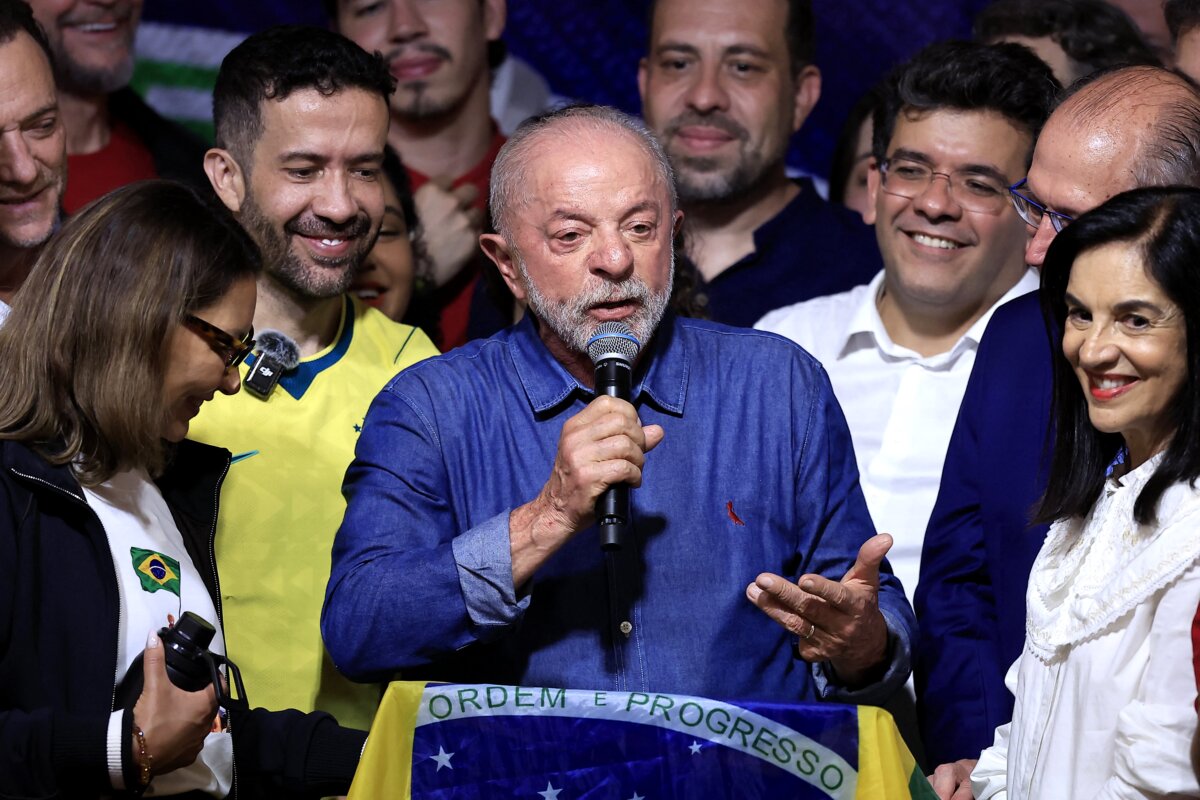
The apparent reelection of Luiz Inácio Lula Da Silva to a fourth term as president of Brazil in his seventh candidacy for that office establishes him as the most durably electorally successful democratic leader in a large country in the world.
His record is particularly remarkable as he was defeated in his first three attempts as a radical leftist, and his non-consecutive terms were interrupted by 18 months in prison for corrupt activities, though it is not entirely clear that he was actually guilty. It is also a stirring tale of the rise of a man from an impoverished background who only became literate the age of 10 and did not graduate from secondary school. He became a skilled metalworker and eventually the leader of the metalworkers’ union, and ultimately the principal spokesman for organized labor in Brazil as it emerged from undemocratic military rule in 1985.
As president of Brazil, Lula, as he is universally known, is generally credited with investment in education, housing, and job creation that very substantially reduced poverty and unsatisfactory housing, attacked illiteracy, stimulated industry, and substantially reduced air and water pollution. When he voluntarily departed office after his first two terms as president, polls indicated that he enjoyed the approval of 80 percent of Brazilians and had ceased to become a frightening figure to Brazilian conservatives, though he was not popular with them either.
He entered office and remained there, mechanically repeating the usual platitudes of the Latin American left, with a high propensity to blame the continent’s underachievement on the American gringos. He supported the Castro regime in Cuba and for a time the Chavez and Maduro regimes in Venezuela, which were conspicuous in their hostility to the United States and ultimately unsuccessful at home. Lula did finally denounce Maduro, shortly before the United States extracted him from the presidential palace in Caracas and moved him involuntarily to the detention center in Brooklyn, New York.
Lula never touched the industrial-scale drug-smuggling operation from China via Mexico, Colombia, and Venezuela to the United States. He has had reasonably good relations with recent U.S. presidents, although President Trump raised tariffs on Brazil because of what he considered, with good reason, to have been a partisan manipulation of the justice system which condemned the immediately preceding president Jair Bolsonaro, a conservative, to 27 years in prison for an attempted coup d’état. It was against Bolsonaro’s son, Flavio, that Lula squeaked out his reelection victory on Oct. 15. His victory ends a long series of elections of pro-U.S. South American leaders, including Argentina, Chile, Colombia, and Peru.
Brazil, the seventh most populous country in the world with 215 million people and tied with Canada with the tenth GDP, does not yet qualify as a sophisticated democracy, but it is getting closer every decade. As the largest Latin American country, Brazil is commendably leading Latin America to a state of political maturity that has stubbornly eluded most South and Central American countries until recently, and still does in the case of several states.
Lula himself, though clearly a man of extraordinary talents, has held remarkably simplistic political opinions that were disturbingly misinformed: in 1979, when asked which historical figures he most admired, he named Gandhi, Che Guevara, Mao Zedong, Fidel Castro, the Ayatollah Khomeini, and Adolf Hitler, saying he admired his determination. It was flippancies like this that caused him to be assimilated by the majority of Brazilians to some of those figures with whom he so strongly identified. There is room for hope that if invited to answer the same question today, he would (apart from Gandhi), produce a more palatable selection.
As he was uneducated and for a long time isolated in the Brazilian working class, Lula’s knowledge of history is limited. He describes himself as a Roman Catholic, though from the pattern of his romantic and family life his practice of that religion has not been rigorous. There is a discernible religious distinction in these contests between Lula and the Bolsonaros, who are members of Brazil’s growing 27 percent evangelical Christian minority. The Roman Catholics are 57 percent, and Brazilians with no religion only 9 percent.
After Lula bought into the left’s ingenious championship of extreme environmental views in order to attack capitalism from the new direction of purporting to be saving the world by doing so, he made himself the chief spokesperson for the unutterable nonsense that it was the responsibility of the Americans to pay billions of dollars in compensation to Brazil and some other countries as reparations for the deforestation of the Amazon jungle.
He has continued to clamber aboard almost any passing anti-American bandwagon, joining BRICS (Brazil, Russia, India, China, South Africa), as a supposed rival to the G7 and championing the Chinese currency—about which it is impossible to believe s single official statement or number—as a substitute for the U.S. dollar. No democratic country should have anything to do with the forlorn Chinese attempt to depose the United States as the world’s most influential country, and Russia and South Africa are economic basket cases. Brazil and India should be invited to join and expand the G7.
Lula condemned the Hamas invasion and massacre in Israel, but was quick to fall in with the blood libel that Israel’s response was genocidal. He’s been a gullible camp-follower in the left’s self-serving propagation of hysteria about climate change. His verbal coziness with the criminal regime in Iran has been an unmitigated disgrace, and is, in all respects, un-Brazilian.
Lula turned 81 two days after the election, and this will presumably be his last presidential term. It is not irrational to hope that the long, mellowing process that he has undergone in his public life of 45 years will bring him safely to a suite of mature and well-considered policies. He should start by pardoning the elder Bolsonaro.
Lula has been a reasonable champion of economic growth and alleviation of the conditions of the underprivileged, but in foreign policy has been easily dragooned into ludicrous posturing, including farcical attempts with the presidents of Turkey and Iran to resolve very complex problems which had nothing to do with Brazil. Brazil is one of the world’s most important countries and Lula is a formidable leader. His final turn could be a pleasant surprise.
Views expressed in this article are the opinions of the author and do not necessarily reflect the views of The Epoch Times.