
Commentary
Europe has begun to play hardball in its trade negotiations with China.
This is a major shift from years past, when major European companies ran profitable operations in China and used their political influence to ensure that nothing from their part of the world offended Beijing.
But circumstances have changed. New competition from domestic Chinese producers has made once-profitable European operations in China far less attractive, while a flood of Chinese exports to Europe has damaged domestic producers.
At the same time, the Trump administration’s tariffs have limited Chinese options in the United States, so Europeans can see that for now, China needs European sales more than ever, and have decided to press their advantage in negotiations with Beijing. How matters will shake out remains a matter of conjecture, but it is a significant turn of events.
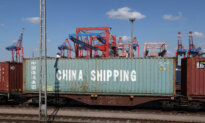
Until the past couple of years, Europe seemed to delight in trade with China. Even as U.S. President Donald Trump complained about what Chinese imports to the United States were doing to the American economy and imposed tariffs that he hoped would reverse that harm, European consumers enjoyed a steady flow of Chinese goods at more attractive prices than were available on European-produced goods.
At the same time, Europe’s major companies enjoyed extremely profitable operations in China, where there seemed to be great appetite for European goods. Autos can illustrate. Between 2003 and 2022, Mercedes’s sales in China rose by 24 percent per year, BMW’s sales rose by 20.2 percent per year, and Audi’s sales rose by 12.6 percent per year. The European Union’s trade balance with China deteriorated somewhat, but it was manageable for most of this time.
However, over the past couple of years, matters changed radically. Beijing’s push through its “Made in China 2025” program to gain advantages in advanced technologies and high-value products has eaten deeply into the sales levels European exporters once enjoyed.
The fate of German autos continues to provide a good illustration. In this year’s second quarter, Mercedes’s sales in China fell by 30 percent from levels 12 months earlier. BMW’s sales fell by 25 percent in the 12 months ended this year’s third quarter, and Audi’s sales fell by 12 percent through the first quarter of this year.
With comparable China sales declines among European exporters of other products, the continent’s business community is much less inclined than it once was to soften official EU attitudes toward China trade.
At the same time, China—having lost some 50 percent of North American sales to Trump’s tariffs over the course of 2025 and regaining little since—has pushed for more European sales. In 2025, EU imports of goods from China rose by 12.5 percent. That flow continued to grow in 2026, with an 8 percent gain over the 12 months ended in the middle of the year.
The EU’s trade deficit with China jumped from 66.14 billion euros (about $71.6 billion) in the first quarter of 2024 to 103.34 billion euros (about $115.7 billion) by the second quarter of this year, almost doubling in only a little more than two years.
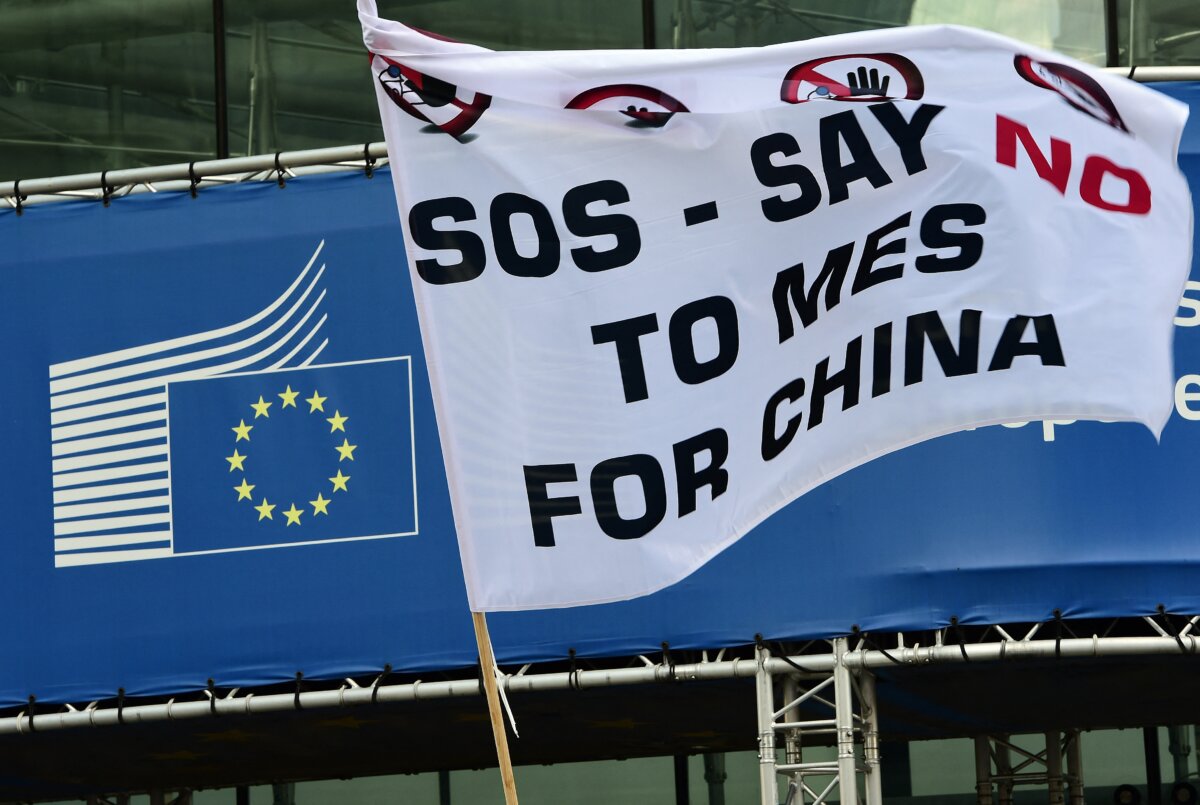
As the European business community no longer committed to easy trade with China, and as the widening trade deficit put more pressure on European authorities to act, EU officials began pressing Beijing for concessions much more forcefully than before. Most notably, France and Germany—the EU’s two largest economies—have joined forces to push for Chinese concessions.
European Central Bank President Christine Lagarde has expressed publicly that China trade will erode the “pillar” of European economic strength: mid-tech manufacturing.
Paris made its position clear in February with a government report provocatively titled “The Chinese Steamroller,” in which it characterized Chinese imports as a threat to European well-being. German Chancellor Friedrich Merz has echoed these sentiments.
As if to give Europeans even more leverage, China, amid sluggish domestic growth, has made its economy even more export-dependent. Its “Made in China 2025” program—by pouring billions of investment funds into electric vehicles, aerospace, semiconductors, quantum computers, and biomedical technology, among other advanced products—has built up productive capacities far beyond what the country’s less-than-robust domestic economy can absorb, leaving exports as the only way to justify those huge investments. And with limited growth potential in U.S. sales, Beijing especially needs European markets.
That urgent need prevents Beijing from bullying Europe, as it has sometimes in the past. Before this recent turn, European complaints about Beijing’s subsidies for Chinese exporters or interference with European sales in China brought few concessions beyond lip service about encouraging Chinese people and companies to buy more European goods.
Had the EU imposed tariffs on Chinese electric vehicles, as they have relatively recently, Beijing would have responded with belligerent accusations of European lawbreaking and threats of retaliation.
But now that China’s economy depends more heavily on European sales, Beijing has taken a much more accommodative stand. In a dramatic turn from past behavior, Beijing recently agreed to cap European sales of electric and hybrid vehicles at 350,000 per year, with future growth limited to 6 percent per year.
The Europeans know that in the words of Elvire Fabry, director of trade and economic security at the Paris-based Jacques Delors Institute, Europe has but a “small window of opportunity.” Recognizing that limited advantage will doubtless spur EU authorities to press Beijing even more in the coming months.
There is talk of building on the EV export cap with something similar for chemicals. In this vein, the EU is discussing what it calls a “diversification instrument” to ensure that European businesses have supply connections beyond China.
It seems that Beijing has overplayed its hand in Europe, as it once did in America.
Views expressed in this article are the opinions of the author and do not necessarily reflect the views of The Epoch Times.