Commentary
In a college psychology course, my class studied an experiment.
This is an oversimplification, but the experiment went as follows. A group of college students was shown a paper on which a 6-inch line was drawn. The paper was passed to the students sitting around a table. They were asked to estimate the length of the line. Now, this experiment was rigged. The instructor and all but one of the students were told to say, “About 3 inches.” Again, the line was clearly longer than 3 inches.
The point was to determine whether these obviously wrong guesses would cause the unsuspecting student—the one not in on the scheme and the last one at the table to offer a guess—to also say, “About 3 inches.” In the overwhelming majority of cases, the unsuspecting students also said, “About 3 inches.”
Now there are a few ways to look at this. But one explanation is that the consensus, although clearly wrong, altered the way the final student viewed the length of the line, as in, “If everybody sees it that way, I must be wrong.”
How much of the current pessimism about the economy is driven by what the media tells us about the economy and how we should feel about it?
For example, the standard common definition of a recession is back-to-back quarters of negative economic growth. In 2025, the first year of President Donald Trump’s second term, every quarter after revisions had positive economic growth. So far this year, each quarter has seen positive economic growth.
But a July Economist/YouGov poll found that 41 percent of adult Americans believed that the country was in a recession, with Democrats three times more likely than Republicans to feel this way. A Napolitan News Service/Rasmussen poll conducted at the end of September found that 39 percent of registered voters believed that the country is currently in a recession.
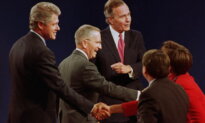
Consider the media coverage of the economy the month before the presidential election of 1992, when President George H.W. Bush ran against then-Arkansas Gov. Bill Clinton. There had been 19 months of positive economic growth leading up to October 1992. A Gallup poll, however, found that a majority of Americans thought the economy was in a recession.
Investor’s Business Daily noted that, in October 1992, 90 percent of the economic news in newspapers was negative. The election was held on Nov. 3. Clinton won, and that month, only 14 percent of the economic news in newspapers was negative. As for the ABC, NBC, and CBS nightly news, about 90 percent of the news about the economy was negative. After the election, for the remaining two months of the year, 60 percent of the economic news in the same newscasts was positive.
Yes, gas prices since the start of the Iran War have gone up. But at 2.5 percent of income, the amount that Americans spend less on gas is less than during the gas spikes of the 1970s. And Americans drive twice as far on a gallon of gas compared with the 1970s.
The average income is at an all-time high. The percentage of those living in poverty is at an all-time low. The stock market indices have hit record highs, and 401(k)s have seen large increases.
Consumers are spending. People who fear an economic downturn and the loss of their jobs typically do not spend in the way that consumers have been doing in recent months. The Atlanta Fed’s GDPNow model estimates a third-quarter 2026 growth of 3.7 percent.
The Media Research Center found that the big three nightly news coverage of Trump was negative in both terms.
“News aggregators” such as Microsoft, Apple, Google, Yahoo, TikTok, and YouTube are where Americans now primarily get their news. In 2025, Google curated 73 percent of articles from outlets with a bias to the left—and just 1 percent of articles from outlets biased to the right. For all the aggregators, less than 10 percent of their curated articles came from outlets on the right.
In “Lessons from the Recession: A Management and Communication Perspective,” published in 1997, the authors wrote: “The highly negative view of the economy in 1992 was due in large part to widespread misperceptions about its performance and prospects, and that unduly negative coverage on network television played some major role informing those misperceptions.”
The anti-Trump media clearly influences how people think and feel about the economy. The only question is to what degree.
Views expressed in this article are the opinions of the author and do not necessarily reflect the views of The Epoch Times.