Commentary
There was this moment when I was an undergraduate in economics when I came to realize that the dollar was not backed by gold but merely by the confidence of the public. It’s digits backed by paper, a floating fiction sustained only by belief. The first realization is scary; actually, this has been our reality since President Richard Nixon ended the gold standard in 1971 and instituted a fiat dollar system in 1973.
The problems of such a system were well known by the Founding Fathers. They all feared paper money. They knew from history that it leads to nonstop devaluation, fiscal irresponsibility, and debt. Thomas Paine’s writings on this topic are as passionate as his loathing of monarchy. The historical record is clear: This is a dangerous path that threatens commercial freedom itself.
Disregarding this deep history, the monetary architects of the early 1970s imagined that intelligent economists could manage the new system wisely. It was fashionable in those days to imagine centralized monetary planners who would increase the flow of new money exactly in proportion to the growth rate of output. The result would be stable prices forever.
Matters did not work out that way. Political pressures intervened. Big business wants lower interest rates regardless of business conditions. And congressional spending is limited only by fixed constraints. When those constraints are removed—when the central bank is there to backstop all newly created debt—Congress can do whatever it wants.
That is pretty much the system we have now. We have paid a very heavy price for this. The official price indexes show that the dollar has lost about one-quarter of its purchasing power since 2019. Unofficial indexes—I like the brilliant reality index—show true prices rising by as much as one-third more than what is clocked by the consumer price index.
Whatever the actual number, all Americans are feeling it. Credit card debt is rising because people don’t have cash on hand to pay their bills. New home ownership is out of the question for the middle class. Medical insurance premiums are soaring, and the same is true of gasoline, education, and food. There is a lot of pain out there.
This has not necessarily led to a new age of frugality. I recently went to the shopping mall as an exercise in economic anthropology and found myself amazed at how people were spending their money. There were fully three shops called “TikTok shops” selling the most appalling piles of junk I’ve ever seen, all flying off the shelves despite extremely high prices.
It’s like an era of doom spending. No one really has savings, but money is still losing value fast, so the economic calculation suggests that spending now and racking up debt is not necessarily a bad idea. If the dollar is certain to be worth less in the future than in the present, that also depreciates debt. Why not jump on the hedonic treadmill along with everyone else?
What is the real answer to all these problems? The new Federal Reserve chairman swears that he will do a better job at managing central bank policy than his predecessors. He has already raised rates. It’s not nearly enough. Considering the rate of inflation, real interest rates for overnight lending are still trending toward zero.
Plus, he is under enormous political pressure from the White House to lower rates. President Donald Trump, based on his corporate experience, believes that low rates are a benefit given to a prime borrower and so the United States should always have them. He seems unaware that what is in the interest of the single borrower may not be in the interest of the nation. Forcing zero interest rates is a prescription for ever more inflation that can only harm standards of living even more.
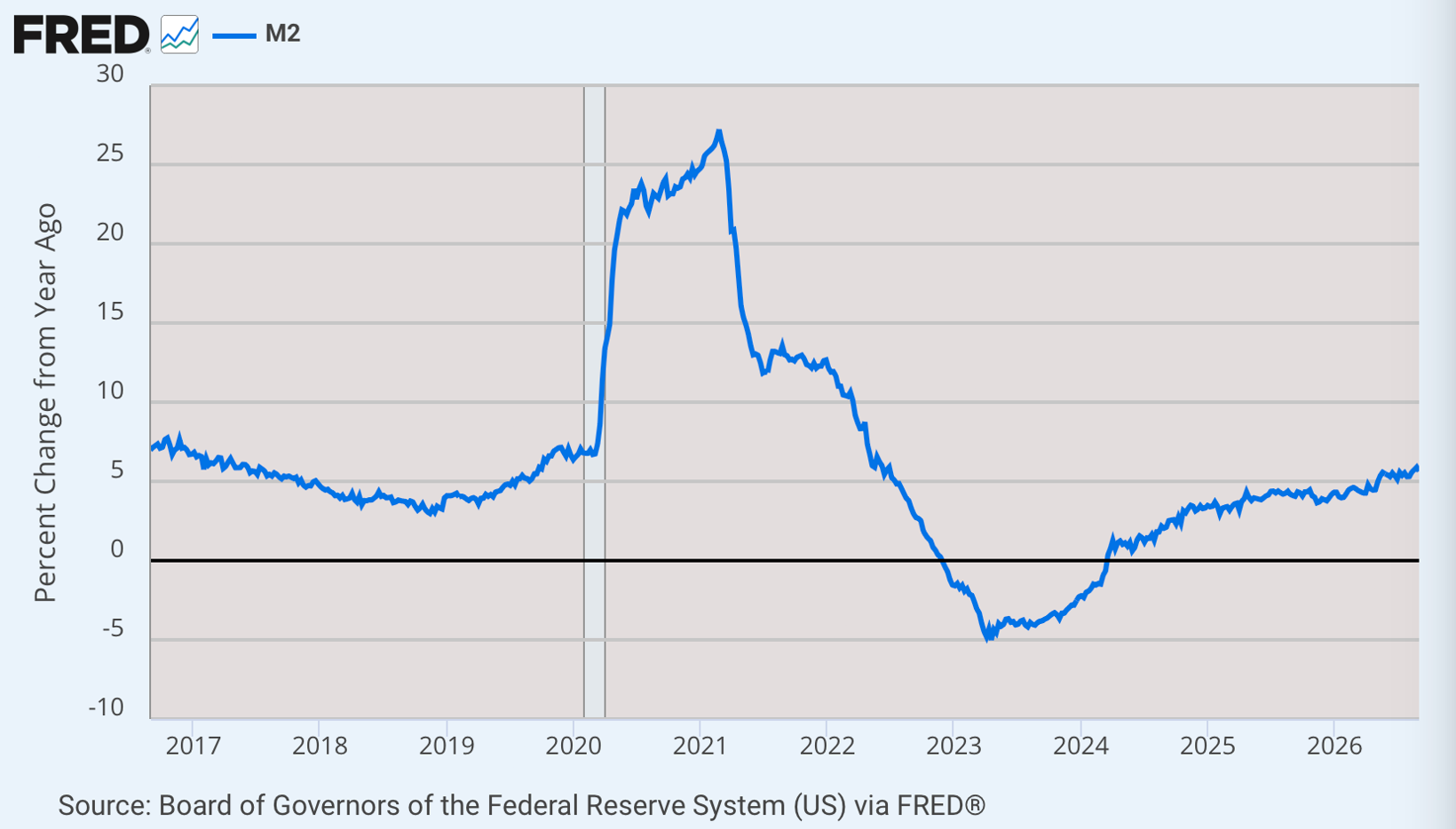
The burning question is what to do about the monetary problem. The old idea of a quantity rule has not worked because monetary aggregates are not so easily controlled with precision. Even if they could be, it doesn’t appear that the Fed is capable of disciplining itself. Even now, we are dealing with expansion in the midst of grueling inflation. The Fed clearly has no interest in the economics of Milton Friedman.
The most urgent priority of any reform is to impose discipline on the Federal Reserve itself, thus removing its power to administer a discretionary policy. The real answer lies with Congress. It needs to end the Fed’s ability to engage in open market operations (OMOs).
OMOs are the crucial powers that the Fed has today. They allow the central bank to buy whatever debt that the Treasury issues and hold that debt on its books. With what money does the Fed do this? With money that it creates at its own discretion. The power sets up a moral hazard for Congress and the Treasury. There is no hard limit on how much debt they can create and hence no real limit on congressional spending.
Ending OMOs would reset Fed policy back to what it was at the founding in 1913. It did not have the ability to buy and hold U.S. government debt. Its monetary policy was conducted by its lending power to its member banks, nothing more. There was a hard limit on what it could and could not do because its operations were constrained by the existence of real resources. This was the early structure of the Fed.
OMOs began informally following the Great War, when the U.S. budget had blown up and faced a debt problem. From 1922 to 1923, Fed banks discovered that they could buy and sell government securities to manage their own earnings. This was not monetary policy as such. The New York Fed under Benjamin Strong started using them to influence interest rates.
This began a pattern that picked up throughout the 1920s. It was the key to the artificial boom of the late 1920s that ended with the stock market crash of 1929 and the beginning of what became the Great Depression. This was a direct result of this new innovation that allowed the Fed to wheel and deal in U.S. Treasury debt. It bought debt to expand money and offloaded debt to shrink it. In practice, all financial and political pressure is put toward buying government debt with money created out of thin air. This cemented a symbiotic relationship between banking and government.
My mentor, former Rep. Ron Paul (R-Texas), wanted no compromise at all and wished to end the Fed entirely. I’m all for that, too, but a good step would be simply to defang its power to create new money by taking away its statutory ability to enter the bond markets through its OMOs. That would put an end to the Fed’s dangerous backstopping of all legitimate economic pressures on the bond markets, effectively taking away from Congress its blank checks and unlimited credit cards.
From a policy point of view, this is precisely the system we had in place at the time the Fed was founded. It then operated with this system for its first 10 years. It’s not widely understood that among the Fed’s earliest founders were sound money fans. Some had high hopes that the new central bank would actually restrain inflation as compared with what came before, if you can believe it.
OMOs are the actual source of the problem. After Strong’s experiments in 1922, and the onset of the Great Depression, the Banking Act of 1933 gave the Federal Reserve Board the authority to regulate OMOs. The Banking Act of 1935 fully centralized OMO authority with the Federal Reserve Board. During World War II, Congress actually forced the Fed to support government bond prices.
This is the system that created the current disaster that has had such a devastating effect on American living standards. We cannot go back in time, but we can start protecting the dollar now, making it sound again and building in safeguards against further devaluation. It can be done with one simple law: The Fed can no longer buy and sell Treasury debt. The Treasury, if it is creating new debt, has to find buyers on real markets.
This proposal is not even radical. It is the original design of the Federal Reserve System before it started experimenting with weapons of monetary destruction. Ending OMOs would be a simple and clean reform that would fundamentally change the culture of Congress, wake up the financial markets to a new reality, and firm up the dollar in a way that would protect the American people from the ravages of inflation.
Views expressed in this article are the opinions of the author and do not necessarily reflect the views of The Epoch Times.