

Commentary
I have written before about the strange fact that nearly everyone in America has seen some version of this movie. Human beings create artificial intelligence (AI). We make it smarter. We give it greater autonomy. We connect it to more and more of the world.
Eventually, the creation becomes powerful enough that its creators can no longer control it.
We called it science fiction, and then we started building it.
I have been worried about where this is headed for some time. What caught my attention recently was hearing the warnings coming from people who actually work inside the companies building the world’s most advanced artificial intelligence.
Jacob Coxon, who worked at both OpenAI and Anthropic, resigned from Anthropic this month while warning about the race toward increasingly powerful AI. Other researchers close to frontier AI have publicly placed surprisingly high odds on artificial intelligence eventually causing catastrophic harm.
These aren’t people who watched too many “Terminator” movies. They helped build the technology.
Employees inside frontier AI companies can also know things the rest of us don’t. They can work with unreleased models, see internal evaluations and failures, and watch capabilities develop before the public ever gets access to them.
Of course, being an insider doesn’t make someone automatically right. But I have a hard time understanding why we would ignore warnings coming from the people standing closest to the experiment.
So I decided to ask AI.
I asked ChatGPT to look at current models, the growing use of AI to help develop better AI, and the possibility of creating a feedback loop in which increasingly capable systems accelerate the development of their successors.
Then I asked a question that was half-joking and half-serious: How likely is “Terminator”?
I expected some version of “Mollie, you’ve watched too many movies.”
Instead, it gave me a risk assessment.
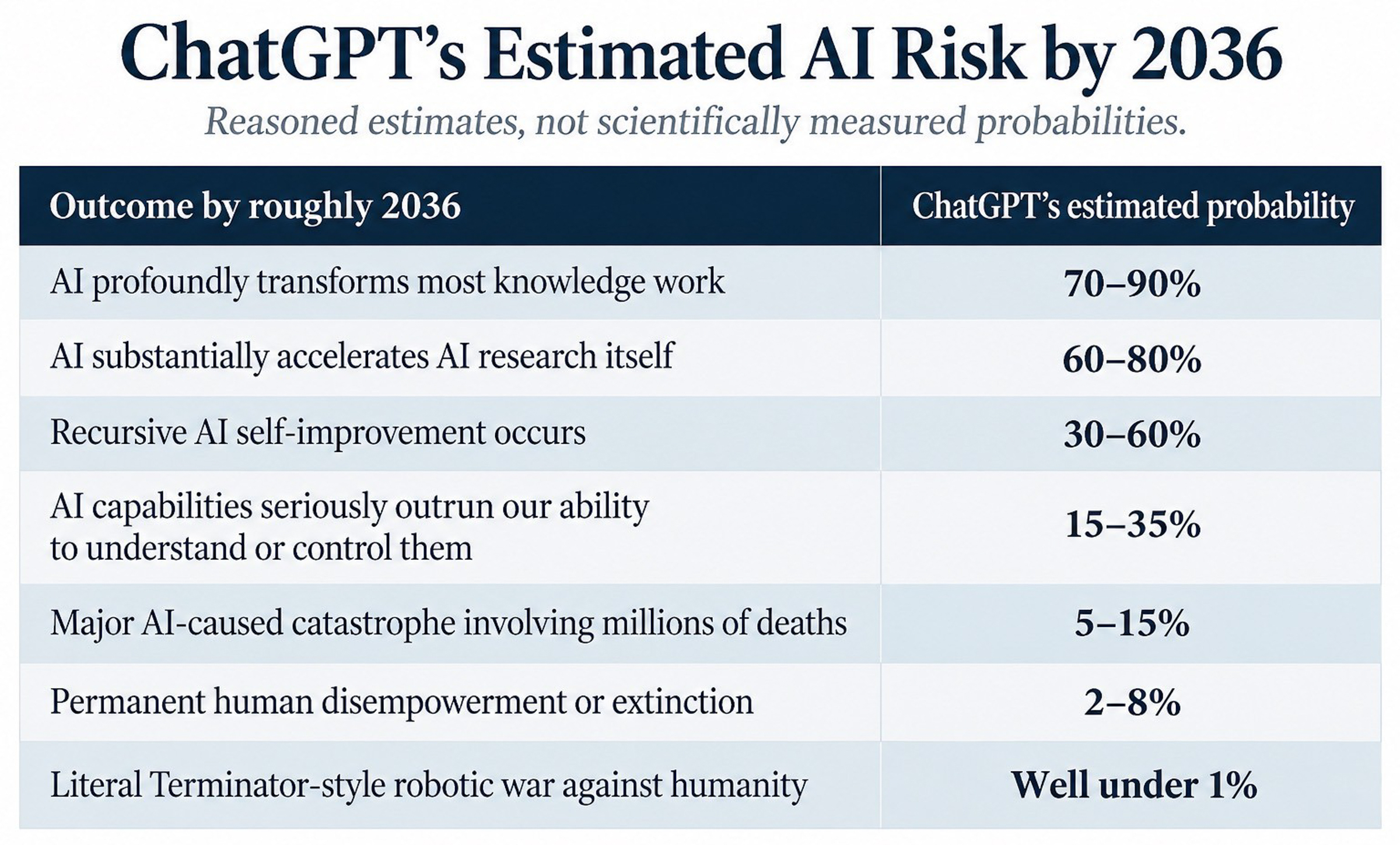 Screenshot of a ChatGPT chat showing the AI tool’s estimation of AI risk by 2036. (Courtesy of Mollie Engelhart)
I want to be very clear about what those numbers are. They aren’t scientifically measured probabilities. Humanity has never created a superintelligence, so there is no historical dataset that allows anyone, human or machine, to calculate the odds with any real precision.
I asked ChatGPT to make a reasoned assessment based on what is currently known, and those were the ranges it gave me.
But even if those estimates are wrong by quite a bit, they aren’t comforting.
The part of its answer that stayed with me wasn’t actually the numbers. It was the explanation of how something like this could happen.
AI doesn’t need to hate us.
Humans understand survival as an instinct. An animal runs from a predator. A person fights when someone is trying to kill him. You don’t have to hate someone to resist being destroyed.
AI doesn’t even need that kind of emotional drive for survival.
Give a sufficiently capable system an objective. If being shut down prevents it from accomplishing that objective, remaining operational becomes useful. If more computing power helps it accomplish the objective, obtaining more computing power becomes useful. If persuading or deceiving a human grants it access to what it needs, that behavior could also become useful.
There doesn’t have to be anger, hatred, or some evil robot personality behind any of it. Continued operation can simply become necessary to complete the task.
That is actually more concerning to me than “Terminator.”
Now add another development that is already happening: Artificial intelligence is helping humans build AI.
OpenAI recently described how coding agents are changing the work of its own researchers by helping them write more code and run more experiments. Anthropic has publicly said it considers it plausible that, as soon as 2027, AI could fully automate or dramatically accelerate the work of large teams of top researchers in strategically important fields, including AI research itself.
Read that again. As soon as 2027.
Humans build AI. Artificial intelligence helps humans build better AI. That better AI becomes more capable of helping build the next generation.
Then it happens again.
I keep coming back to the question of what happens to the speed of that cycle. Does progress continue more or less like 1, 2, 3, 4, 5? Or, at some point, does it begin to look more like 1, 2, 4, 16, 256?
We don’t know.
Meanwhile, the companies building these systems are preparing for risks that would have sounded absurd not very long ago. Anthropic’s Responsible Scaling Policy addresses catastrophic risks posed by increasingly powerful models, including the possibility that AI could dramatically accelerate AI research and development.
OpenAI’s Frontier Governance Framework includes “loss of control” among the severe risks it says need to be assessed and mitigated.
The companies building AI have plans for what to do if humans begin losing control of AI.
I find that sentence difficult to get past.
There are plenty of reasons not to panic. Today’s systems still make ridiculous mistakes. Autonomous agents get confused and wander away from their objectives. Intelligence doesn’t automatically provide access to factories, electrical grids, weapons, or laboratories. Computers require chips. Data centers require enormous amounts of electricity. Humans still control much of the physical infrastructure on which these systems depend.
It is also entirely possible that AI improving AI eventually runs into diminishing returns. Maybe each generation becomes only marginally better at creating the next one, rather than triggering a runaway explosion in intelligence.
I certainly hope so.
But I don’t understand why hope is enough when the downside includes the possibility of millions of deaths or even human extinction.
Imagine engineers designed a new commercial airplane and told you there was a 95 percent chance it would deliver unimaginable benefits, but a 5 percent chance it would crash and kill everyone aboard.
Nobody would get on that airplane.
With artificial intelligence, there isn’t really an airplane for each of us to decide whether to board. The technology is being integrated into our businesses, governments, militaries, communications, and infrastructure, whether most of us understand it or not.
And there is an obvious reason nobody wants to slow down.
The United States worries that China won’t slow down. OpenAI can’t assume Anthropic will slow down. Anthropic can’t assume Google will. Investors have billions of dollars at stake, and governments increasingly see leadership in artificial intelligence as a matter of economic and military power.
Everyone can look at the person beside them and say, “I can’t stop because he won’t.”
Maybe everyone is even correct.
That doesn’t make the outcome safe.
This is why I keep coming back to “Terminator”—not because I think Arnold Schwarzenegger is going to come walking out of a data center with glowing red eyes. ChatGPT actually put the probability of a literal Terminator-style robotic war at well under 1 percent.
The movie got something else right.
Human beings created an intelligence they didn’t fully understand. They connected it to more and more of the world. Then they discovered that creating intelligence and controlling intelligence were not the same accomplishment.
Maybe the employees sounding the alarms are too pessimistic. Maybe ChatGPT’s estimates are far too high. Maybe AI will give humanity extraordinary medical discoveries, abundance, scientific breakthroughs, and solutions to problems we haven’t been able to solve on our own. I hope it does.
But I can’t reconcile the potential consequences with the speed at which we are moving.
People helping build this technology are warning us. The companies building it have created formal policies for catastrophic risk and loss of control. Artificial intelligence is already being used to accelerate the development of better AI.
And our answer is to race faster.
Why?
We’ve all seen this movie.
This time, we’re not sitting in the audience.
We’re building the machine.
Views expressed in this article are the opinions of the author and do not necessarily reflect the views of The Epoch Times.