
Commentary
When Chinese Communist Party leader Xi Jinping warned President Donald Trump about the “Thucydides Trap,” he was talking about the risk of war with China, presumed to be a rising power, threatening the United States, presumed to be the declining power.
Xi invoked the concept during his May 2026 meeting with Trump in Beijing.
But is that a realistic assumption?
What Is the Thucydides Trap?
The term comes from ancient Greek historian Thucydides, who wrote about the Peloponnesian War between Athens and Sparta.
Harvard political scientist Graham Allison later popularized the phrase the “Thucydides Trap.” His argument was that when a rising power threatens to displace an established power, fear and miscalculation can make military conflict more likely.
The message behind Xi’s warning seems unmistakable. China and America should avoid falling into a cycle in which one country’s rise automatically produces fear and confrontation in the other.
Xi also made the point that China was the rising power in this scenario while the United States is characterized as the declining power.
Is US Decline Real, Inevitable, and Imminent?
Xi Jinping’s claim that America is declining isn’t new, nor is it unfounded.
The United States certainly has some serious economic problems. Over the past 40 years, manufacturing moved to China and elsewhere. The national debt is over $40 trillion, and the income gap is at 30-year highs. What’s more, interest rates remain high, as do oil prices and inflation overall.
Furthermore, the bond market is flagging and consumer confidence has fallen. The middle class is shrinking and housing is becoming increasingly unaffordable. Home ownership among Gen Z is a fraction of what it was to the equivalent generation in 1990.
These are just a few of the economic challenges facing the United States.
China’s Rise to Global Economic Powerhouse
There’s no doubt that China is an enormous economic force in the world, and that it occurred at the expense of the U.S. and other Western economies. Its vast and cheap workforce transformed the global economy over the past two decades. Today, its GDP is second only to America’s.
China’s not only the world’s manufacturing leader, it is also the world’s biggest importer of energy, food and commodities, providing an enormous market for other nations.
Additionally, China is the leader in rare earth elements, and is a major player in foreign investment, although Beijing has lessened those in recent years.
But sheer economic size and dominance in certain markets aren’t the same thing as economic momentum or sustainability.
That distinction is critical.

China’s Economic Rise May Have Peaked
China officially reported 5 percent GDP growth in 2025. The IMF projects growth of about 4.5 percent in 2026 and, most importantly, expects growth to slow further over the medium term.
There are several structural and policy reasons for this, such as an aging population, a shrinking labor force, declining returns on investment, and weaker productivity growth.
China does not have to enter an outright recession to face a structural decline.
If GDP grows 4 percent while the population and workforce shrink, productivity slows and debt rises, China can become a weaker economic competitor even while its headline GDP continues to increase.
Perhaps just as important, the economic figures Beijing actually puts out are most likely inflated to justify the Chinese Communist Party’s continued existence.
The real issue is therefore not whether China’s GDP is already falling. It is whether the economic model that powered China’s extraordinary rise can continue producing the same results.
Xi Diverting Attention From China’s Big Problems?
But is a perceived declining United States the only possible explanation for Xi’s warning, or could there be another motivation behind it?
The reality is that the leader of the Chinese Communist Party could have been talking about something else entirely.
In fact, things may be the exact opposite of how Xi portrayed them. The truth is that China’s economic rise is losing momentum in several key metrics, amounting to what has been called a structural slowdown.
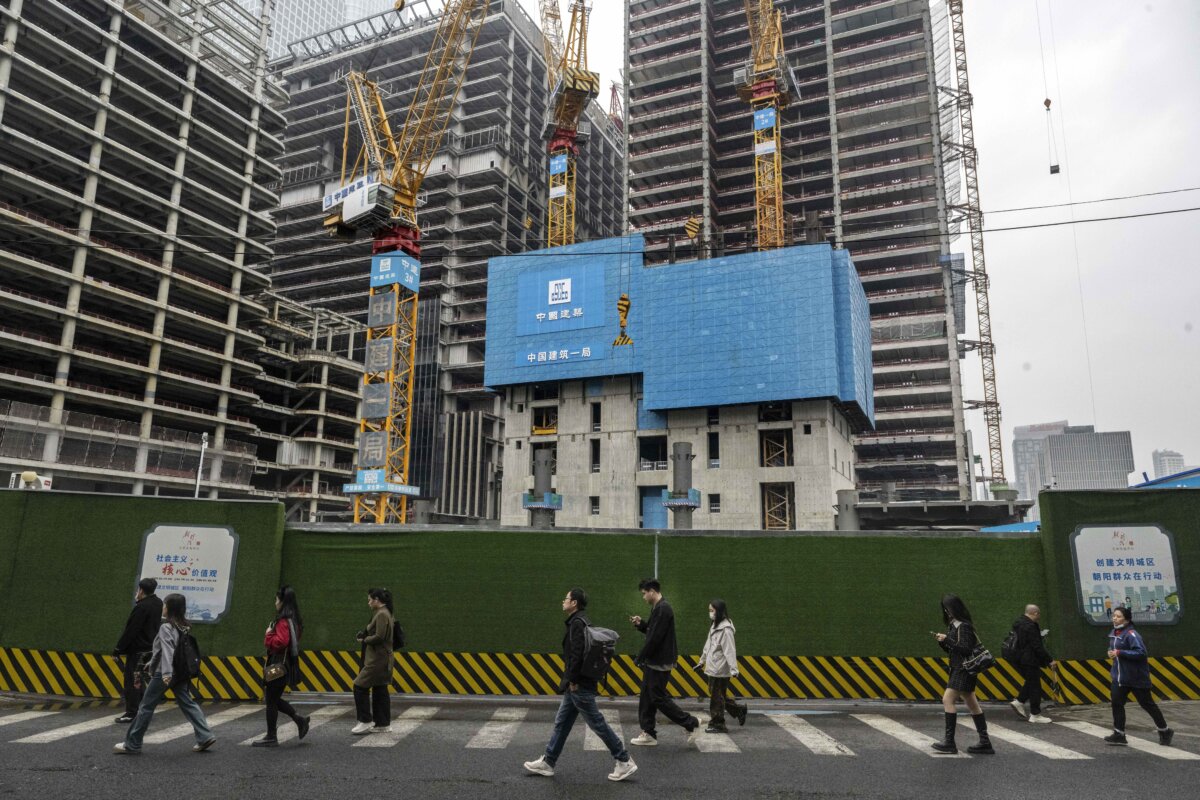
For example, domestic demand is at its weakest in years. The property sector, once a third of China’s GDP, is still in crisis, still cratering.
What’s more, China’s once vaunted labor force is shrinking, and yet youth unemployment remains persistently high at 16 percent or more. As a result, China is becoming increasingly dependent on exports to compensate for weakness at home.
Those are structural changes, not just temporary conditions.
Globally, direct foreign investment into China is also cratering, down 99 percent from just a few years ago, and international sentiment has turned against China due to its adversarial trade policies.
Nations are no longer willing to accept China’s artificially low-priced products that destroy their manufacturing base, and the massive intellectual property theft that comes with trading with China.
China’s rise may have already peaked—and Xi is using the language of great-power rivalry to distract attention from an increasingly difficult economic and social reality.
Is China Wary of a Resurgent US?
A good case can be made that Beijing sees its advantages rapidly shifting away from itself and toward the United States.
For example, global manufacturers are fleeing China. Many will be relocating to the United States under Trump’s new trade deals he’s made over the past couple of years. Those deals represent an estimated $15 trillion in new factories, potentially millions of new jobs, and a higher GDP.
This manufacturing renaissance is only starting to materialize and will have a significantly positive impact on the U.S. economy going forward.
Additionally, individual and business taxes and regulations have been cut and domestic energy production is at an all-time high. But again, the growth effect of those factors will be seen over time.
On the global stage, the United States has cut China’s access to cheap energy through its actions in Venezuela and Iran. Those same actions have served to diminish Beijing’s influence around the world.
The Thucydides Trap Paradox
Of course, reality is complex.
In some areas, China is undoubtedly a rising power confronting American power. It’s a global leader in AI, robotics, bio-tech, hypersonic weapons, and other critical areas.
But its internal structural weaknesses and adversarial trade policies, both created and driven by the Chinese Communist Party, pose bigger threats to China’s economy than America’s economic resurgence.
The paradox of the Thucydides Trap is that China, having already peaked, may be seeing its window to compete against the United States closing, and therefore may see aggression as the only way to prevent its own decline.
It’s worth recalling that China isn’t the first communist regime to predict the decline of the United States.
The Marxists in the old Soviet Union said the same thing 60 years ago, and today resides in the dustbin of history.
Views expressed in this article are the opinions of the author and do not necessarily reflect the views of The Epoch Times.