
Commentary
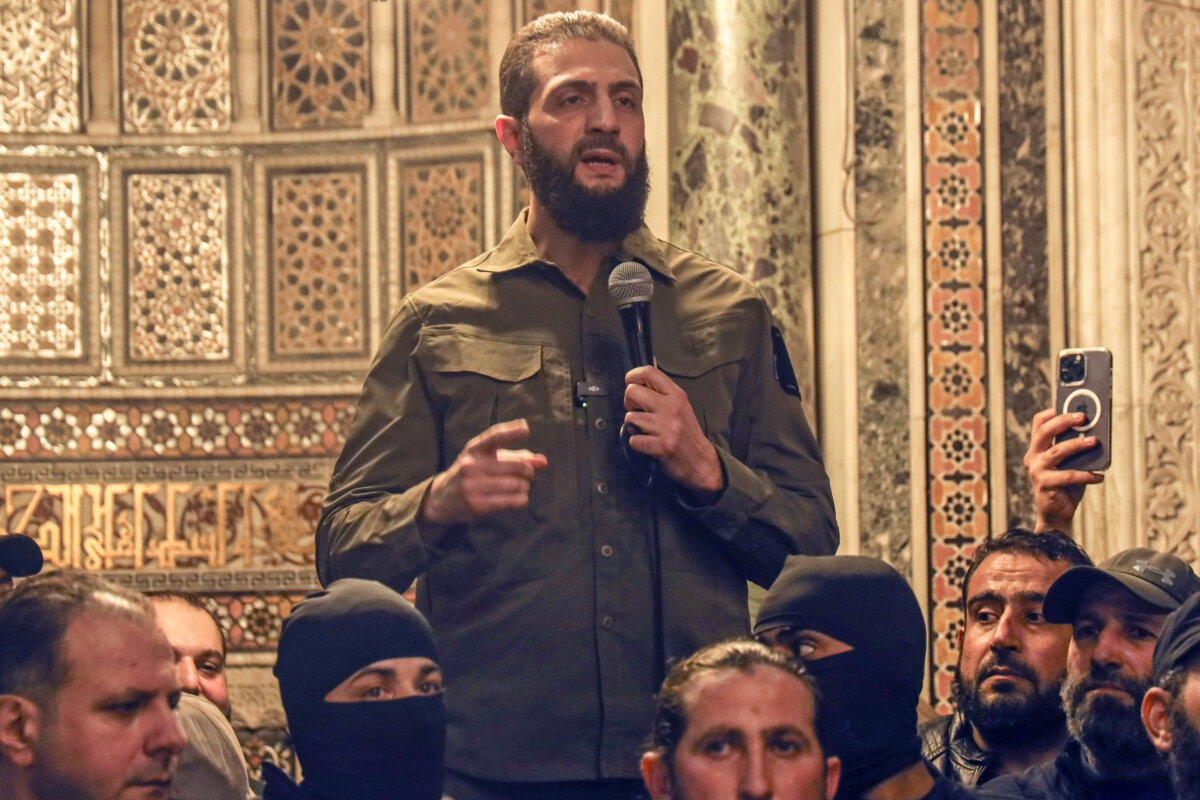
Syrian President Ahmed al-Sharaa faces a core contradiction: He depends on Western legitimacy, yet his power base consists of former jihadists who view moderation as apostasy.
One year after Bashar al-Assad’s fall, Syria under al-Sharaa has shown limited stabilization amid deep structural fragility. The transitional government quickly formed a technocratic Cabinet and temporary parliament, partially rebuilt state institutions, and restored diplomatic ties, securing Turkish and Qatari recognition alongside easing U.S. sanctions that coincided with al-Sharaa’s invitation to meet U.S. President Donald Trump at the White House. The United States lifted its $10 million bounty on al-Sharaa in December 2024 and removed Hayat Tahrir al-Sham (HTS) from its terrorist designation list by July 2025, as Western governments signaled cautious engagement.
Despite al-Sharaa’s efforts to recast himself as a nationalist and distance himself from his jihadist past, Syria is moving toward a more openly theocratic system of governance. The gradual pattern of Islamization is evident, although far less abrupt or coercive than the models typically imposed by ISIS, the Taliban, or al-Qaeda. Islamic law has served as a basis for constitutional authority and has been used in training new police recruits. On March 13, 2025, al-Sharaa signed a temporary constitution that will govern Syria for five years. The document explicitly states that “Islamic jurisprudence is the principal source of legislation” and that “the religion of the President of the Republic is Islam.”
This language is stricter than prior constitutions and, under an Islamist president and a court appointed by him, carries real legal weight rather than symbolic meaning. Although outward religious conservatism has increased through public worship, religious events, Quran memorization, and traditional dress, these practices have not been formally mandated by the state and largely reflect pressure from conservative Sunni communities. Even as Sharaa speaks against rigid regulation of daily life, Islamist and hardline factions within his coalition continue to push governance toward fundamentalism and Islamic rule.
Al-Sharaa is constrained by his reliance on Western legitimacy for political survival while his authority rests on former jihadists who regard moderation as apostasy. He projects secular democracy abroad to secure diplomatic recognition, aid, and investment, while enforcing ideological discipline at home. Although he has recast HTS as moderate and cites women’s participation in higher education under its rule, the current constitution explicitly guarantees women only two rights: the right to study and the right to work.
This trajectory echoes post-1979 Iran, when Ayatollah Khomeini promised legality and restraint abroad while avoiding firm commitments to democracy, only for the Islamic Republic to impose sweeping repression once consolidated. Al-Sharaa’s ideological background shows similar warning signs. His Salafi worldview rejects democracy as incompatible with Sharia law and emerged through a process of radicalization that included training under Abu Musab al-Zarqawi, the Jordanian militant jihadist who founded the organization that later became ISIS.
That trajectory continued as he fought against U.S. forces in Iraq and rose within jihadist networks linked to the Islamic State. He later founded al-Qaeda’s Syrian affiliate, Jabhat al-Nusra, and subsequently rebranded the movement as Hayat Tahrir al-Sham.
Although al-Sharaa has formally broken with ISIS and al-Qaeda, his Salafi-jihadist ideology treats minorities as unbelievers or apostates and prioritizes religious conformity over pluralism. Under HTS rule in the city of Idlib, which it has controlled since 2017, governance relied on Sharia-based law, repression of dissent, restrictions on women, ideological control of education, and the displacement of Christian, Shia, and Druze communities.
In Idlib, the group initially enforced strict Islamic social codes through morality patrols, including detaining women for perceived improper dress or for traveling without a male family member. Although some of these practices were later moderated in response to local pushback, the underlying system of control remained intact.
Analysts have described this evolution as a form of “neo-jihadism,” blending jihadist ideology with political pragmatism and authoritarian governance, making it more adaptable than earlier movements despite a softened public image.
Al-Sharaa’s background under Ba’athist socialism, combined with his leadership of HTS, enabled him to outmaneuver rivals not through doctrinal purity but through political flexibility paired with ruthless militancy. He has renounced transnational jihad against Western states and pledged to protect minorities, yet his record and the conduct of his organization point to continued attachment to Salafist Islamism.
Under al-Sharaa’s government, several large-scale attacks against minorities have occurred. In March 2025, an estimated 1,093 to 1,500 Alawites were killed in massacres across at least 44 sites in Latakia, Tartus, and Homs governorates. Druze communities were also repeatedly attacked, including the killing of at least 43 Druze in an ambush by government-affiliated forces in April and May 2025, followed by further attacks. In July 2025, violence between Druze and Bedouins led to the extrajudicial execution of at least 46 Druze by government forces; total deaths exceeded 600 amid clashes that continued into late 2025.
Christian communities have likewise faced sustained violence since Assad’s fall, including shootings, arson attacks, desecrations, and threats targeting churches and cemeteries in Hama, Homs, Damascus, Suqaylabiyah, Sweida, Tartus, and Safita. The deadliest incident occurred on June 22, 2025, when a suicide bomber attacked Mar Elias Greek Orthodox Church in Damascus, killing at least 25 people and wounding more than 50. Subsequent attacks and a thwarted car bombing further underscored the continued targeting of Christian sites.
Apart from al-Sharaa’s own background and continued adherence to a Salafist ideology, the problem of secular legitimacy is compounded by his reliance on a militant base that fought a war explicitly to impose strict Islamic law, repress women, and exclude or forcibly convert minorities. Even if al-Sharaa is to be believed when he claims to have changed, his base has not. This dynamic suggests the country will continue moving toward theocratic Islam and greater extremism and that ISIS attacks, which are already frequent, are likely to become more frequent still.
Views expressed in this article are the opinions of the author and do not necessarily reflect the views of The Epoch Times.