Commentary
I gave birth to four children, three at home and one in a hospital. The hospital wasn’t part of the plan. Years earlier, I had broken my tailbone in a car accident. It did not heal properly, but I didn’t realize that until I went into labor. My son’s head kept striking a bone that would not move. Hours went by, and he still couldn’t descend. Both of our lives were at risk. They rushed me to the hospital, gave me an epidural, rebroke the bone, and used a vacuum to pull him into the world.
It wasn’t the birth I had dreamed of, but it was the birth that saved us both. That experience left me grateful for modern medicine but also deeply aware that interventions should be used sparingly and only when absolutely necessary.
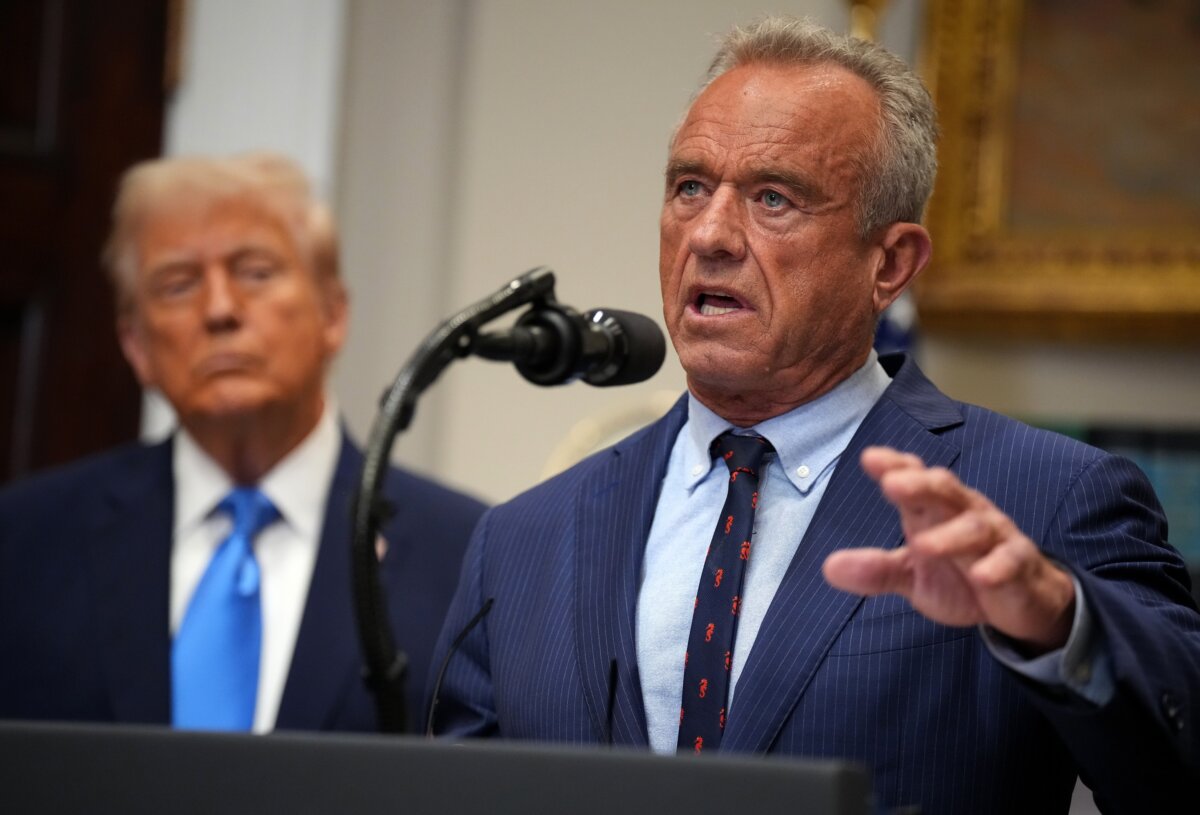
That is why, when I saw the news conference in which President Donald Trump and Health and Human Services Secretary Robert F. Kennedy Jr. raised new concerns about acetaminophen in pregnancy and a possible link to autism and attention-deficit/hyperactivity disorder, my ears perked up. Their words, along with confirmation from the Food and Drug Administration (FDA) that labels will be updated to reflect a “possible association,” should have sparked careful discussion.
Instead, what I saw was surreal. Almost immediately, videos appeared on social media of pregnant women swallowing Tylenol on camera. Not because they had a fever or pain, but because they were making a political point to “spite Trump.” I couldn’t believe it.
I didn’t take acetaminophen during my pregnancies except once under extraordinary circumstances, when a high fever from an infection required a minor procedure. But I would never medicate my baby just to win an argument online. That is like swallowing poison and waiting for your enemy to drop dead. It doesn’t touch him. It only touches you and your child.
On Sept. 22, Trump and Kennedy said pregnant women should limit acetaminophen. The FDA confirmed that it is beginning the process of adding a pregnancy-related safety label and notifying physicians of research that suggests a possible association between prenatal acetaminophen use and autism or attention-deficit/hyperactivity disorder.
That word, “possible,” matters. The FDA did not declare causation. The World Health Organization has said the evidence is “inconsistent.” The American College of Obstetricians and Gynecologists reaffirmed that acetaminophen remains the safest first-line option for fever and pain in pregnancy, while also noting that untreated high fever is dangerous.
The research is mixed. Smaller observational studies and biomarker analyses have found associations worth considering. I am most interested in the smaller, independent studies, the ones less likely to be funded by the pharmaceutical industry, which has both the means and the motive to drown out contradictory findings. A 2021 consensus statement in Nature Reviews Endocrinology urged women to use acetaminophen only when medically indicated, at the lowest dose for the shortest time. But the largest study to date, which tracked 2.4 million Swedish children, found no increased risk when researchers looked only inside sibling groups.
In other words, the science is not settled. But science should never be settled. We should always be observing, questioning, and reexamining.
Even without the autism debate, we already know that acetaminophen is not harmless. Every year, poison centers in the United States handle nearly 18,000 pediatric exposures to acetaminophen. Most children survive because treatment is quick, but not all do. I personally have a friend who lost his healthy 20-year-old daughter to acetaminophen toxicity. She was only dealing with stomach pain and never imagined that it could take her life. These stories rarely make headlines, but they are real.
Pregnancy is full of caution signs. Don’t eat sushi. Limit coffee. Some women avoid hair dye for nine months. Each expectant mother filters these warnings through her own values and makes choices for herself and her baby. I remember arguing with my friend Jeanette once as she was eating fast food. I told her, “I don’t think you should be eating that while you’re pregnant,” and she shot back, “Well I don’t think you should be dyeing your hair while you’re pregnant.” After she said that, I stopped dyeing my hair during pregnancy altogether.
That moment reminded me that we are all doing the best we can with the information we have. But it also convinced me that we should be willing to look at every piece of information available, no matter who shares it, and not filter it through politics.
For me, the guiding principle was always to lower the chemical burden. Babies enter a world already filled with toxins: plastics, pollution, chemical additives, endocrine disruptors in fragrances. The placenta and umbilical cord do not filter them out. They carry what we carry. That is why, during pregnancy, I cut out scented detergents and air fresheners, filtered my water, and ate organic food whenever I could. Not because I had a double-blind study proving harm, but because less is more when you are building a human life.
Here is the part I cannot shake. The United States consumes more pharmaceuticals than any country on earth. No nation swallows more pills. Yet despite our overflowing medicine cabinets, we do not have better health. We do not live longer or healthier lives. In fact, our outcomes often lag behind those of nations that rely less on drugs and more on diet, movement, and community. We have been trained to believe that there is a pill for every ache and inconvenience. A headache? A pill. A restless child? A pill. The discomforts of pregnancy? A pill. But medicine was never meant to be our daily bread. It was meant to be a tool, used when life and death demand it.
What disturbed me most after the acetaminophen announcement was not the uncertainty of the science. It was the immaturity of the reaction. Too many people no longer ask, “Is this information credible?” Instead, they ask, “Who said it?” If the “wrong” person points to a danger, we plug our ears.
But discernment does not work that way. If I am in a crowded building and someone yells, “Shooter! Get down!” I am not going to pause to ask their party affiliation before dropping to the floor. I am going to act, and then look around. That is what wisdom looks like.
And it makes me wonder. If Trump had been reelected and led the charge promoting the COVID-19 vaccine, would vaccination rates have soared? Or would some people have resisted it simply because they distrusted the messenger?
My own views were consistent. I did not want the vaccine when Trump was selling it and I did not want it when President Joe Biden was pushing it, either. My stance was not about the messenger. It was about necessity. At my age, weight, and level of health, the risk of dying from COVID-19 was so low that I saw no reason to take a brand-new pharmaceutical unless it was absolutely required. That is the lens I bring to every decision: Only take medication when it is truly necessary.
Motherhood demands maturity. It requires us to rise above reactionary antics and put the life inside us first. Yes, be grateful for medicine when it saves you, as it once saved me and my son. But do not make your child’s body the stage for a political performance. We already consume more pharmaceuticals than any people in history, and it has not delivered us better health.
Maybe the wiser path is not to add another pill, but to ask why we have come to need so many in the first place. Let us be discerning. Let us be humble. And let us remember that the point of medicine is not to win arguments but to save lives.
Views expressed in this article are the opinions of the author and do not necessarily reflect the views of The Epoch Times.