
Commentary
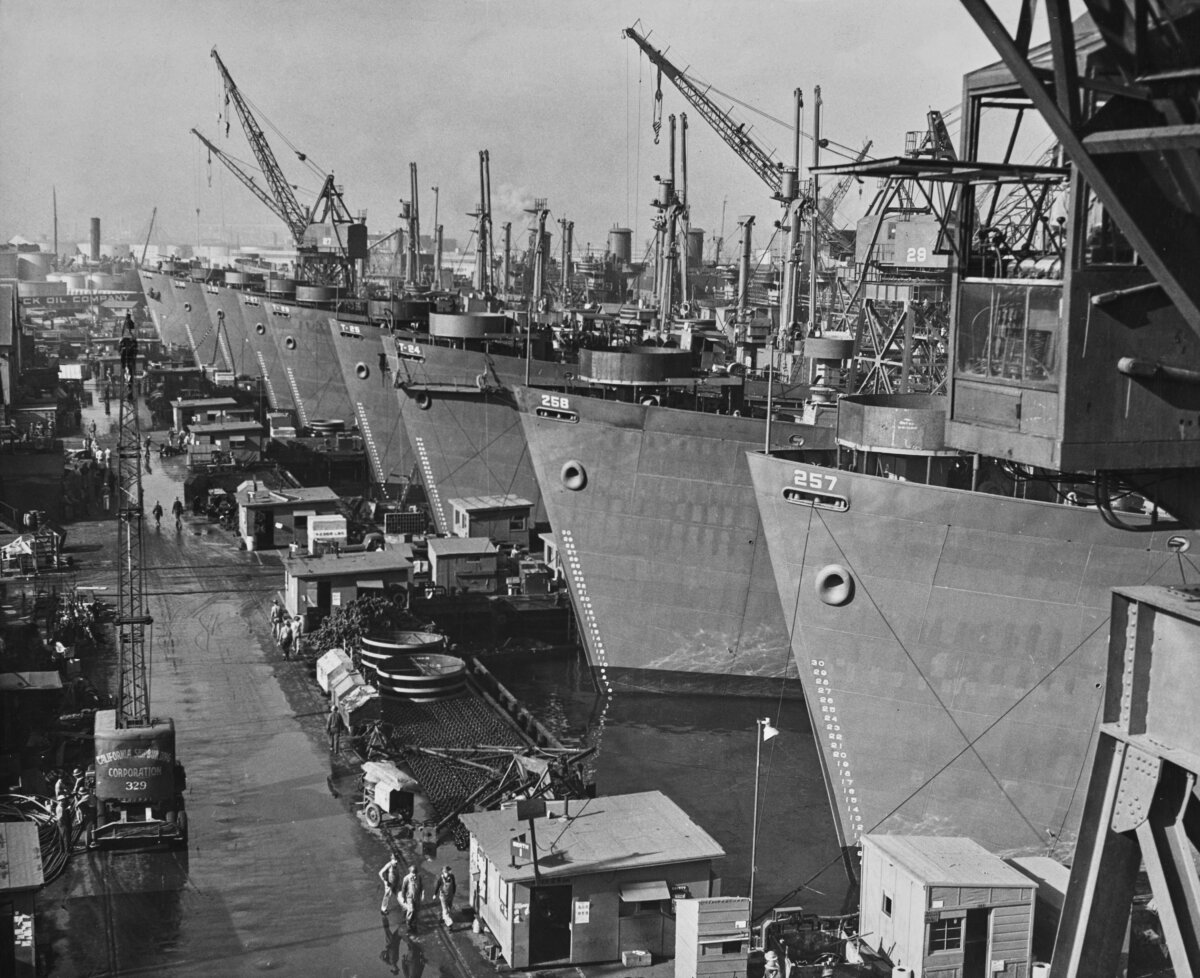
During World War II, U.S. shipbuilding was decisive in overcoming the initial shock of the surprise attack on Pearl Harbor. During the war, the United States would outproduce Japan in merchant shipping by a factor of 8:1, despite a weak shipbuilding industry throughout the 1930s. This was only possible because of actions taken by American industry well before the conflict began. As the United States prepares for another potential Pacific conflict, it should look to the 1937 Long-Range Shipbuilding Program (LRSP) as an example of how an aggressive industrial policy can greatly improve readiness.
As a result of the Great Depression, American shipbuilding had been decimated, with dwindling shipyards and an aging merchant fleet. In response to this, the U.S. Maritime Commission implemented the LRSP as part of the Merchant Marine Act of 1936, ordering the production of 500 cargo ships over 10 years in new and existing commercial shipyards. The program proved crucial to rebuilding the U.S. maritime industry. By 1941, the number of U.S. shipyards capable of building oceangoing vessels quadrupled to 40 from 10, allowing America to better meet wartime demand. Without the foresight of the LRSP, World War II may have been a much more difficult fight.
Today, America finds itself in a similar predicament as it did in 1937. American shipbuilding is at its lowest point in decades, with precipitous declines in both active shipyards and output. In addition, the existing military logistics fleet is not prepared for near-peer conflict. This has become a source of widespread consternation as a potential war against China looms.
While wargames have anticipated a wide variety of outcomes for a Pacific conflict, the resilience of American forces in the face of significant losses has often proved critical to fending off Chinese aggression. In a protracted Taiwan campaign, American sealift would be relied upon to resupply friendly forces from across the Pacific and provide humanitarian assistance to a Taiwanese population heavily dependent on imports for survival. This would place a heavy burden on American sealift and thus American shipyards.
To meet this demand, the United States will first call on its surge sealift fleet—which has suffered from aging inventory and flagging readiness. Next, it will turn to the U.S.-flagged merchant fleet, which has shrunk by more than 70 percent since 1991. Finally, it will attempt to charter foreign-flagged merchant vessels, which made up almost half of the U.S. logistics fleet during Desert Storm.
A war against China complicates this plan. Many foreign ships refused to sail during the Gulf War, a pattern which will only be worsened by the threat of Chinese attack. For those ships willing to be chartered, insurance and lease costs will balloon. Moreover, China is investing heavily in its ability to disrupt American logistics. The People’s Liberation Army Navy’s submarine fleet is expected to grow by 80 vessels by 2035. Moreover, China’s growing A2/AD arsenal is especially threatening to sealift ships, which are less durable and have fewer countermeasures against attack than warships.
Once existing sealift vessels are damaged or destroyed, the only way for the United States to reliably address the shortfall is to either purchase ships from allied shipyards or produce them itself. The United States would likely turn to Japan and South Korea, which produce 28 percent and 15 percent of global shipping, respectively, to help fill the gap. However, the proximity of these shipyards to China makes them vulnerable to both military denial and diplomatic pressure. If such coercion is successful, and American shipbuilding is forced to stand alone, it is simply not up to the task.
Drastic changes are needed to rebuild America’s maritime industry. A new long-range shipbuilding program, in which the United States funds the commercial construction of new cargo vessels in commercial shipyards, could provide the jump-start needed to reinvigorate the U.S. maritime industry while also bolstering military readiness. A larger number of active commercial shipyards can more easily absorb the demands of war while also giving the United States the ability to grow and retain its base of skilled workers. Commercial ownership also means that vessels and mariners will be able to serve in peacetime, maintaining human capital and readiness. This approach will more sustainably bolster American capacity than one that only focuses on immediate military needs.
Ultimately, the success of the Long-Range Shipbuilding Program serves as both a model and a warning to American policymakers. Just as public-private partnership has become a crucial element of American military technological development, it can also help bolster the defense industrial base in more traditional sectors. Increased support for maritime industry could even help deter Chinese aggression by signaling a stronger commitment to the Indo-Pacific and increasing American readiness. The time for rebuilding American sealift is now. Otherwise, an American war effort may be fatally compromised before it is even underway.
From RealClearWire
Views expressed in this article are the opinions of the author and do not necessarily reflect the views of The Epoch Times.







