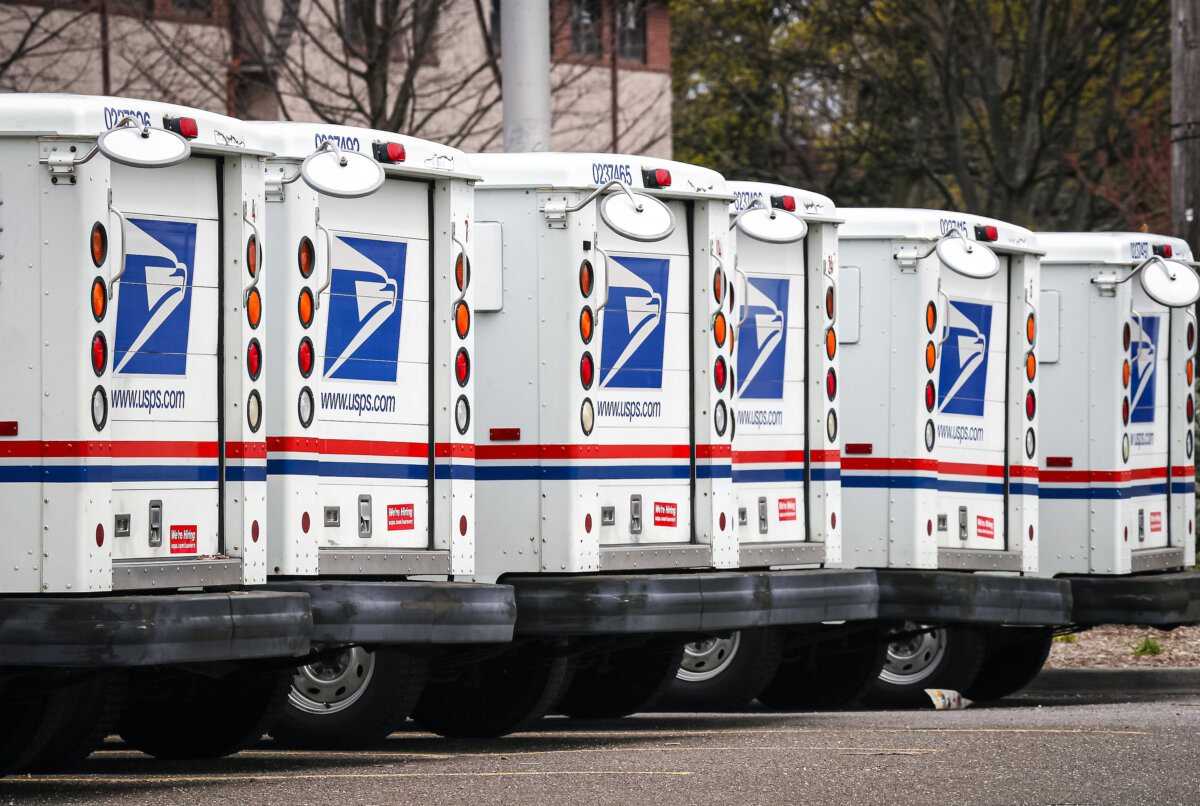

A federal court in Brooklyn on Nov. 25 permanently barred two U.S. logistics companies and their owner from shipping business-related parcels through the U.S. Postal Service (USPS) and ordered them to pay $300,000 to settle allegations of postage fraud involving packages from China.
The settlement involves Yizhao Hou, also known as Harvey Hou, California-based YDH Int’l Inc., and YDH Express Inc., a New York corporation that was dissolved in September 2025.
The prohibition extends to other privately held companies Hou controls or in which he holds a majority ownership interest, according to the court-approved settlement agreement reviewed by The Epoch Times.
The U.S. Attorney’s Office for the Eastern District of New York alleged in its May 2025 complaint that the defendants knowingly cooperated with their customers in China to ship thousands of parcels bearing counterfeit postage.
The defendants denied wrongdoing, and the settlement contains no admission of liability.
Repeated Discoveries of Counterfeit Postage
The two companies operated warehouses near John F. Kennedy International Airport in New York and Los Angeles International Airport in California, handling shipments of clothing, jewelry, handbags, phone cases, and shoes from Chinese sellers to American consumers.
Their customers printed and attached USPS shipping labels to individual parcels in China before sending them to the United States. The logistics companies then transferred the shipments to USPS for domestic delivery.
According to a sworn declaration by Postal Inspector Eduardo Gelpi, some counterfeit labels can appear valid and scan into the Postal Service’s tracking system, even though no postage had been paid.
The investigation began in June 2022 after postal employees in Queens alerted inspectors to packages bearing counterfeit postage. Inspectors subsequently examined a shipment from China at the New York warehouse and found that all 1,667 parcels bore counterfeit labels.
Hou signed a written commitment on July 5, 2022, to discontinue using invalid postage. Later that month, inspectors discovered another 4,460 parcels bearing counterfeit labels, which customs authorities ordered returned to China.
Hou signed a second statement on Aug. 10, 2022.
“From this date, I will cease using counterfeit or otherwise invalid postage,” he wrote.
Inspectors subsequently discovered more counterfeit postage at the California warehouse in March 2023 and at the New York warehouse in October 2023 and April 2024. Altogether, investigators identified 8,653 parcels bearing counterfeit postage during eight inspections.
Under postal regulations cited in the government’s complaint, businesses presenting packages to USPS for delivery must ensure postage has been paid. Federal attorneys argued that the logistics companies had that responsibility even though their customers in China had prepared the labels.
The defendants disputed that obligation, maintaining that they transported shipments without unpacking the boxes containing individual parcels. They acknowledged signing the written statements but denied knowingly participating in fraud.
Their attorneys did not respond to a request for comment from The Epoch Times by publication time.
Potential Losses in the Millions
Federal prosecutors alleged in the complaint that hundreds of additional shipments had gone uninspected and that USPS revenue losses could amount to millions of dollars if those shipments contained counterfeit or invalid postage at rates similar to those discovered during inspections.
The defendants rejected that assessment as “purely speculative and entirely without foundation.”
In granting a temporary restraining order in May 2025, U.S. District Judge Natasha Merle found probable cause to believe the defendants engaged in ongoing mail fraud and conspired to commit mail fraud.
Merle also found that without court intervention and the preservation of business records, USPS would have difficulty identifying the affected parcels after they had been mailed and recovering its losses.
Under the final settlement, the defendants must pay the $300,000 in three installments, with the final payment due on April 27, 2027. None of the money constitutes restitution, and the agreement does not specify the actual postal revenue losses.
The U.S. Attorney’s Office did not respond by publication time to questions about the financial losses, the settlement amount, and the identities of the Chinese companies allegedly involved.
Business Ties to China
Chinese corporate disclosures reviewed by The Epoch Times identify Shanghai-based YDH Cross-Border Logistics as a business that purchased U.S. parcel delivery services from YDH Int’l in 2022, 2023, and the first quarter of 2024, during the period covered by the postal investigation.
The Shanghai company previously held a 40 percent stake in YDH Int’l through an individual holding shares on its behalf. The stake was transferred to Hou at no cost in December 2021, before the postal investigation began.
The court records The Epoch Times reviewed do not identify the Shanghai company as a participant in the alleged postage fraud.
The Shanghai company did not respond by publication time to questions about its business dealings with YDH Int’l and its knowledge of the case.
Gaps in Postal Fraud Detection
The difficulty of intercepting packages bearing counterfeit postage extends beyond the YDH case.
A September audit by the USPS Office of Inspector General identified shortcomings in the Postal Service’s ability to detect and intercept counterfeit labels, estimating that the gaps resulted in $3.1 billion in lost revenue between March 2024 and February 2026.
Auditors also found deficiencies in oversight of counterfeit-postage prevention efforts and recommended addressing known vulnerabilities and improving detection technology.
Tasos Kalfas, an auditor who worked on the report, said in an official podcast released in November that between October 2023 and February 2026, 97 percent of counterfeit labels were still processed for delivery.
Kalfas said the volume of counterfeit labels had declined since December 2025, after USPS introduced new controls.
The U.S. Postal Inspection Service did not respond by publication time to questions about the prevalence of counterfeit postage on packages originating from China.
In a separate criminal case, California resident Lijuan “Angela” Chen pleaded guilty in April 2024 to conspiracy to defraud the United States and using counterfeit postage.
Chen and her co-defendant ran a shipping business that served China-based logistics companies. According to her plea agreement, the pair knowingly mailed or caused to be mailed more than 34 million parcels bearing counterfeit postage between January 2020 and May 2023, costing USPS more than $150 million.
Chen was sentenced in July 2026 to 2.5 years in prison, according to the Postal Inspection Service.