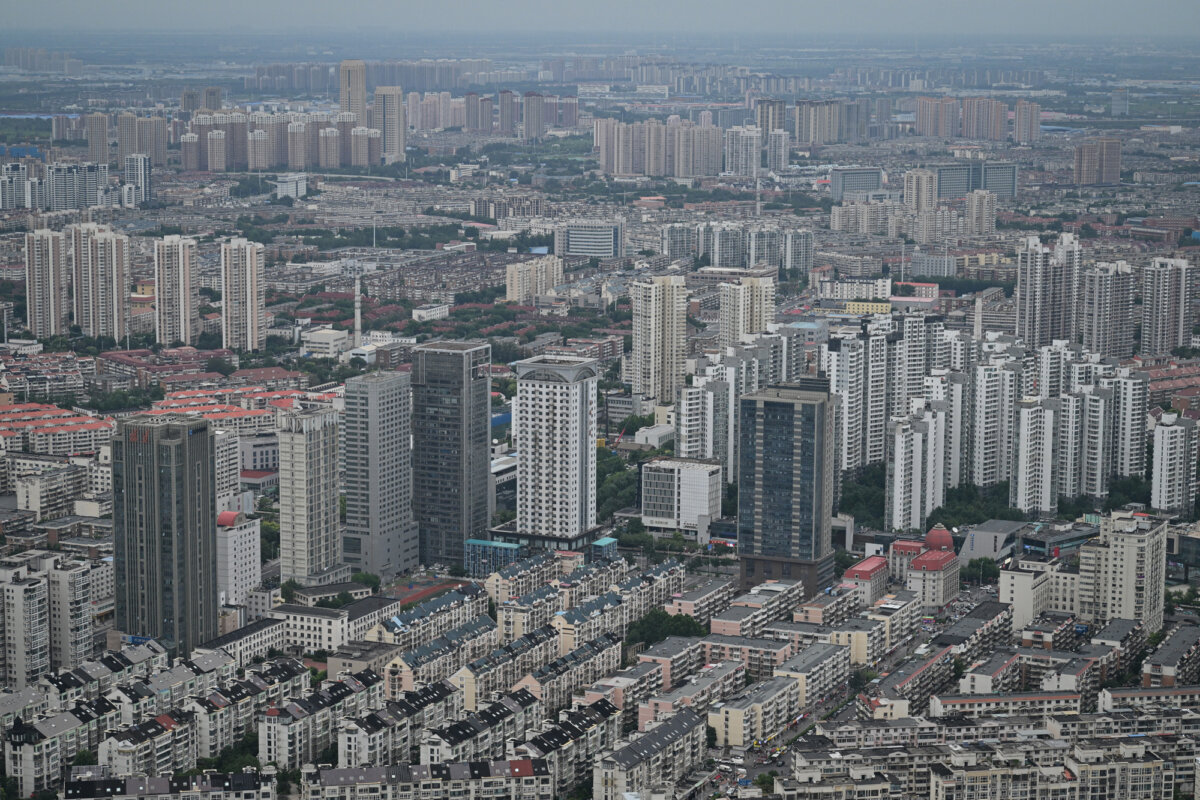

Retail sales in Beijing and Shanghai fell in October, with China’s two largest cities recording further signs of weakening consumer demand amid a broader economic slowdown.
Beijing’s total retail sales of consumer goods dropped 12.1 percent year over year to 127.09 billion yuan (about $19.1 billion) last month, down about 17.5 billion yuan (about $2.63 billion), according to data released by the Beijing Municipal Bureau of Statistics on Nov. 17. The fall was the largest single-month year-over-year decline since the start of 2025.
Shanghai’s retail sales fell 4.5 percent from a year earlier, marking the seventh consecutive month of negative growth since April, according to data released by the Shanghai Municipal Statistics Bureau on Nov. 18.
The declines in the two cities are significant because Beijing and Shanghai have some of China’s highest per capita incomes and are often viewed as indicators of nationwide consumer spending trends.
U.S.-based political economist Davy Jun Huang, a former columnist for Chinese state media outlet CNTV, told The Epoch Times that the figures point to three broader trends: consumers becoming more cautious, a sustained—rather than temporary—pullback in spending, and diminishing returns from state subsidies.
Huang said sharp declines in auto and household appliance sales—categories that had benefited heavily from state trade-in subsidies—suggest policy incentives are losing effectiveness. He added that consumers are increasingly gravitating toward budget-friendly alternatives, reserving their limited spending for small indulgences that provide some emotional satisfaction.
Beijing’s retail sector has faced sustained pressure. Total retail sales of consumer goods in the city declined 2.7 percent for all of 2024 and 2.9 percent in 2025.
From January to October, automobile sales fell 20.7 percent year over year, while household appliance sales dropped 10.6 percent and office supplies declined 10.3 percent.
Frank Tian Xie, a professor at the University of South Carolina Aiken School of Business, told The Epoch Times that Beijing’s double-digit decline reflects the severity of the country’s economic difficulties.
“The decline of as much as 12 percent in Beijing shows that the condition of China’s economy is very serious. The economy is in recession, the bubble is bursting, and unemployment is increasing,” Xie said.
He predicted that conditions would not improve through the end of this year or the first quarter of 2027.
The weak retail figures come as Chinese financial markets have also experienced declines. Over the past week, the Shanghai Composite Index fell about 2.77 percent, the Shenzhen Component Index dropped 6.49 percent, and the ChiNext Index, which tracks growth-oriented companies, declined 8.82 percent.
As financial markets weakened, Beijing’s mouthpiece People’s Daily published a commentary on Nov. 21 rejecting descriptions of the country’s economic problems as a “deflation trap,” “overcapacity,” and a second “China shock.” The article argued that those predicting a downturn in China’s economy would ultimately be proven wrong. A follow-up commentary published the following day reiterated the same argument.
Xie questioned the timing of the official response, pointing to the simultaneous decline in stock markets. He said the commentaries appeared to reflect a lack of effective responses among authorities and financial regulators to the economic challenges.
“Your own stock market is already falling, and those who are bearish have already been proven right. Now, you are still saying that they will ultimately be proven wrong,” he said.
Huang said dismissing economic criticism could further erode public confidence, particularly among investors and middle-class households facing falling property values, investment losses, wage cuts, and layoffs.
“State media’s repeated use of labels and grand rhetoric cannot reassure people. Instead, it provokes strong resentment and ridicule, while also suggesting a crisis of trust,” Huang said.
“When investors and stockholders no longer believe what the state media says, it becomes difficult for the entire market to recover.”
Yi Ru contributed to this report.