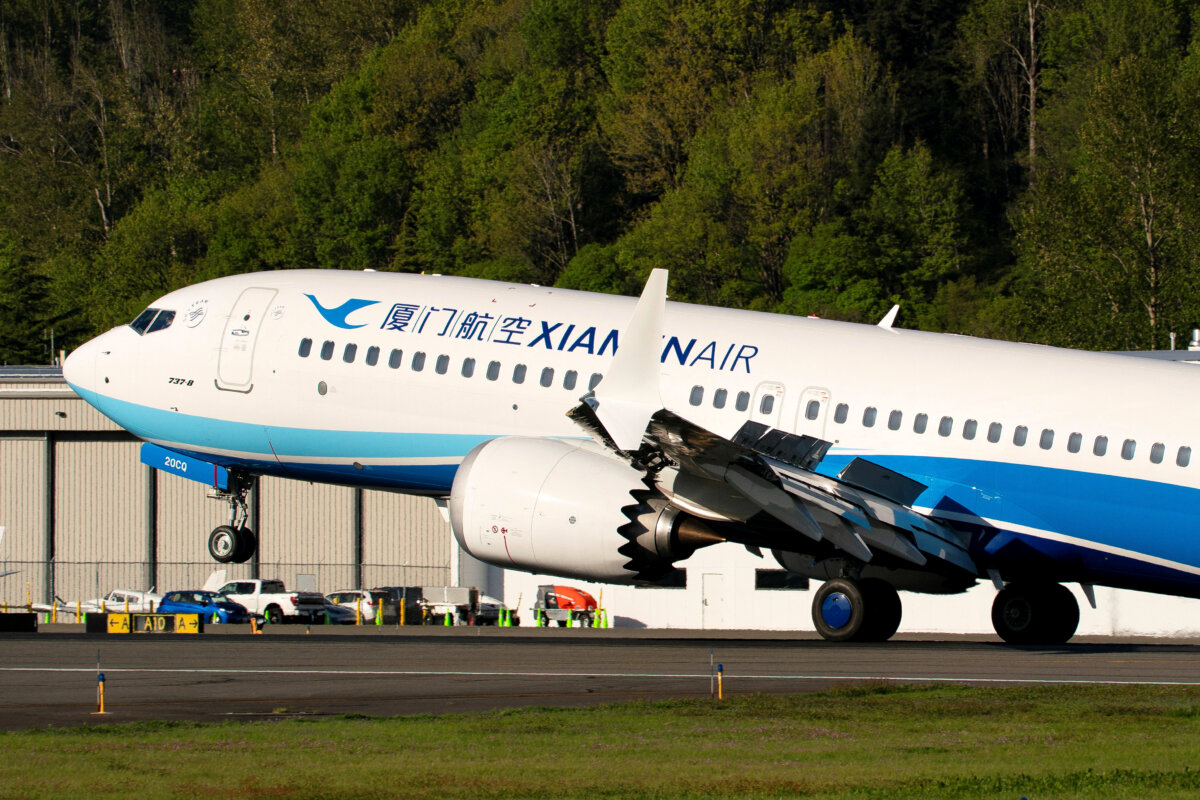

China’s Xiamen Airlines signed an agreement on Nov. 24 to purchase 50 Boeing aircraft, a day after President Donald Trump said he expected China to buy another 250 planes from the American manufacturer.
The 50 Boeing 737-8 aircraft have a combined list price of about $7.4 billion, according to a filing by China Southern Airlines, which controls Xiamen Airlines. Boeing offered the carrier a substantial discount, but China Southern did not disclose the actual purchase price.
China Southern’s board unanimously approved the purchase, but shareholders and Chinese authorities still need to approve it. The aircraft, also known as the 737 MAX 8, are scheduled for delivery between 2031 and 2034.
Trump discussed Chinese aircraft purchases during a Nov. 23 interview with CNBC, four days after meeting Chinese leader Xi Jinping in Shenzhen.
“I sold 250 Boeings to China, and I think they’re going to do another 250,” Trump said.
In May, the White House announced that Beijing had approved an initial purchase of 200 Boeing aircraft.
China Southern did not specify whether the latest purchase counts toward that commitment.
The company said the aircraft would support Xiamen Airlines’ route-network expansion and operations at the new Xiamen Xiang’an International Airport in southeastern China.
In April 2025, during the escalating tariff dispute between Washington and Beijing, two Boeing 737 MAX aircraft intended for Xiamen Airlines were returned to the United States.
Boeing said at the time that some Chinese customers had temporarily stopped accepting aircraft deliveries during the second quarter of 2025 in response to ongoing tariff negotiations. The company subsequently confirmed that deliveries to those customers had resumed.
Chip Restrictions and Critical Minerals
Aircraft purchases and critical-mineral supplies were both part of the trade commitments announced by the White House following Trump’s May visit to China. However, Washington and Beijing remain at odds over China’s access to advanced American chips.
On Nov. 16, the U.S. Commerce Department announced new restrictions to prevent Chinese companies from bypassing U.S. chip export controls by remotely using advanced American computing technology at data centers outside China.
Beijing responded the following day, accusing Washington of departing from the consensus reached by the two countries’ leaders and threatening countermeasures if the United States pressed ahead.
The dispute came days after Jensen Huang, chief executive of leading U.S. artificial intelligence chipmaker Nvidia, resigned on Nov. 11 after the company launched an investigation into reports, including those published by The New York Times, that a foreign intelligence operation had allegedly targeted him.
Huang was also a prominent advocate of maintaining American chipmakers’ access to the Chinese market.
Trump told CNBC that Xi had praised Huang’s technological expertise during their meeting. Trump also said he had strongly supported Huang’s return to Nvidia.
On Nov. 23, Nvidia announced Huang’s reinstatement, citing input from senior U.S. government officials. The company said its independent investigation would continue.
Despite earlier warnings of countermeasures over U.S. chip restrictions, Beijing announced on Nov. 24 that it would extend a suspension of export restrictions on several critical minerals bound for the United States through Jan. 27, 2027.
In December 2024, Beijing imposed restrictions on certain dual-use materials, including gallium, germanium, antimony, and superhard materials, and tightened scrutiny of graphite exports, following stricter U.S. semiconductor export controls.
Despite supporting Huang’s return, Trump told CNBC that Nvidia still would not be allowed to sell its advanced Blackwell AI chips to China.